What is a Utility Invoice?
Recurring bills from utility providers that require usage verification, rate validation, and consistent processing every billing cycle.
Quick Definition
A utility invoice is a recurring bill from utility service providers (electricity, gas, water, telecommunications) that charges for usage-based consumption over a billing period, requiring rate validation and usage verification before payment.
- Recurring monthly or bi-monthly billing cycles
- Variable amounts based on actual consumption
- Complex rate structures requiring validation
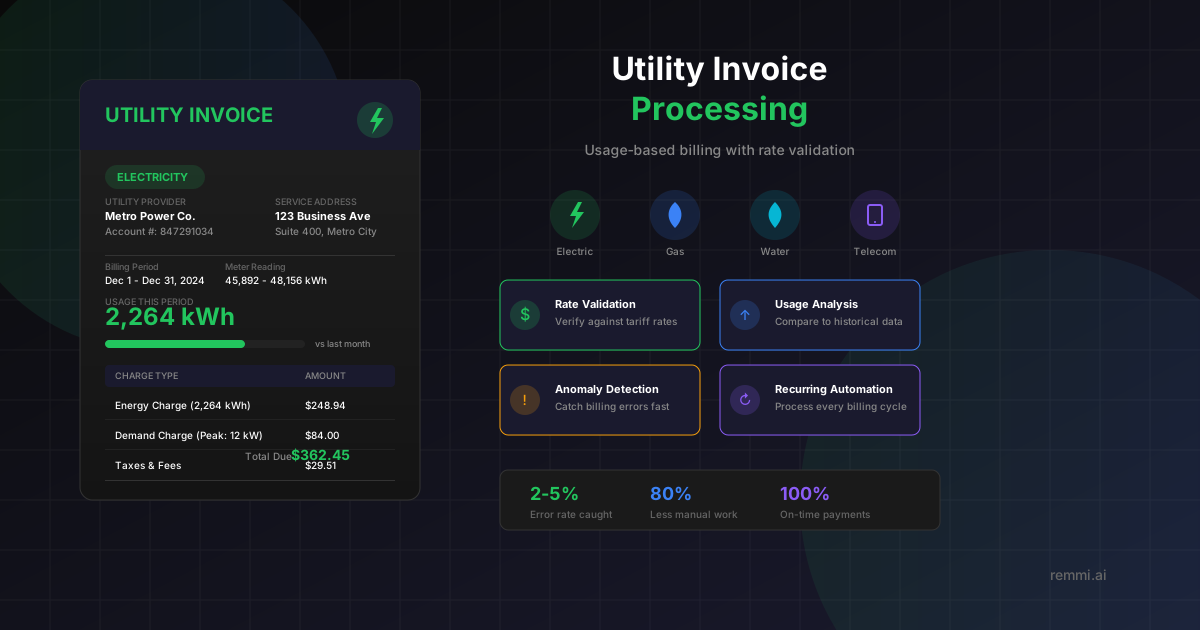
Understanding Utility Invoices
Utility invoices are among the most common recurring expenses for any organization, yet they present unique challenges for accounts payable teams. Unlike fixed-price invoices, utility bills vary each period based on actual consumption, making them harder to predict, validate, and process efficiently.
Every billing cycle, organizations receive utility invoices for essential services:
- Electricity — Measured in kilowatt-hours (kWh), often with demand charges for peak usage
- Natural Gas — Measured in therms or CCF (hundred cubic feet)
- Water & Sewer — Measured in gallons or cubic feet, often with tiered pricing
- Telecommunications — Phone, internet, and data services with usage and fixed components
The recurring nature of utility invoices means errors compound over time. A rate miscalculation that goes unnoticed can cost thousands of dollars over a year. This makes proper utility invoice processing and validation essential for controlling costs.
Anatomy of a Utility Invoice
Usage Data
Consumption details that drive the bill amount:
- - Previous meter reading
- - Current meter reading
- - Total usage quantity
- - Billing period dates
Rate Information
Pricing structure applied to your usage:
- - Tariff code / rate schedule
- - Per-unit pricing tiers
- - Demand charges (if applicable)
- - Time-of-use rates
Charges & Fees
Additional costs beyond base usage:
- - Service/delivery charges
- - Taxes and assessments
- - Regulatory fees
- - Late payment penalties
Utility Invoice Validation Points
What to Verify
- -Rate matches contract or published tariff
- -Usage is within expected range vs. history
- -Service address is active and correct
- -Meter reading is actual, not estimated
- -Math calculations are accurate
Common Errors
- -Wrong tariff code applied
- -Estimated reading when actual available
- -Billing for closed/vacated location
- -Duplicate billing for same period
- -Rate increase not in contract
Why Utility Invoice Processing Matters
Average utility billing error rate
Annual overpayment for mid-size companies
Errors from rate misapplication
Utility invoices represent a significant and ongoing expense. Without proper validation, billing errors accumulate month after month. Organizations that implement utility invoice automation typically recover 2-8% of their utility spend through error detection alone.
Utility Invoice Processing Workflow
Invoice Receipt
Utility invoice arrives via mail, email, EDI, or is retrieved from utility portal automatically.
Data Extraction
OCR and AI extract key data: account, service address, usage, rates, and amount due.
Rate Validation
System compares applied rates against contracted rates or published tariff schedules.
Usage Analysis
Current usage compared to historical patterns to identify anomalies or unusual spikes.
Exception Handling
Invoices with variances flagged for review; clean invoices proceed to payment approval.
GL Coding & Payment
Invoice coded to appropriate cost centers/GL accounts and scheduled for payment.
Utility Invoice Best Practices
Maintain Rate Library
Keep an up-to-date library of contracted rates and tariff schedules for each utility account to enable automatic validation.
Track Historical Usage
Compare each invoice to historical consumption patterns to catch anomalies, meter issues, or billing errors early.
Automate Recurring Processing
Set up automated workflows for utility invoices since they recur predictably every billing cycle.
Consolidate Utility Accounts
Use a centralized system to manage all utility accounts across locations for better visibility and control.
Monitor Due Dates
Utility late fees are expensive. Ensure invoices are processed with enough lead time to meet payment deadlines.
Common Utility Invoice Mistakes to Avoid
- xPaying without validation — Assuming utility bills are always correct leads to overpayment
- xIgnoring estimated readings — Estimated bills should be flagged and reconciled when actuals arrive
- xNot tracking vacated locations — Continuing to pay for services at closed facilities is common
- xMissing rate change notifications — Utilities change rates; contracts should be reviewed annually
Types of Utility Invoices
| Type | Unit | Key Validation |
|---|---|---|
| Electricity | kWh | Demand charges, time-of-use rates, peak usage |
| Natural Gas | Therms / CCF | Seasonal rate changes, delivery charges |
| Water/Sewer | Gallons / CCF | Tiered pricing, sewer ratio calculations |
| Telecom | Various | Service bundles, overage charges, taxes |
Related Terms
Recurring Invoice
Invoice generated automatically on a regular schedule
Invoice
Document requesting payment for goods or services
Accounts Payable
Department managing vendor invoices and payments
Invoice Processing
End-to-end handling of invoices from receipt to payment
Vendor
Supplier or service provider billing your organization
Payment Terms
Conditions specifying when and how payment is due