What is Machine Learning?
AI technology that enables systems to learn from data and improve invoice processing accuracy over time without explicit programming.
Quick Definition
Machine Learning (ML) is AI technology that enables systems to learn from data and improve invoice processing accuracy over time without being explicitly programmed for each scenario. It powers intelligent automation that adapts to your organization.
- Learns from historical data and user corrections
- Improves accuracy automatically over time
- Handles new formats without manual configuration
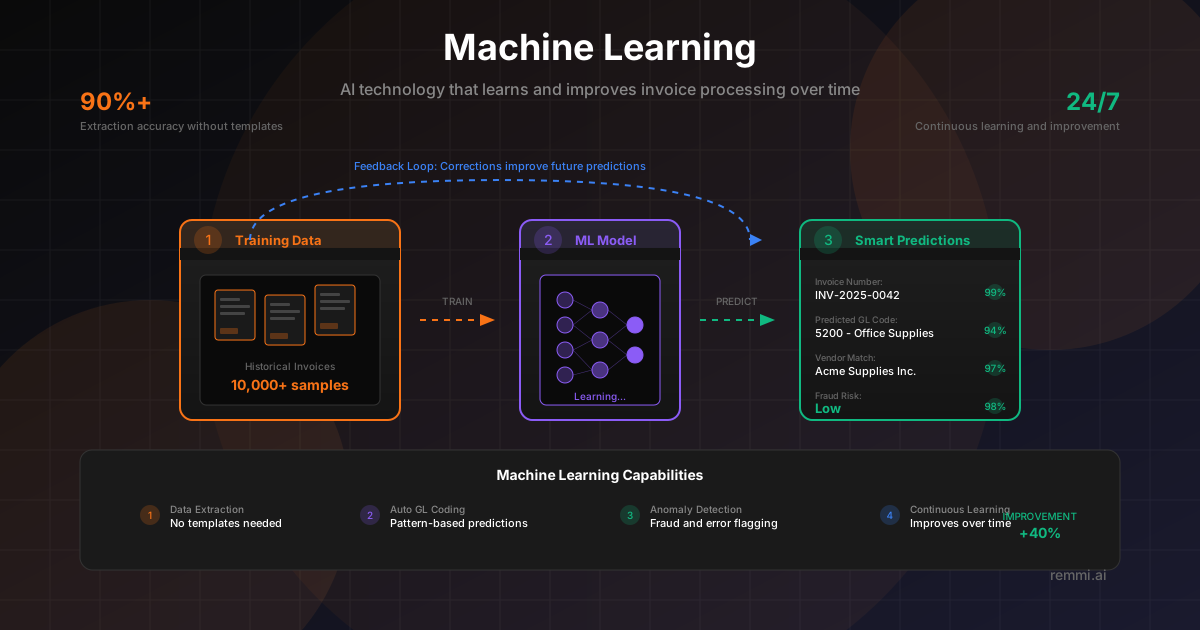
Understanding Machine Learning in Invoice Processing
Machine learning is transforming how organizations handle invoices. Unlike traditional rule-based systems that require manual configuration for every scenario, ML systems learn patterns from your data and continuously improve their performance.
In the context of accounts payable, machine learning powers capabilities like intelligent data extraction, automatic GL coding, vendor matching, and fraud detection. The technology analyzes thousands of data points to make predictions that would be impossible with static rules alone.
What makes ML particularly powerful for invoice processing is its ability to:
- Extract data from any invoice format without templates
- Predict correct GL codes based on historical patterns
- Match invoices to vendors even with name variations
- Detect anomalies and potential fraud automatically
- Learn from corrections to reduce future errors
The result is automation that gets smarter over time, reducing manual work while increasing accuracy and catching issues that human reviewers might miss.
How Machine Learning Works
1. Data Collection
The system gathers training data:
- Historical invoice data
- User corrections and approvals
- GL coding decisions
- Vendor matching history
2. Pattern Learning
ML algorithms identify patterns:
- Document structure recognition
- Field location patterns
- Coding correlations
- Anomaly signatures
3. Prediction & Improvement
The model applies learning:
- Predicts field values
- Suggests GL codes
- Flags anomalies
- Learns from feedback
Machine Learning vs Rule-Based Automation
Rule-Based Systems
- -Fixed rules programmed by developers
- -Manual updates for each new scenario
- -Struggles with exceptions and variations
- -Static accuracy over time
Best for: Simple, highly consistent processes
Machine Learning
- +Learns patterns from your data
- +Adapts to new scenarios automatically
- +Handles variations gracefully
- +Improves accuracy continuously
Best for: Variable formats, complex decisions
How ML Improves Over Time
Pre-trained models provide baseline accuracy
Learning from your data improves predictions
Optimal accuracy with continuous refinement
Machine learning models improve through feedback loops. Every correction, approval, and rejection teaches the system. Organizations typically see 20-40% accuracy improvement in the first 90 days as the model learns organization-specific patterns.
Machine Learning Invoice Workflow
Invoice Ingestion
Invoice arrives and ML model analyzes the document structure, identifying fields and extracting data.
Intelligent Extraction
ML extracts key fields using pattern recognition, assigning confidence scores to each prediction.
Automated Coding
Based on historical patterns, the system predicts GL codes, cost centers, and approval routing.
Anomaly Detection
ML identifies unusual patterns that may indicate errors, duplicates, or potential fraud.
Human Review (if needed)
Low-confidence predictions are flagged for review; high-confidence items flow through automatically.
Feedback Loop
Corrections and approvals feed back into the model, improving future predictions.
ML Implementation Best Practices
Start with Quality Data
Ensure historical invoice data is accurate and well-labeled. Clean data leads to better model performance from day one.
Set Appropriate Confidence Thresholds
Configure thresholds that balance automation with accuracy. Higher thresholds mean more human review but fewer errors.
Enable the Feedback Loop
Ensure user corrections are captured and fed back to the model. This is how ML systems improve over time.
Monitor Performance Metrics
Track accuracy rates, automation percentages, and error types to identify improvement opportunities.
Combine ML with Business Rules
Use ML for predictions while maintaining business rules for compliance requirements and hard constraints.
Common ML Mistakes to Avoid
- xIgnoring the feedback loop — ML only improves if corrections are captured; skipping this step means static accuracy
- xExpecting 100% automation immediately — ML systems need time to learn; start with realistic expectations
- xPoor quality training data — Garbage in, garbage out; historical errors will be learned and repeated
- xNo performance monitoring — Without tracking accuracy, you can't identify when models need retraining
Machine Learning Use Cases in AP
| Use Case | How ML Helps | Typical Improvement |
|---|---|---|
| Data Extraction | Learns field locations from any format | 90%+ accuracy without templates |
| GL Coding | Predicts codes from invoice content | 70-85% auto-coded correctly |
| Vendor Matching | Matches despite name variations | 95%+ match rate |
| Fraud Detection | Identifies anomalous patterns | 10x more fraud caught |
| Duplicate Detection | Catches fuzzy duplicates | 98%+ duplicate detection |