What is IDP?
Intelligent Document Processing is AI-powered technology that combines OCR, NLP, and machine learning to automatically extract, classify, and process invoice data.
Quick Definition
Intelligent Document Processing (IDP) is an AI-powered approach that goes beyond simple OCR by combining optical character recognition, natural language processing (NLP), and machine learning to understand, extract, and validate data from invoices and other business documents.
- Understands document context, not just text
- No templates required for new vendor formats
- Continuously learns and improves accuracy
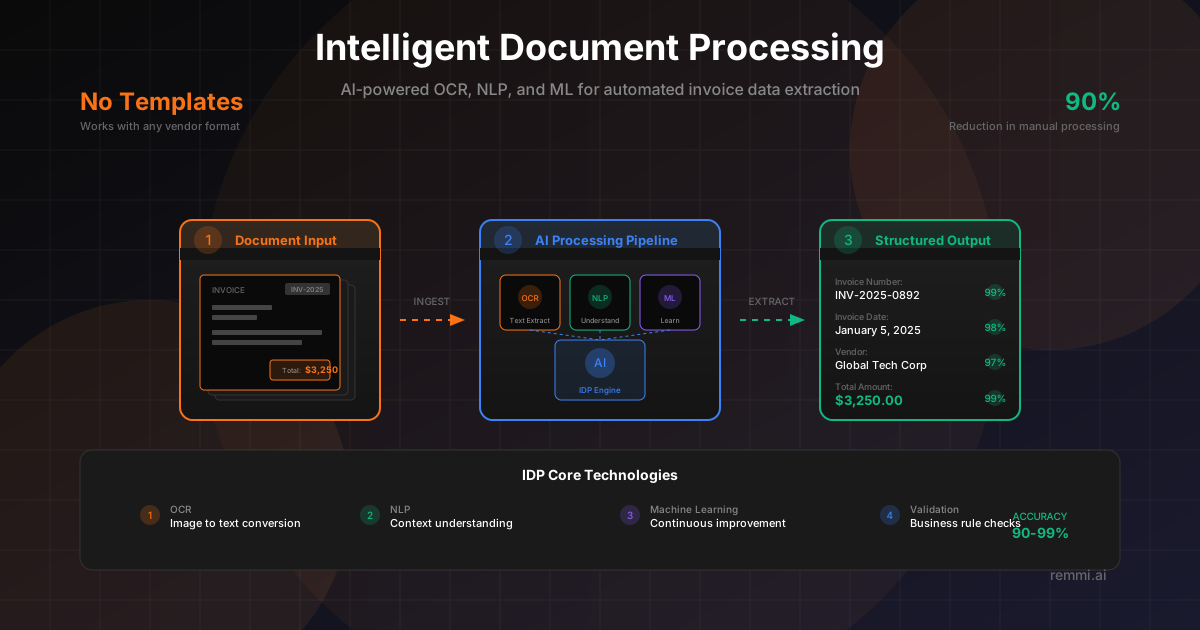
Understanding Intelligent Document Processing
Intelligent Document Processing (IDP) represents the evolution of document automation. While traditional OCR simply converts images to text, IDP uses artificial intelligence to truly understand documents—identifying what type of document it is, locating specific fields regardless of layout, extracting data with context awareness, and validating information against business rules.
For invoice processing, IDP is transformative. Instead of requiring IT teams to create templates for every vendor's invoice format, IDP systems learn to identify invoice numbers, dates, line items, and totals automatically. When a new vendor sends their first invoice, IDP handles it without configuration.
The technology combines three core AI capabilities:
- OCR (Optical Character Recognition) - Converts document images into machine-readable text
- NLP (Natural Language Processing) - Understands the meaning and context of extracted text
- Machine Learning - Improves accuracy over time by learning from corrections and patterns
This combination enables touchless invoice processing where the majority of invoices flow through without human intervention, while exceptions are intelligently routed for review.
How IDP Technology Works
1. Document Ingestion
Documents enter the IDP pipeline from any source:
- Email attachments
- Scanned paper documents
- Digital PDF files
- API uploads
2. AI Processing
Multiple AI models work together:
- Document classification
- OCR text extraction
- NLP context understanding
- Field identification
3. Data Output
Validated, structured data ready for use:
- Header information
- Line item details
- Confidence scores
- Validation flags
IDP vs Traditional OCR: Key Differences
Traditional OCR
- -Converts images to raw text only
- -Requires templates per document type
- -Struggles with layout variations
- -Static accuracy over time
Best for: High-volume, identical document formats
Intelligent Document Processing
- +Understands document meaning and structure
- +No templates needed, works out-of-box
- +Handles any layout automatically
- +Continuously learns and improves
Best for: Variable vendors, complex documents, scaling AP
Core Components of IDP Technology
Converts document images into machine-readable text
Understands context and meaning of extracted text
Learns patterns and improves accuracy over time
IDP Invoice Processing Pipeline
Document Intake
Invoice arrives via email, scan, upload, or API integration with source system.
Document Classification
AI identifies document type (invoice, PO, receipt) and routes accordingly.
Pre-Processing
Image quality enhancement, deskewing, noise removal, and format normalization.
OCR Extraction
Text is extracted from the document image using advanced character recognition.
NLP Understanding
AI understands document structure and identifies field locations contextually.
Data Extraction
Specific fields (invoice #, date, amounts, line items) are captured with confidence scores.
Validation
Business rules check data integrity—math validation, format checks, duplicate detection.
Routing
High-confidence invoices auto-process; exceptions route to human review queue.
Benefits of IDP for Invoice Processing
No Template Maintenance
IDP handles new vendor formats automatically without IT configuration, eliminating the template maintenance burden of traditional OCR.
Continuous Improvement
Machine learning models improve accuracy over time by learning from corrections, achieving higher accuracy the more documents they process.
Faster Processing
AI-powered extraction processes invoices in seconds rather than minutes, enabling same-day processing of high invoice volumes.
Higher Accuracy
Contextual understanding reduces errors—IDP knows that '$1,234.56' next to 'Total' is an amount, not just a number.
Scalability
Cloud-based IDP scales automatically to handle volume spikes without infrastructure changes or additional licensing.
Common IDP Implementation Mistakes
- xExpecting 100% automation immediately — IDP improves over time; plan for initial exception handling and gradual accuracy improvement
- xSkipping the feedback loop — IDP systems need human corrections fed back to improve; ignoring this prevents accuracy gains
- xNot defining validation rules — IDP extraction is only half the solution; business rule validation catches errors AI may miss
- xIgnoring document quality — Even AI-powered IDP performs better with clear scans; establish quality standards for incoming documents
IDP vs Other Approaches
| Capability | Manual Entry | Template OCR | IDP |
|---|---|---|---|
| New vendor setup | None needed | Hours per vendor | Automatic |
| Processing speed | 5-10 min/invoice | Seconds | Seconds |
| Accuracy over time | Consistent | Static | Improves |
| Layout changes | Handled | Requires update | Auto-adapts |
| Cost at scale | Highest | Medium | Lowest |