What is Internal Controls?
The policies, procedures, and safeguards that protect assets, ensure accurate reporting, and maintain regulatory compliance.
Quick Definition
Internal controls are the systematic measures an organization implements to safeguard assets, ensure the accuracy of financial records, promote operational efficiency, and enforce compliance with policies and regulations.
- Prevents fraud, errors, and unauthorized access
- Required for SOX compliance and audit readiness
- Built on the COSO framework with five components
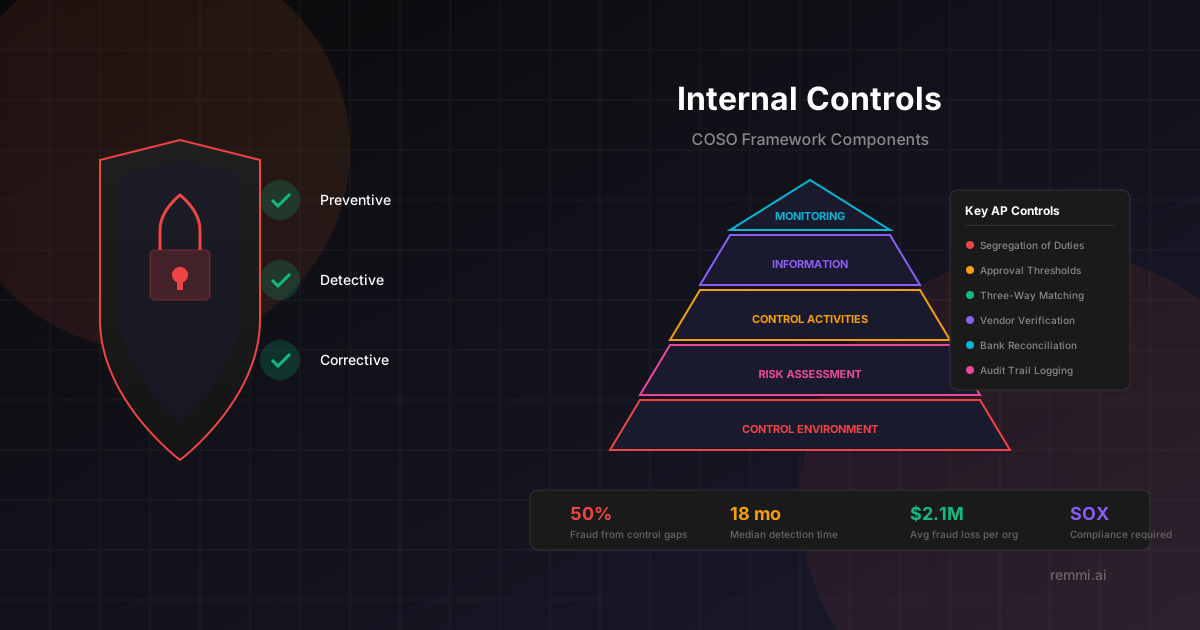
Understanding Internal Controls
Internal controls are the backbone of sound financial management and corporate governance. They represent the collective policies, procedures, and mechanisms that organizations put in place to achieve four primary objectives: safeguarding assets, ensuring accurate and reliable financial reporting, promoting operational efficiency, and ensuring compliance with applicable laws and regulations.
In the context of accounts payable, internal controls are particularly critical because AP is responsible for significant cash outflows and is frequently targeted by both internal and external fraud schemes. Without robust controls, organizations risk duplicate payments, unauthorized disbursements, vendor fraud, and material misstatements in their financial records.
The concept of internal controls gained significant prominence following major corporate scandals like Enron and WorldCom, which led to the Sarbanes-Oxley Act (SOX) of 2002. SOX requires public companies to maintain and assess the effectiveness of their internal controls over financial reporting, with management and external auditors both attesting to their adequacy.
Modern internal control frameworks, particularly the COSO framework, provide a structured approach to designing, implementing, and evaluating controls. Rather than viewing controls as a compliance checkbox, leading organizations treat them as strategic assets that reduce risk, improve operations, and build stakeholder trust.
Types of Internal Controls
Preventive Controls
Stop errors or fraud before they occur. Examples include approval requirements, segregation of duties, access controls, and vendor verification procedures.
Detective Controls
Identify issues after they happen. Examples include bank reconciliations, variance analysis, exception reports, and periodic audits.
Corrective Controls
Fix problems once detected. Examples include error correction procedures, policy updates, retraining programs, and process improvements.
IT Controls
Technology-based safeguards including system access controls, automated validations, audit logging, data encryption, and system backups.
Why Internal Controls Matter
Average loss per organization from AP fraud schemes
Median time to detect occupational fraud
Of fraud cases due to internal control weaknesses
Strong internal controls are not just about compliance - they directly protect the bottom line. Organizations with robust controls experience fewer losses, faster fraud detection, and greater stakeholder confidence. For public companies, material control weaknesses must be disclosed and can impact stock prices and investor trust.
The COSO Framework Components
Control Environment
The foundation of all other components. Includes integrity, ethical values, management philosophy, and organizational structure. Sets the 'tone at the top.'
Risk Assessment
Identifying and analyzing risks that could prevent achieving objectives. Includes assessing fraud risk and evaluating changes that could impact the control system.
Control Activities
The policies and procedures that ensure management directives are carried out. Includes approvals, authorizations, verifications, reconciliations, and segregation of duties.
Information & Communication
Relevant information must be identified, captured, and communicated in a timely manner. Includes both internal and external communication channels.
Monitoring Activities
Ongoing evaluations, separate evaluations, or a combination to assess whether each component is present and functioning. Deficiencies are communicated to management.
Internal Controls Best Practices
Enforce Segregation of Duties
Separate invoice entry, approval, and payment execution roles. No single person should control an entire transaction.
Require Three-Way Matching
Match invoices to purchase orders and receiving documents before payment to prevent overpayment and fraud.
Implement Strong Access Controls
Limit system access based on job responsibilities. Use role-based permissions and regularly review access rights.
Monitor with Exception Reports
Generate regular reports on duplicate payments, unusual vendors, round-dollar amounts, and other red flags.
Document and Test Regularly
Maintain written policies and procedures. Conduct periodic testing to verify controls are operating effectively.
Internal Control Weaknesses to Avoid
- xOverride by management - Allowing executives to bypass controls undermines the entire system
- xLack of segregation - One person controlling vendor setup, invoice entry, and payments
- xInfrequent reconciliations - Waiting too long to reconcile accounts allows errors to compound
- xNo monitoring or testing - Controls that are never tested may not work when needed most
Related Terms
Segregation of Duties
Dividing tasks to prevent fraud and errors
Approval Workflow
Routing invoices for authorization before payment
Audit Trail
Record of all transactions and changes
Three-Way Match
Matching invoice, PO, and receipt before payment
Duplicate Payment
Paying the same invoice more than once
Vendor Master
Central database of approved supplier information