What is Check Payment?
The traditional paper-based payment method still used in B2B transactions, though rapidly being replaced by electronic alternatives.
Quick Definition
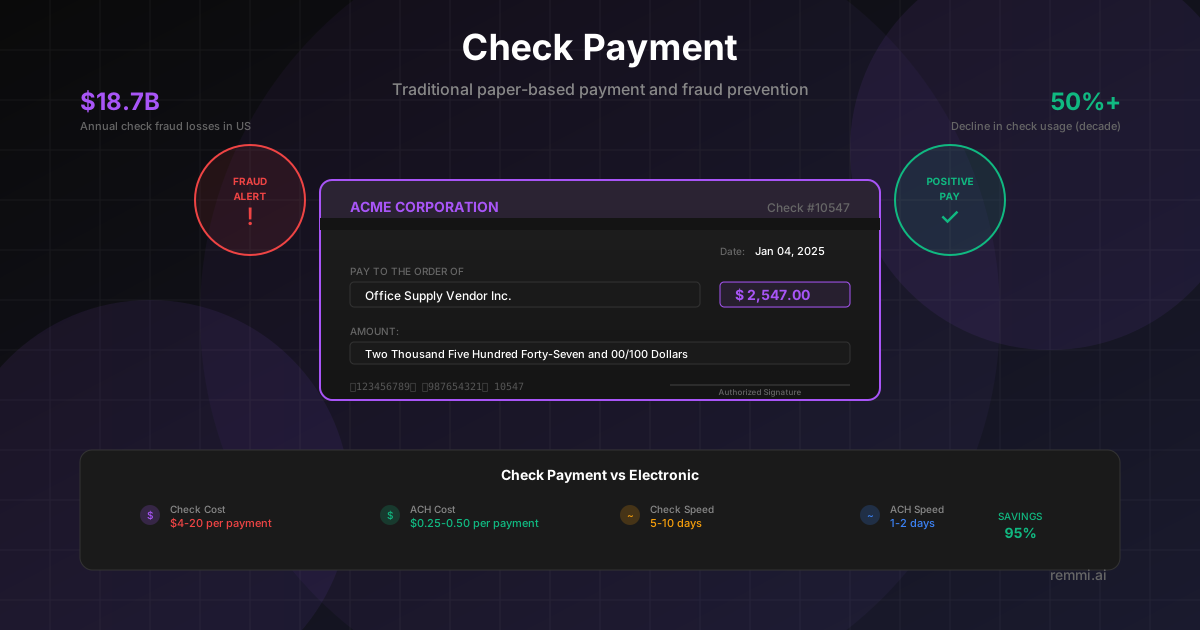
A check payment is a written order directing a bank to pay a specific amount from the payer's account to a named recipient. While checks have been a business payment standard for decades, they are increasingly being replaced by faster, cheaper, and more secure electronic payment methods.
- Provides paper trail and physical payment record
- Requires positive pay for fraud prevention
- Costs 10-40x more than electronic alternatives
Understanding Check Payments
Check payments have been a cornerstone of business-to-business transactions for over a century. A check is a negotiable instrument that instructs a bank to transfer funds from the payer's account to the payee. Despite the rise of digital payments, checks remain in use for many B2B transactions, particularly in industries with established paper-based processes.
However, the landscape is rapidly changing. Check usage in the United States has declined by more than 50% over the past decade, with businesses increasingly adopting ACH transfers, virtual cards, and other electronic payment methods that offer significant advantages in cost, speed, and security.
Understanding the check payment process, its costs, and associated fraud risks is essential for AP teams—whether to optimize existing check operations or to build the case for transitioning to electronic alternatives.
The Check Payment Lifecycle
1. Check Issuance
Creating and sending the check payment:
- • Print check with payment details
- • Apply authorized signature
- • Record in check register
- • Mail or hand-deliver to payee
2. Check Deposit
Recipient processes the check:
- • Recipient endorses check
- • Deposits at their bank
- • Bank captures check image
- • Initiates clearing process
3. Clearing & Settlement
Banks process and transfer funds:
- • Check presented to payer's bank
- • Positive pay verification (if enabled)
- • Funds debited from payer
- • Settlement in 2-5 business days
Check Payment vs Electronic Payment
Check Payment
- $Cost: $4-20 per payment
- ~Speed: 5-10 days end-to-end
- !Fraud risk: High (check washing, forgery)
- ~Reconciliation: Manual, time-consuming
Electronic Payment (ACH)
- $Cost: $0.25-0.50 per payment
- ~Speed: 1-2 business days
- !Fraud risk: Lower with bank verification
- ~Reconciliation: Automated, instant
The True Cost of Check Payments
Fully-loaded cost per check payment
Annual check fraud losses in the US
Decline in check usage over past decade
While checks may seem inexpensive at face value, the total cost includes printing, materials, postage, labor for handling, bank fees, positive pay services, and the cost of fraud when it occurs. Organizations processing thousands of checks monthly can save hundreds of thousands of dollars annually by transitioning to electronic payments.
How Positive Pay Prevents Check Fraud
Issue Check File
When you print checks, generate a file with check numbers, amounts, dates, and payee names.
Transmit to Bank
Send the positive pay file to your bank via secure transmission, typically daily or per check run.
Check Presented
When someone deposits or cashes a check drawn on your account, the bank receives it for clearing.
Bank Verification
Bank automatically compares the presented check against your positive pay file for matches.
Exception Handling
Mismatches are held as exceptions—you review and decide to pay or return each flagged item.
Fraud Prevention
Fraudulent, altered, or counterfeit checks are blocked before funds leave your account.
Check Payment Best Practices
Enable Positive Pay
Always use positive pay services for any significant check volume. The small monthly fee prevents major fraud losses.
Reconcile Daily
Review bank activity daily to catch fraudulent checks before the return window closes (typically 24-48 hours).
Plan Your Transition
Develop a roadmap to move vendors to ACH or virtual cards. Start with high-volume, low-risk payees.
Use Secure Check Stock
If printing checks, use security features like watermarks, microprinting, and chemical-sensitive paper.
Track Your Costs
Measure the true cost per check including labor and fraud losses to build the case for electronic payment adoption.
Common Check Fraud Schemes to Watch For
- !Check washing — Criminals steal checks from mail, use chemicals to remove ink, and rewrite amounts or payees
- !Counterfeit checks — Fraudsters create fake checks using stolen account and routing numbers from discarded checks
- !Forgery — Unauthorized individuals sign checks using forged or copied signatures
- !Payee alteration — Original payee name is modified to redirect payment to a fraudster
Comparing Payment Methods
| Method | Cost | Speed | Best For |
|---|---|---|---|
| Check | $4-20 | 5-10 days | Vendors without electronic capability |
| ACH | $0.25-0.50 | 1-2 days | Recurring and high-volume payments |
| Wire Transfer | $15-45 | Same day | Large, time-sensitive payments |
| Virtual Card | Rebate possible | Instant | Vendors accepting cards, earning rebates |
Related Terms
ACH Payment
Electronic bank-to-bank transfers via the ACH network
Electronic Payment
Digital payment methods replacing paper-based transactions
Positive Pay
Bank service to prevent check fraud by matching check data
Payment Processing
Systems and workflows for executing vendor payments
Accounts Payable
Department managing vendor invoices and payments
Bank Reconciliation
Matching bank statements with internal payment records