What is an Intercompany Invoice?
The billing document that tracks transactions between subsidiaries, divisions, and affiliates within the same corporate group.
Quick Definition
An intercompany invoice is a billing document exchanged between related legal entities within the same corporate group. It records internal transactions for goods, services, or cost allocations between subsidiaries, divisions, or affiliates.
- Essential for transfer pricing compliance
- Must be eliminated during financial consolidation
- Requires reconciliation between related entities
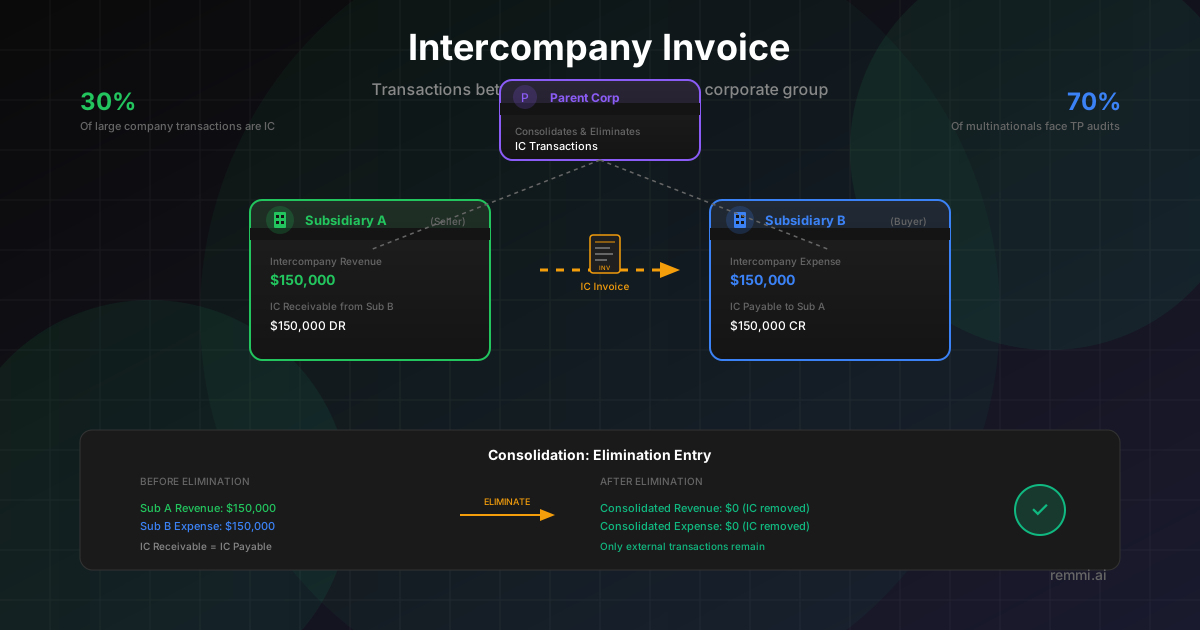
Understanding Intercompany Invoices
When a corporation grows to include multiple legal entities - whether through acquisitions, geographic expansion, or organizational restructuring - transactions between these entities need to be formally documented. This is where intercompany invoices come into play.
An intercompany invoice serves the same purpose as a regular invoice: it documents a transaction, specifies amounts owed, and creates a record for accounting. The key difference is that both the buyer and seller are part of the same corporate family.
These internal invoices are critical for several reasons:
- Legal Compliance - Each legal entity must maintain its own books and records, even within a group
- Tax Documentation - Transfer pricing rules require documentation of intercompany transactions at arm's length prices
- Accurate Consolidation - Proper tracking enables correct elimination entries during financial consolidation
Without proper intercompany invoicing, organizations face tax audit risks, consolidation errors, and compliance violations across multiple jurisdictions.
Key Concepts
Related Entities
Companies under common ownership or control:
- - Parent and subsidiaries
- - Sister companies
- - Divisions or branches
- - Joint ventures
Transfer Pricing
Setting prices for internal transactions:
- - Arm's length principle
- - Market-based pricing
- - Cost-plus methods
- - Tax compliance
Elimination Entries
Removing internal transactions:
- - Revenue elimination
- - Expense elimination
- - Receivable/payable offset
- - Profit in inventory
How Intercompany Transactions Flow
Selling Entity
- 1Creates intercompany invoice
- 2Records intercompany receivable
- 3Recognizes intercompany revenue
- 4Sends to buying entity
Buying Entity
- 1Receives intercompany invoice
- 2Records intercompany payable
- 3Recognizes intercompany expense
- 4Settles via netting or payment
At Consolidation: The intercompany revenue/expense and receivable/payable are eliminated, showing only external transactions in consolidated financials.
Why Intercompany Invoicing Matters
Of large company transactions are intercompany
Annual global intercompany trade volume
Of multinationals face transfer pricing audits
Intercompany transactions represent a significant portion of activity for multinational corporations. Proper invoicing and documentation is essential for regulatory compliance, accurate financial reporting, and avoiding costly tax disputes.
Intercompany Reconciliation Process
Extract Balances
Pull intercompany receivable and payable balances from all entities in the group.
Currency Conversion
Convert all balances to a common reporting currency using consistent exchange rates.
Match Counterparties
Match each entity's receivable against the corresponding entity's payable for the same transaction.
Identify Differences
Flag mismatches from timing differences, FX translation, or booking errors.
Investigate and Resolve
Research each difference and post correcting entries or document timing items.
Prepare Elimination Entries
Create consolidation entries to eliminate matched intercompany balances.
Intercompany Invoice Best Practices
Establish Clear Transfer Pricing Policies
Document arm's length pricing methodologies and apply them consistently across all intercompany transactions.
Use Standardized Invoice Templates
Create consistent intercompany invoice formats with required fields for easier matching and reconciliation.
Automate Reconciliation
Implement automated matching tools to identify differences in real-time rather than at period end.
Reconcile Monthly
Perform intercompany reconciliation monthly to catch and resolve issues before they compound.
Implement Intercompany Netting
Reduce payment volume and FX costs by netting offsetting intercompany balances before settlement.
Common Intercompany Mistakes to Avoid
- xInconsistent pricing across transactions - Creates transfer pricing audit risk and compliance issues
- xDelayed invoice posting - Causes timing differences and reconciliation nightmares at period end
- xMissing elimination entries - Results in overstated consolidated revenue and expenses
- xPoor documentation - Leaves organization vulnerable during tax authority audits
Common Intercompany Transaction Types
| Type | Description | Example |
|---|---|---|
| Goods Sale | Inventory transfers between entities | Manufacturing sub sells to distribution sub |
| Service Charges | Shared services allocation | IT, HR, or finance shared services |
| Management Fees | Corporate overhead charges | HQ charges subs for executive oversight |
| Royalties | IP and trademark licensing | Payment for brand or patent usage |
| Intercompany Loans | Internal financing arrangements | Parent lends to subsidiary + interest |
Related Terms
Invoice
Document requesting payment for goods or services
Accounts Payable
Department managing vendor invoices and payments
Accounts Receivable
Money owed to a company by its customers
Consolidation
Combining financial statements of related entities
Reconciliation
Process of matching and verifying financial records
Subsidiary
Company controlled by a parent corporation