What is E-Invoicing?
The exchange of invoice documents between buyers and sellers in structured digital formats that can be automatically processed by receiving systems—eliminating manual data entry entirely.
Quick Definition
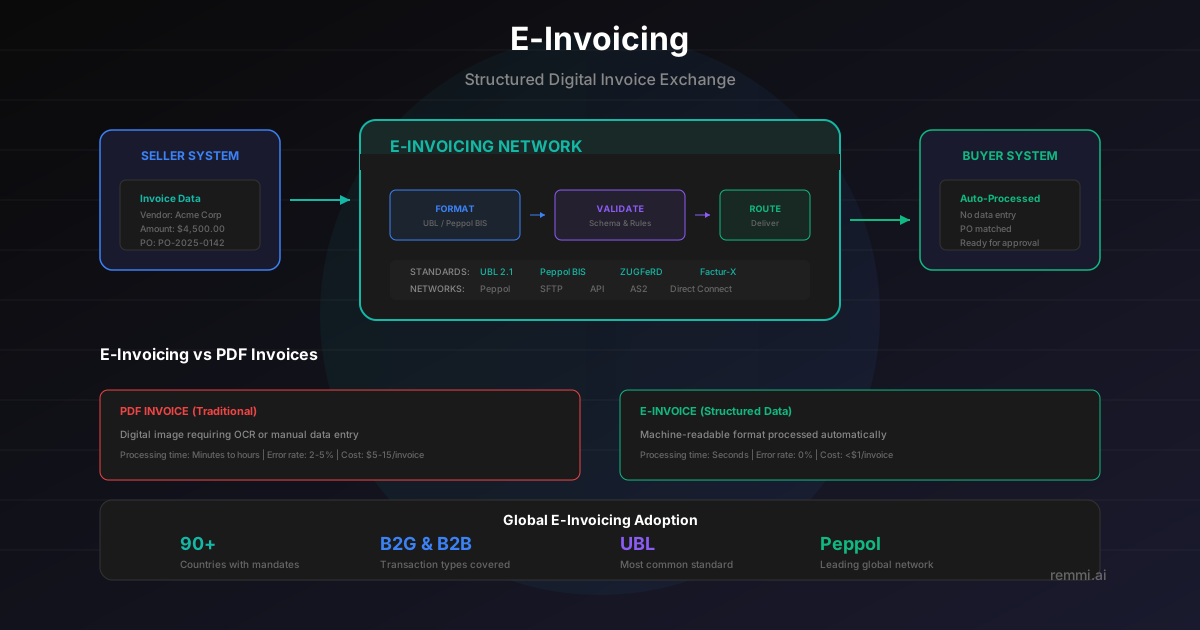
E-invoicing (electronic invoicing) is the exchange of invoice documents in structured digital formats (like XML, UBL, or JSON) between trading partners' systems. Unlike PDF invoices, e-invoices contain machine-readable data that receiving systems process automatically.
- Enables true touchless, straight-through processing
- Eliminates data entry and OCR errors
- Mandatory in many countries for B2G and B2B
Understanding E-Invoicing
E-invoicing represents the evolution of invoice exchange from paper and PDF to truly digital, machine-readable formats. Instead of sending a document that humans or OCR must interpret, e-invoicing transmits structured data that systems can process instantly and accurately.
The key distinction is between digital images of invoices (PDF, scanned paper) and structured data invoices (XML, UBL, EDI). A PDF requires interpretation—whether by a person or OCR software. An e-invoice arrives as data that maps directly into receiving systems without translation or interpretation.
E-invoicing involves several components:
- Standard Format — Structured data format like UBL, Peppol BIS, or country-specific schemas
- Exchange Network — Secure transmission via networks like Peppol or direct connections
- Validation — Automatic checking against format rules and business requirements
- Processing — Direct ingestion into AP systems without data entry
As governments worldwide mandate e-invoicing for tax compliance and efficiency, organizations must prepare their systems to send and receive structured electronic invoices.
Key E-Invoicing Standards
UBL (Universal Business Language)
The most widely adopted international standard for e-invoicing, used as the basis for Peppol and many national formats.
Peppol BIS
Pan-European network standard enabling cross-border e-invoicing, now expanding globally to Asia-Pacific and beyond.
Country-Specific Formats
FatturaPA (Italy), ZUGFeRD (Germany), Factur-X (France), CFDI (Mexico), and others mandated for local compliance.
Hybrid Formats
Formats like ZUGFeRD and Factur-X embed structured XML data within a human-readable PDF for dual compatibility.
E-Invoicing Benefits
Cost reduction vs. paper
Data entry errors
Processing time
E-invoicing eliminates the entire capture and data entry step from invoice processing, enabling true straight-through processing and dramatically improving cycle times.
E-Invoicing Best Practices
Understand Your Requirements
Map which countries and trading partners require e-invoicing, and which standards apply to your transactions.
Choose a Multi-Standard Solution
Select platforms that support multiple e-invoicing standards to handle global requirements from a single system.
Plan for Compliance Deadlines
Track upcoming mandates in your operating countries. Many have staggered rollouts by company size or transaction type.
Integrate with Your AP System
Ensure e-invoices flow directly into your AP automation for seamless processing without manual intervention.
Communicate with Trading Partners
Coordinate with suppliers and customers on e-invoicing capabilities, standards, and network connections.
Common E-Invoicing Challenges
- ×Multiple standards — Different countries and networks use different formats, requiring translation
- ×Trading partner readiness — Not all suppliers can send e-invoices, requiring hybrid approaches
- ×Evolving mandates — Requirements change frequently as countries update regulations
- ×System integration — Legacy ERP systems may lack native e-invoicing support