What is SOX Compliance?
The Sarbanes-Oxley Act mandates strict internal controls and audit trails to ensure financial accuracy and prevent fraud. Learn how SOX requirements impact accounts payable.
Quick Definition
SOX compliance refers to adherence to the Sarbanes-Oxley Act of 2002, which requires public companies to implement internal controls and maintain audit trails in financial processes. For accounts payable, this means documented workflows, segregation of duties, and complete transaction records.
- Applies to all U.S. public companies
- Requires annual internal control assessments
- Penalties include fines up to $5M and imprisonment
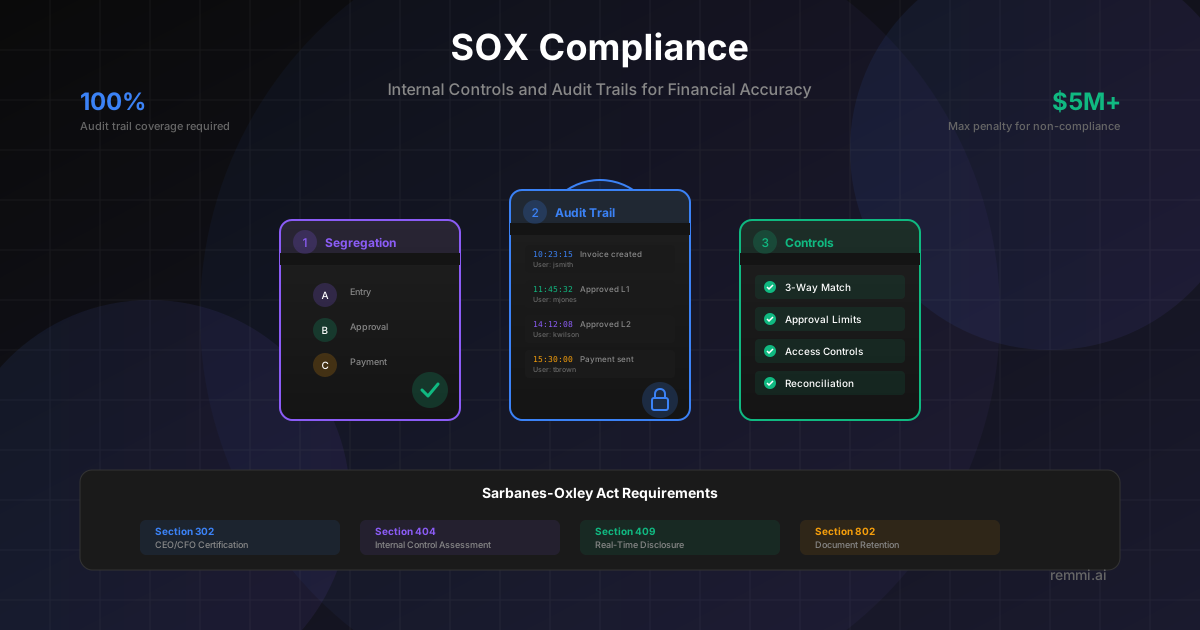
Understanding SOX Compliance
The Sarbanes-Oxley Act (SOX) was enacted in 2002 following major corporate accounting scandals at Enron, WorldCom, and other companies. The legislation aims to protect investors by improving the accuracy and reliability of corporate financial disclosures through strict internal control requirements.
For accounts payable departments, SOX compliance means implementing controls that ensure every payment is properly authorized, accurately recorded, and fully documented. This includes establishing clear approval hierarchies, maintaining separation between those who can approve invoices and those who execute payments, and creating audit trails that track every action taken on financial transactions.
While SOX primarily applies to public companies, many private organizations adopt SOX-like controls as best practices or in preparation for going public. Strong internal controls not only satisfy regulatory requirements but also reduce the risk of fraud and errors in financial processes.
Key SOX Sections for AP
Section 302
CEO and CFO must personally certify the accuracy of financial statements and the effectiveness of internal controls.
Section 404
Requires annual assessment of internal controls over financial reporting, with external auditor attestation.
Section 409
Mandates real-time disclosure of material changes to financial condition, requiring timely reporting systems.
Section 802
Criminal penalties for altering, destroying, or falsifying records. Requires document retention policies.
Essential SOX Controls for Accounts Payable
Segregation of Duties
- -Separate invoice entry from approval
- -Separate approval from payment execution
- -Limit vendor master data access
- -Require dual approval for high-value payments
Audit Trail Requirements
- -Log all user actions with timestamps
- -Track all invoice modifications
- -Record approval history and comments
- -Maintain immutable transaction records
Implementing SOX Compliance in AP
Document Current Processes
Map all AP workflows, identify control points, and document who performs each function and what authorizations they have.
Identify Control Gaps
Compare current state against SOX requirements to find areas lacking proper segregation, documentation, or oversight.
Design and Implement Controls
Create approval matrices, establish role-based access, implement three-way matching, and set up audit logging.
Test Control Effectiveness
Conduct regular testing to verify controls are working as designed. Document test results and remediate any failures.
Monitor and Report
Establish ongoing monitoring, exception reporting, and periodic control assessments to maintain compliance.
Prepare for Audit
Maintain organized documentation, evidence of testing, and management certifications for external auditor review.
Consequences of SOX Non-Compliance
Maximum fines for executives
Maximum prison sentence
Removal from stock exchanges
- xMaterial weakness disclosures — Required public disclosure of control failures damages reputation
- xIncreased audit costs — Remediation efforts and additional testing significantly increase expenses
- xInvestor confidence loss — Stock price decline and difficulty raising capital
How AP Automation Supports SOX Compliance
Enforced Segregation of Duties
Role-based access controls and automated workflows ensure proper separation between invoice processing, approval, and payment functions.
Immutable Audit Trails
Every action is automatically logged with user, timestamp, and details. Records cannot be modified or deleted, providing complete transaction history.
Automated Three-Way Matching
System automatically matches invoices to POs and receipts, ensuring payments are only made for authorized purchases actually received.
Approval Workflow Enforcement
Payments cannot proceed without required approvals. System enforces authorization limits and escalation rules automatically.
Compliance Reporting
Generate audit-ready reports showing control effectiveness, exception handling, and approval histories for auditor review.
AP SOX Compliance Checklist
| Control Area | Requirement | Evidence Needed |
|---|---|---|
| Segregation of Duties | No user can complete payment end-to-end | Access matrix, role definitions |
| Approval Workflows | Documented authorization limits | Approval matrix, delegation policy |
| Audit Trails | All transactions logged with user/time | System logs, change history reports |
| Vendor Master Controls | Restricted access, change approvals | Access logs, change request records |
| Reconciliation | Regular AP subledger to GL reconciliation | Reconciliation reports, signoffs |