What is ASC 606?
The comprehensive revenue recognition standard that establishes a five-step model for recognizing revenue from contracts with customers.
Quick Answer
ASC 606 (Revenue from Contracts with Customers) is the FASB accounting standard that replaced legacy industry-specific revenue recognition rules with a single, principles-based framework. It requires companies to recognize revenue when control of goods or services transfers to the customer.
- Unified five-step model applies across all industries
- Control-based approach replaces risks and rewards focus
- Enhanced disclosures improve transparency for investors
Understanding ASC 606
ASC 606, officially titled "Revenue from Contracts with Customers," represents one of the most significant changes to GAAP in decades. Issued jointly by the Financial Accounting Standards Board (FASB) and the International Accounting Standards Board (IASB) in 2014, this standard fundamentally transformed how companies recognize revenue.
Before ASC 606, companies followed a patchwork of industry-specific guidance that led to inconsistent practices. A software company might recognize revenue differently than a manufacturer, even when the underlying economics were similar. ASC 606 established a single, comprehensive framework designed to produce comparable and consistent financial statements across industries.
The core principle is straightforward: recognize revenue to depict the transfer of promised goods or services to customers in an amount that reflects the consideration the entity expects to receive. However, applying this principle requires careful judgment, particularly for complex arrangements involving multiple deliverables, variable consideration, or significant financing components.
The Five-Step Revenue Recognition Model
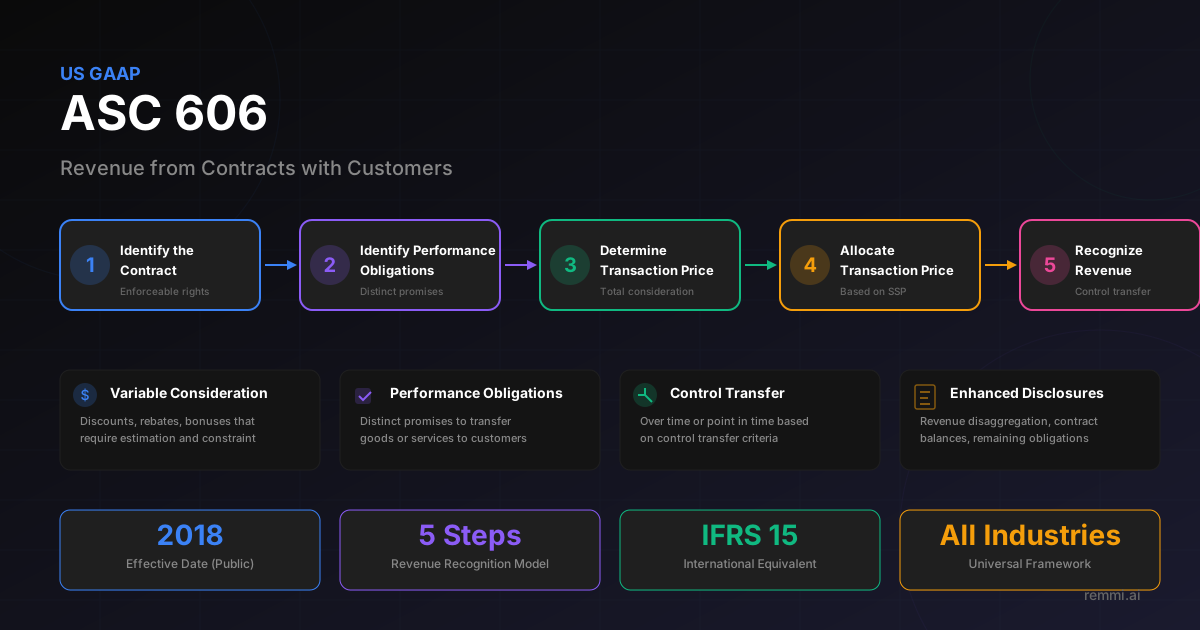
ASC 606's five-step model provides a structured approach to revenue recognition that applies universally. Each step requires specific analysis and documentation, ensuring consistent application across different contract types and industries.
Step 1: Identify the Contract
Determine if a contract exists with enforceable rights and obligations. The contract must have commercial substance and collectability must be probable.
Step 2: Identify Performance Obligations
Identify each distinct promise to transfer goods or services. Distinct items are separately identifiable and provide standalone value to the customer.
Step 3: Determine Transaction Price
Calculate the total amount of consideration expected, including variable consideration, significant financing, and non-cash consideration.
Steps 4-5: Allocate & Recognize
Allocate transaction price to each performance obligation based on standalone selling prices, then recognize revenue when control transfers.
Why ASC 606 Matters for Your Business
$5T+
Revenue affected annually by ASC 606 across US companies
75%
Of public companies reported significant implementation impacts
200+
Pages of guidance in the codification topic
ASC 606 impacts virtually every company that generates revenue from contracts with customers. The standard affects not only financial reporting but also systems, processes, internal controls, compensation structures tied to revenue metrics, and debt covenants. Companies in technology, media, telecommunications, construction, and professional services faced the most significant changes to their revenue recognition patterns.
Key Implementation Considerations
Contract Portfolio Analysis
Evaluate all contract types to identify those requiring detailed ASC 606 analysis, focusing on bundled arrangements, variable consideration, and licensing.
Performance Obligation Identification
Document the distinct goods and services promised in each contract type, assessing whether items are capable of being distinct and separately identifiable.
Standalone Selling Price Determination
Establish observable prices for each performance obligation, or use estimation methods (adjusted market assessment, expected cost plus margin, residual approach) when direct prices are unavailable.
Variable Consideration
Estimate and constrain variable consideration (discounts, rebates, refunds, bonuses) using the expected value or most likely amount approach.
Over Time vs. Point in Time Recognition
Determine the appropriate timing of revenue recognition based on control transfer criteria, documenting the rationale for over-time or point-in-time treatment.
Disclosure Requirements
Prepare comprehensive disclosures including revenue disaggregation, contract balances, remaining performance obligations, and significant judgments applied.
Best Practices for ASC 606 Compliance
Document All Judgments
Maintain detailed documentation of key judgments, including performance obligation identification and SSP determinations.
Standardize Contract Terms
Work with sales and legal to standardize contract language, reducing complexity in revenue recognition analysis.
Automate Where Possible
Implement systems to automate revenue calculations, particularly for high-volume, standardized contracts.
Regular Training Programs
Ensure finance, sales, and operations teams understand ASC 606 implications for contract structuring and modifications.
Monitor ASU Updates
Stay current with FASB accounting standards updates that clarify or modify ASC 606 guidance.
Common ASC 606 Mistakes to Avoid
- Improper performance obligation bundling: Failing to separate distinct goods and services, or incorrectly combining items that should be recognized separately.
- Insufficient variable consideration constraint: Recognizing revenue for variable amounts without adequate consideration of reversal probability.
- Incorrect SSP allocation: Using inconsistent or unsupported methods to determine standalone selling prices for allocation purposes.
- Inadequate disclosure: Providing insufficient detail on disaggregation, remaining performance obligations, or significant judgments.
Related Terms
ASC 842
Lease accounting standard for lessees and lessors
IFRS 15
International equivalent of ASC 606 for revenue recognition
Deferred Revenue
Liability representing payments received before performance
Contract Assets
Rights to consideration for satisfied performance obligations
Variable Consideration
Revenue amounts that may vary based on contract terms
Performance Obligations
Promises to transfer goods or services to customers