Purchase Order Management: Building a Foundation for Efficient AP Operations
The difference between chaotic AP operations and streamlined invoice processing often comes down to one thing: how well you manage purchase orders. Strong PO management eliminates maverick spend, enables automated 3-way matching, and gives finance leaders the visibility they need to control costs.
Ryan Shugars
Director of Product
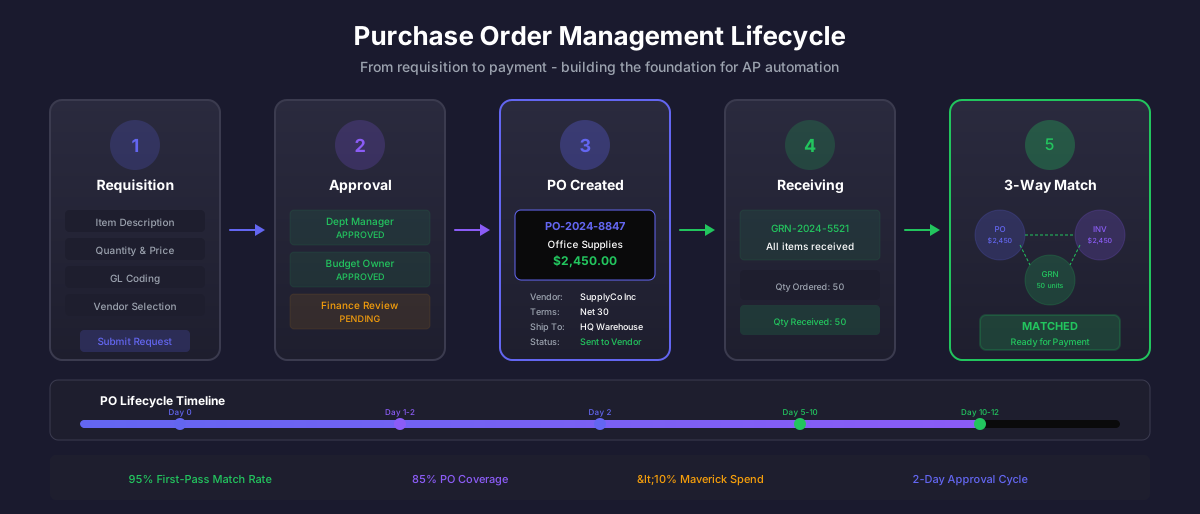
According to APQC benchmarking data, organizations with mature purchase order processes achieve 95%+ touchless invoice processing rates, while those without structured PO management struggle to automate even 30% of their invoices. The gap represents millions in operational costs for mid-size and enterprise organizations.
Purchase orders are more than administrative paperwork. They represent pre-approved spending authority, establish contractual terms, and create the baseline for invoice validation. When PO management breaks down, the consequences ripple through the entire procure-to-pay cycle: invoices queue for manual review, payments get delayed, vendors become frustrated, and finance teams drown in exceptions.
Understanding the True Impact of PO Management
Before exploring solutions, it's essential to understand what's at stake. Organizations often underestimate how much poor PO management costs them because the impacts are distributed across multiple departments and hidden in operational overhead.
The Cost of Poor PO Management
of spend occurs without approved POs (maverick spend)
cost to manually process a non-PO invoice vs $3-5 for PO-backed
of invoice exceptions stem from PO mismatches
additional processing time for non-PO invoices
The math is compelling: if your organization processes 10,000 invoices annually and 25% lack proper PO backing, you're spending an extra $100,000-$350,000 in processing costs alone. Add in the cost of missed early payment discounts, late payment penalties, and strained vendor relationships, and the total impact often exceeds $500,000 annually for mid-size organizations.
The Anatomy of Effective PO Management
Successful purchase order management isn't about adding bureaucracy. It's about creating a system that captures spending intent at the right time, with the right level of detail, while minimizing friction for requisitioners and approvers.
1. Establishing Clear PO Requirements
The first step is defining when purchase orders are required. A common approach uses spend thresholds and category rules:
- All purchases above $500 require a PO before ordering
- Recurring services require blanket POs with defined limits
- Capital expenditures always require POs regardless of amount
- Pre-negotiated catalog items can use simplified requisition workflows
- Emergency purchases have expedited approval paths with post-facto documentation
The key is balance. Too strict, and employees circumvent the system. Too loose, and you lose spend visibility. Most organizations find that covering 80-90% of spend value with POs provides optimal control without excessive friction.
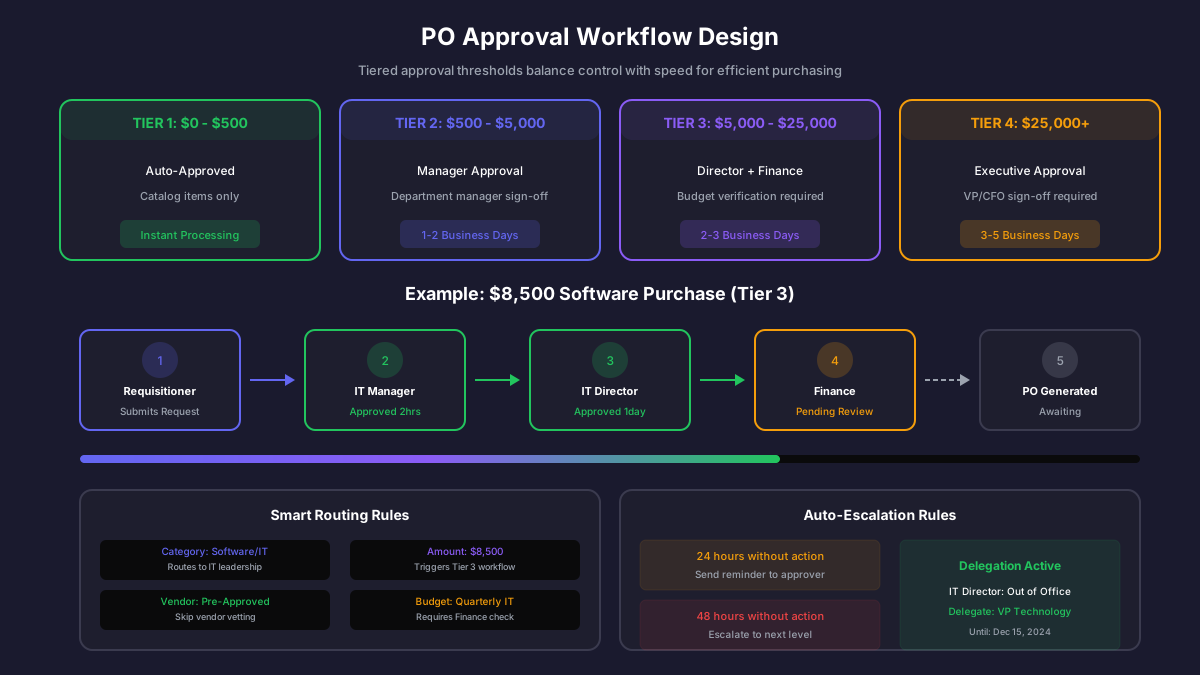
A well-designed PO workflow balances control with speed, ensuring purchases move quickly while maintaining approval oversight
2. Designing Efficient Approval Workflows
Approval workflows should reflect actual decision-making authority while minimizing bottlenecks. Best practices include:
Workflow Design Principles
- - Tiered thresholds: Higher amounts require additional approvers
- - Category-based routing: IT purchases go to IT managers, marketing spend to marketing
- - Delegation rules: Allow temporary delegates when approvers are unavailable
- - Auto-approval: Low-value, pre-negotiated items can be automatically approved
- - Escalation paths: Auto-escalate after 48 hours to prevent bottlenecks
3. Capturing Complete PO Information
The detail level on purchase orders directly impacts downstream matching accuracy. Effective POs capture:
- Line-item detail with quantities, unit prices, and descriptions
- Delivery terms including expected dates and ship-to locations
- Payment terms and any early payment discount opportunities
- GL coding for automatic expense categorization
- Tax treatment to enable proper tax calculation on invoices
- Project or cost center allocation for multi-department orders
This upfront investment in data quality pays dividends when invoices arrive. With complete PO data, automated matching can validate prices, quantities, and terms without human intervention.
Conquering Maverick Spend
Maverick spend, the purchasing of goods or services outside established procurement channels, is the enemy of efficient AP. It creates invoices that can't be matched, prevents volume discounting, and introduces compliance risk.
Why Employees Bypass Procurement
Understanding why maverick spend occurs is the first step to preventing it:
- Process friction: PO creation takes too long or is too complicated
- Urgency: Employees feel they can't wait for approvals
- Lack of awareness: Employees don't know procurement policies
- No consequences: Finance processes non-PO invoices anyway
- Inadequate catalogs: Needed items aren't available through approved channels
Strategies to Reduce Maverick Spend
Effective maverick spend reduction combines process improvement, technology, and enforcement:
Maverick Spend Prevention Framework
Simplify PO Creation
Mobile apps, quick forms, catalog ordering
Reduce friction by 60%
Expand Approved Vendor Catalogs
Punch-out integrations, preferred supplier lists
Cover 95% of common purchases
Enforce PO Requirements
Return non-PO invoices, require retroactive POs
Add accountability
Track and Report Violations
Department-level maverick spend dashboards
Create visibility

3-way matching compares purchase orders, receiving documents, and invoices to validate accuracy and prevent overpayment
Mastering 3-Way Matching
3-way matching is the gold standard for invoice validation. By comparing the purchase order (what was ordered), the receiving document (what was delivered), and the invoice (what's being billed), organizations can catch discrepancies before payment.
Key Match Points
Effective 3-way matching validates multiple elements:
- Quantities: Invoice quantities don't exceed received quantities
- Prices: Invoice unit prices match PO prices
- Line items: All invoiced items appear on the original PO
- Totals: Invoice total doesn't exceed PO value
- Vendor: Invoice vendor matches PO vendor
- Tax: Tax calculations align with expected rates
Configuring Match Tolerances
Perfect matching isn't always practical or desirable. Reasonable tolerances account for rounding differences, shipping variations, and minor price adjustments:
Recommended Tolerance Settings
- - Price variance: +/- 2% or $50, whichever is greater
- - Quantity variance: +/- 5% for consumables, 0% for assets
- - Tax variance: +/- $5 to account for rounding
- - Total variance: +/- 3% or $100, whichever is greater
- - Freight/shipping: Automatically match if within 10% of estimate
The Role of Receiving in PO Management
The often-overlooked middle step in 3-way matching is goods receipt. Without accurate receiving records, matching becomes impossible. Best practices include:
- Mobile receiving: Enable warehouse staff to record receipts in real-time
- Partial receipt handling: Support receiving against blanket POs over time
- Service completion: Track service delivery milestones for non-goods POs
- Tolerance rules: Allow minor over/under-delivery without exceptions
- Integration: Connect receiving systems with AP for real-time visibility
Automating PO Management with Technology
Modern procurement and AP platforms transform PO management from a manual burden to an automated engine. Key automation capabilities include:
Intelligent PO Creation
- AI-powered requisition forms that suggest GL codes and approvers
- Automatic vendor selection based on price and performance history
- Smart catalogs that learn from purchasing patterns
- Mobile-first interfaces for on-the-go requisitioning
Automated Matching and Exceptions
- Real-time 3-way matching as invoices arrive
- Intelligent tolerance handling that reduces false exceptions
- Automatic routing of true exceptions to appropriate reviewers
- Machine learning that improves match rates over time
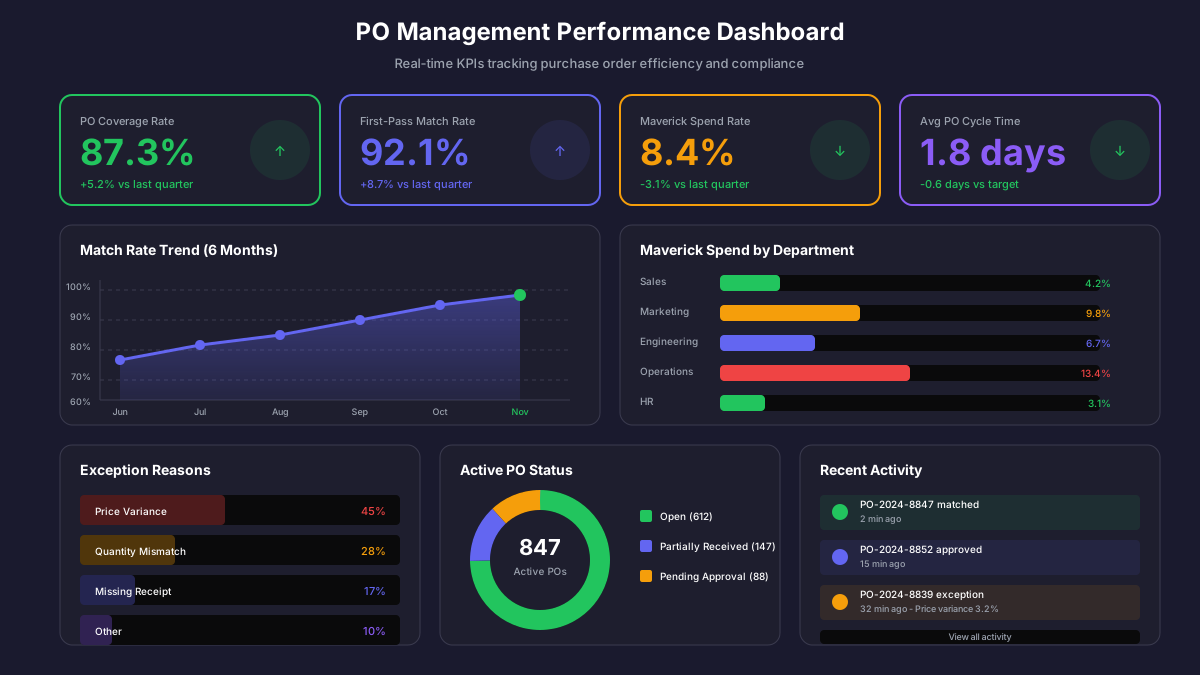
Real-time dashboards give finance leaders visibility into PO performance and identify areas for improvement
Measuring PO Management Success
Track these key performance indicators to assess and improve your PO management maturity:
PO Management KPIs
PO Coverage Rate
% of invoices with valid PO backing
Target: > 85%
First-Pass Match Rate
% of PO invoices matching without intervention
Target: > 90%
Maverick Spend Rate
% of spend outside procurement channels
Target: < 10%
PO Cycle Time
Time from requisition to approved PO
Target: < 2 business days
Common PO Management Pitfalls to Avoid
Even well-intentioned organizations make mistakes that undermine PO management effectiveness:
- Over-engineering approval workflows: Five approval levels for a $500 purchase drives employees to bypass the system
- Ignoring blanket POs: Requiring individual POs for recurring services creates unnecessary workload
- Not closing completed POs: Open POs with remaining value create audit issues and inaccurate reports
- Poor vendor communication: Vendors need PO numbers to include on invoices for matching to work
- Treating all exceptions equally: A $5 variance shouldn't get the same attention as a $5,000 discrepancy
Your PO Management Improvement Roadmap
Transforming PO management takes time, but the payoff is substantial. Here's a practical roadmap:
Phase 1: Foundation (Month 1-2)
- - Document current PO policies and identify gaps
- - Establish clear PO requirements by category and amount
- - Communicate policies to all requisitioners
- - Begin tracking maverick spend by department
Phase 2: Optimization (Month 3-4)
- - Streamline approval workflows based on actual bottlenecks
- - Implement or expand blanket PO programs
- - Configure automated 3-way matching with appropriate tolerances
- - Integrate receiving processes with AP system
Phase 3: Excellence (Month 5-6)
- - Implement vendor catalog punch-out integrations
- - Deploy analytics dashboards for ongoing monitoring
- - Establish continuous improvement process for exceptions
- - Consider AI-powered automation for remaining manual steps
The Bottom Line
Purchase order management is the foundation of efficient accounts payable operations. Without strong POs, automation fails, costs increase, and finance teams spend their days chasing exceptions instead of providing strategic value.
The investment in better PO management pays for itself many times over. Organizations that achieve high PO coverage and match rates see processing costs drop by 60-80%, processing times shrink from weeks to days, and finance teams freed to focus on analysis rather than data entry.
The path forward is clear: establish clear policies, simplify compliance, measure rigorously, and leverage technology to automate what humans shouldn't be doing manually. Your AP team, your vendors, and your bottom line will thank you.
Ryan Shugars
Director of Product
Ryan has spent 15 years as a Systems Architect, building enterprise solutions that transform how organizations manage their financial operations.