Professional Services AP: Managing Time and Expense Invoice Verification
Professional services invoices present unique verification challenges. Unlike product-based invoices with clear unit prices, consulting and services bills require validation against contracts, time reports, and expense policies to ensure billing accuracy.
Ryan Shugars
Director of Product
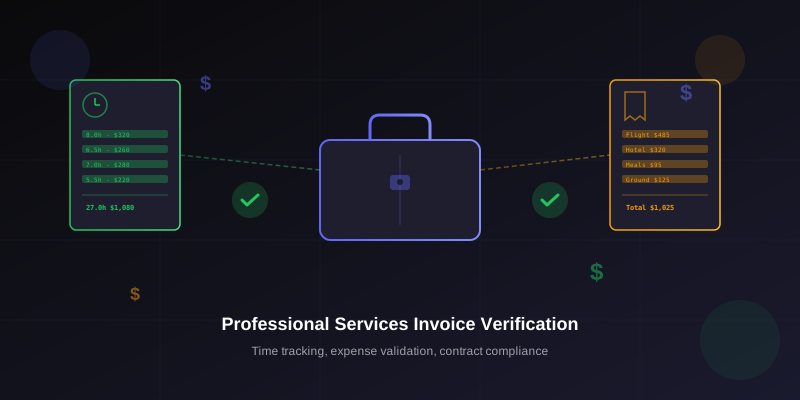
Organizations spend billions annually on professional services—consulting firms, law practices, accounting firms, IT contractors, marketing agencies, and other specialized service providers. Unlike goods-based purchases where you can count widgets received, professional services billing relies on time entries and expense reports that are notoriously difficult to verify without proper systems and processes in place.
Industry research consistently shows that 5-10% of professional services invoices contain billing errors or discrepancies. These errors range from simple miscalculations to more significant issues like billing for unauthorized work, exceeding rate caps, or charging for expenses that don't comply with contract terms. For an organization spending $50 million on professional services, that's $2.5-5 million in potential overbilling annually.
The complexity intensifies when you consider that most organizations engage dozens or even hundreds of professional services providers, each with unique contract terms, rate schedules, and expense policies. Manual verification at scale is impractical, yet paying without verification guarantees overspend. Automated validation provides the solution.
The Unique Challenge of Services Invoices
Professional services invoices differ fundamentally from product invoices in ways that complicate AP processing and verification.
Why Services Invoices Are Complex
Each hour billed requires validation against rate cards and authorized work
Partners, managers, associates, and staff bill at different rates
Travel, meals, and other expenses must align with corporate policies
Work outside original scope needs explicit approval before billing
The Opacity Problem
When you receive an invoice for 500 widgets at $10 each, verification is straightforward: count the widgets, confirm the price, pay the bill. But when a consulting firm invoices for 847.5 hours across 23 consultants over the past month, how do you verify that?
Traditional approaches rely on project managers reviewing invoices against their understanding of work performed. This approach fails for several reasons: project managers don't track consultant hours in detail, they may not know contracted rates, and they lack visibility into expense policy compliance. The result is rubber-stamp approvals that let billing errors flow through unchallenged.
Rate Card Complexity
Professional services contracts typically include rate cards with multiple billing levels:
- Partner/Principal: Senior expertise at premium rates
- Director/Manager: Project leadership and oversight
- Senior Consultant: Experienced delivery resources
- Consultant/Analyst: Standard delivery staff
- Administrative: Support functions at lower rates
Verifying that each person billing time is assigned the correct rate level requires maintaining a mapping of individuals to rate categories and checking each invoice line against that mapping. Many organizations lack these mappings, making rate verification impossible.
The Rate Creep Problem
A common billing issue is "rate creep"—where providers gradually assign more senior (and expensive) resources than authorized or bill junior resources at senior rates. Without systematic rate verification, organizations overpay by 8-15% on labor charges due to rate-level mismatches. Over a multi-year engagement, this compounds into significant unexpected cost overruns.
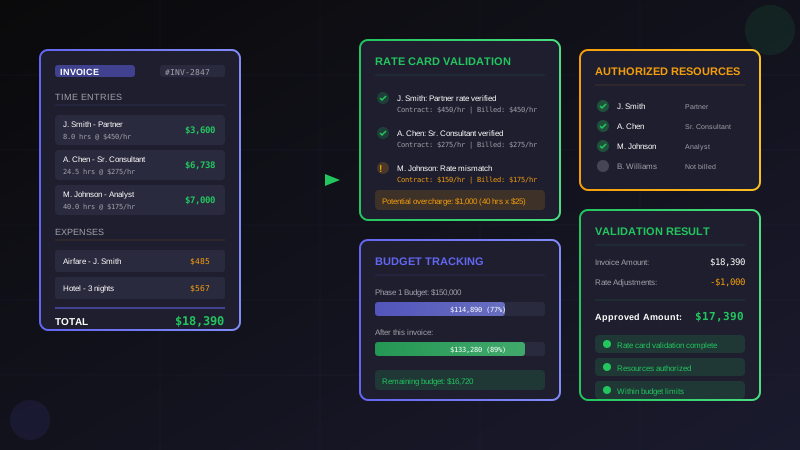
AI-powered extraction captures time entries and validates against contracted rate cards
Building Automated Services Invoice Verification
Effective verification of professional services invoices requires systems that can capture detailed billing data, maintain contract and rate information, and apply validation rules automatically.
Step 1: Contract and Rate Card Management
The foundation of services invoice validation is comprehensive contract data. Before you can verify an invoice, you need to know what you agreed to pay.
Essential Contract Data Points
Rate Schedule
Hourly rates by role level with effective dates
Expense Policies
Allowable expenses, per diems, markup limits, approval thresholds
Budget and Caps
Not-to-exceed amounts, phase budgets, annual limits
Resource Authorizations
Named individuals approved to bill at specific rate levels
Step 2: Invoice Data Extraction
Professional services invoices require detailed extraction to enable line-level validation. The system must capture:
- Time entries with consultant name, date, hours, rate, and amount
- Work descriptions or task codes for each time entry
- Expense line items with category, date, description, and receipt references
- Project or matter codes for allocation
- Billing period and cumulative totals
AI-powered extraction handles the variety of invoice formats across providers, from structured spreadsheet attachments to narrative billing summaries. The goal is converting unstructured billing documents into structured data that can be validated automatically.
Step 3: Time Validation Rules
With contract data and invoice data captured, the system applies validation rules to every time entry:
Time Entry Validation Checks
Rate Validation
- - Consultant authorized to bill?
- - Rate matches contract rate card?
- - Correct rate level for individual?
- - Within rate escalation limits?
Hours Validation
- - Within daily hour limits?
- - Reasonable total for period?
- - Within project phase budget?
- - Overall budget remaining?
Step 4: Expense Validation Rules
Expense verification applies policy rules to each reimbursable expense:
- Category eligibility: Is this expense type reimbursable under the contract?
- Amount limits: Does the expense exceed per-item or per-diem caps?
- Markup compliance: Are administrative markups within allowed percentages?
- Documentation: Is required receipt documentation attached?
- Timing: Was the expense incurred during the engagement period?
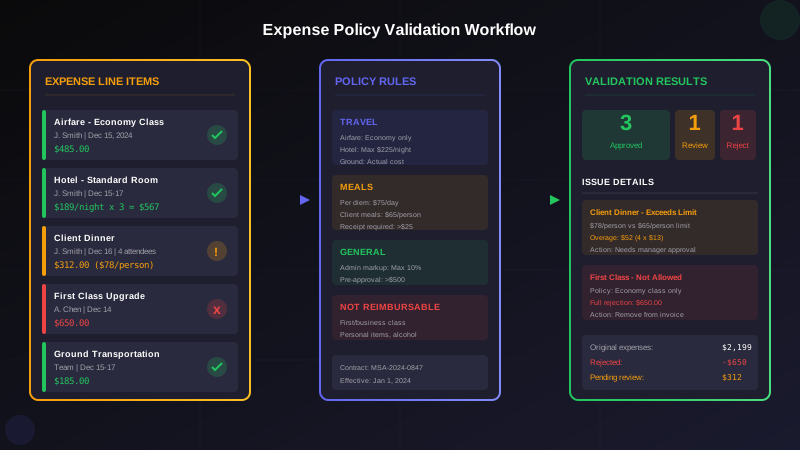
Automated workflows validate expenses against corporate policies and contract terms
Common Professional Services Billing Errors
Understanding the most frequent billing errors helps prioritize validation rules and focus verification efforts where they deliver the highest returns.
Top Professional Services Billing Issues
Rate Errors (35% of issues)
- Billing at wrong rate level
- Unapproved rate increases
- Unauthorized personnel billing
- Incorrect overtime rates
Expense Issues (30%)
- Exceeding per-diem limits
- Non-reimbursable categories
- Excessive markups
- Missing documentation
Scope Issues (20%)
- Out-of-scope work billed
- Exceeding phase budgets
- Unauthorized change orders
- Work before approval
Calculation Errors (15%)
- Math errors in totals
- Incorrect tax calculations
- Currency conversion errors
- Duplicate entries
The Budget Visibility Challenge
One of the most valuable aspects of automated services invoice verification is real-time budget tracking. Without automation, organizations often discover they've exceeded engagement budgets only after the fact—when an invoice arrives that pushes cumulative spend over approved limits.
Proactive Budget Management
Automated verification enables proactive budget management by tracking cumulative spend against authorized amounts in real time. When an invoice would push spend over budget, the system alerts stakeholders before payment, enabling conversations about scope, extensions, or adjustments before commitments are made rather than after.
Implementation Best Practices
Successfully implementing professional services invoice verification requires thoughtful planning and stakeholder alignment.
Contract Digitization
The biggest implementation challenge is typically capturing contract terms in a structured format. Many organizations have professional services agreements scattered across legal files, procurement systems, and project manager emails. Consolidating this information is essential for automated validation.
Contract Data Requirements
Required Fields
- - Vendor name and identifier
- - Contract effective dates
- - Rate card with all levels
- - Budget/NTE amounts
Optional Enhancements
- - Named resource list
- - Expense policy details
- - Milestone schedules
- - Approval hierarchies
Provider Communication
Implementing systematic invoice validation often requires communication with service providers about invoice format requirements. Providers accustomed to sending narrative summaries may need to provide more detailed time and expense breakdowns to enable automated verification.
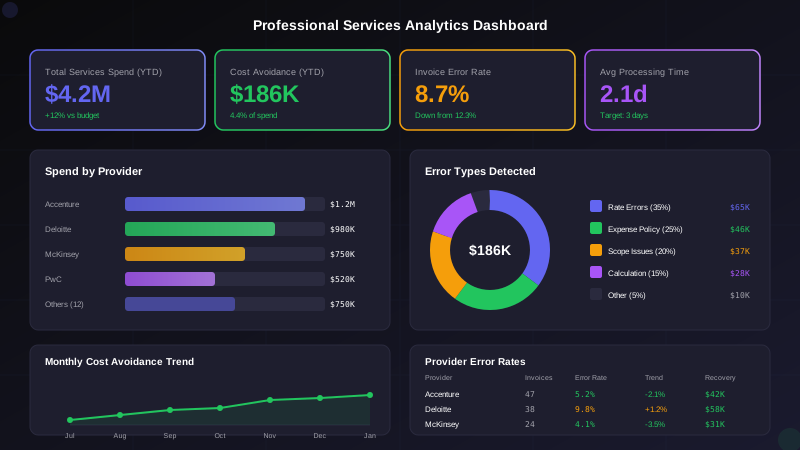
Analytics dashboards provide visibility into spend, compliance, and provider performance
Measuring Success
Track these metrics to evaluate the effectiveness of your professional services invoice verification program.
Key Performance Indicators
Error Detection Rate
Percentage of invoices with identified discrepancies
Benchmark: 8-12%
Cost Avoidance
Total value of billing corrections and prevented overpayments
Target: 3-5% of spend
Verification Coverage
Percentage of services spend with automated validation
Target: 90%+
Processing Time
Average days from receipt to validation completion
Target: 2-3 days
Beyond Cost Recovery: Strategic Benefits
While cost savings drive the initial business case, automated services invoice verification delivers broader organizational benefits:
- Provider accountability: Clear validation requirements improve provider billing discipline
- Budget predictability: Real-time tracking prevents surprise overruns
- Negotiation leverage: Data on billing patterns informs contract renewals
- Compliance assurance: Audit trails demonstrate policy enforcement
- Resource optimization: Analytics reveal staffing and utilization patterns
The Bottom Line
Professional services represent a significant and growing portion of organizational spend, yet these invoices receive less verification scrutiny than far smaller product purchases. The complexity of time-based billing, variable rates, and expense passthroughs creates fertile ground for billing errors—most of which favor the service provider.
Organizations that implement systematic verification typically identify 3-5% cost avoidance on their professional services spend in the first year, with ongoing savings as providers adjust their billing practices to match verification rigor. For an organization spending $50 million on professional services, that's $1.5-2.5 million in annual savings.
Modern automation makes comprehensive services invoice verification practical. AI-powered extraction handles diverse invoice formats, rules engines validate against contracts and policies, and workflow automation routes exceptions for resolution. The result is confidence that you're paying accurately for the professional services you actually received at the rates you actually agreed to.
Start with Your Largest Providers
You don't need to verify every professional services invoice immediately. Start by implementing validation for your top 10-20 providers by spend. These typically represent 70-80% of your professional services spend, delivering most of the savings benefit while you refine processes before broader rollout.
Ryan Shugars
Director of Product
Ryan has spent 15 years as a Systems Architect, building enterprise solutions that transform how organizations manage their financial operations.