Positive Pay Implementation: Bank-Level Fraud Prevention for Check Payments
Check fraud costs businesses over $18 billion annually. Positive pay is the single most effective control for preventing unauthorized check payments, yet many organizations still haven't implemented it.
Ryan Shugars
Director of Product
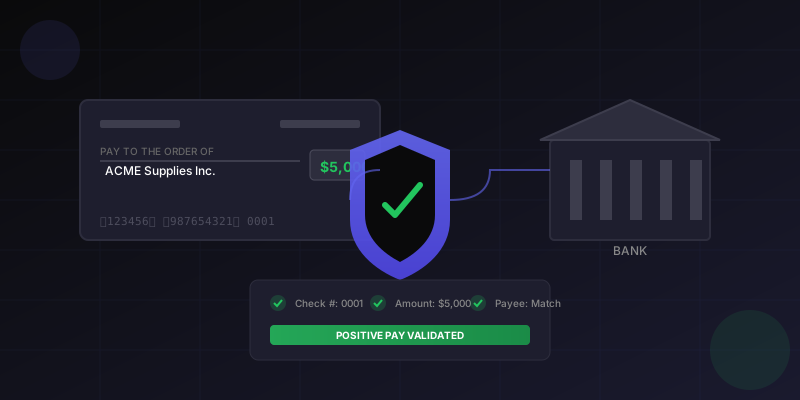
A regional manufacturing company discovered that a single fraudulent check had cost them $287,000. The check looked legitimate—correct logo, proper MICR encoding, accurate bank routing number. But the payee name had been altered, and the amount inflated. Their bank processed it without question. Positive pay would have stopped it cold.
Despite the prevalence of electronic payments, checks remain a significant payment method for businesses, particularly for large transactions, vendor relationships requiring paper trails, and industries with established check-based workflows. According to the Association for Financial Professionals, checks still represent over 40% of B2B payments by value in many sectors.
This continued reliance on checks makes organizations vulnerable to increasingly sophisticated fraud schemes. Positive pay creates a verification layer between your issued checks and your bank's processing, ensuring that only authorized payments clear your account.
Understanding How Positive Pay Works
Positive pay is a bank-offered fraud prevention service that matches presented checks against a file of issued checks provided by your organization. When a check is presented for payment, the bank compares it against your authorized issue file before processing.
The Positive Pay Validation Process
Issue File Transmission
Your AP system sends check details (number, amount, payee, date) to your bank
Check Presentation
Vendor deposits check; their bank submits it for clearing through the Federal Reserve
Automated Matching
Your bank compares presented check against issue file for exact match
Exception Handling
Mismatches generate exceptions requiring your approval or rejection decision
The key to positive pay's effectiveness is its fail-safe design. Rather than trying to identify fraudulent checks (which requires knowing what fraud looks like), it only allows checks that exactly match your authorized records. Everything else requires explicit approval.
Types of Positive Pay Services
Banks offer several variations of positive pay, each providing different levels of protection:
Standard Positive Pay
The basic service matches check number and amount against your issue file. This catches altered amounts and completely counterfeit checks but won't detect payee modifications if the check number and amount are correct.
Payee Positive Pay
The enhanced version adds payee name matching to the validation criteria. When a check is presented, the bank's optical character recognition (OCR) reads the payee line and compares it against your issued payee name. This catches payee alterations that standard positive pay misses.
Payee Matching Challenges
Payee positive pay requires exact name matching, which creates operational challenges. "John Smith LLC" won't match "John Smith, LLC" without proper configuration. Work with your bank to establish appropriate fuzzy matching rules that balance security with operational efficiency.
Reverse Positive Pay
A variation where the bank sends you a file of presented checks each day, and you identify any that shouldn't be paid. This approach requires daily attention and places the burden on your organization rather than the bank, making it less secure than standard positive pay.
ACH Positive Pay (ACH Debit Block)
While technically different from check positive pay, ACH positive pay applies similar principles to electronic debits. You provide a list of authorized ACH originators, and the bank blocks any debit attempts from unauthorized sources. This prevents fraudulent ACH debits from draining your accounts.
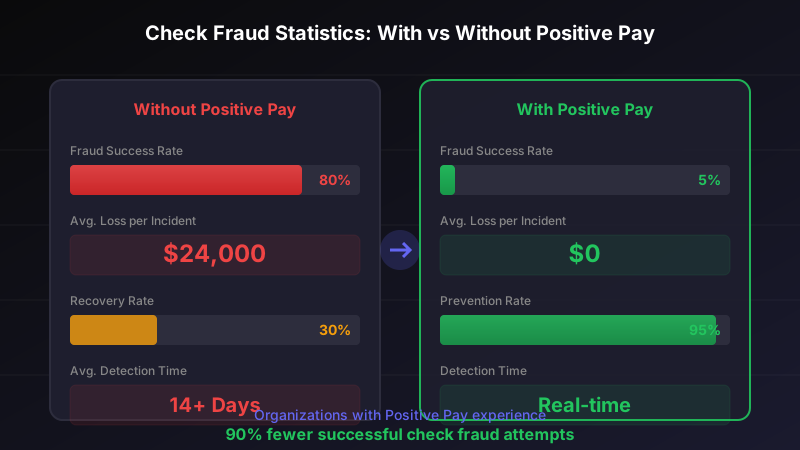
Positive pay stops over 95% of check fraud attempts when properly implemented
The True Cost of Check Fraud
Understanding check fraud's financial impact helps justify positive pay implementation costs. The losses extend far beyond the face value of fraudulent checks:
Check Fraud Cost Components
Average fraudulent check value: $24,000. Many schemes involve multiple checks.
Internal staff time, forensic accounting, legal fees average $15,000+ per incident
Bank claims processes can take 90+ days, during which funds are unavailable
Vendor relationships, customer confidence, and banking relationships suffer
The AFP's annual Payments Fraud Survey consistently shows that organizations with positive pay in place experience 90% fewer successful check fraud attempts compared to those without it. The ROI calculation becomes straightforward: positive pay's monthly cost is typically less than a single prevented fraud incident.
Implementation Best Practices
Successful positive pay implementation requires coordination between your AP department, treasury team, IT group, and banking partner. Follow these best practices to ensure smooth deployment:
1. Establish Issue File Automation
Manual issue file transmission is error-prone and creates gaps that fraudsters can exploit. Automate the transmission of check issue data to your bank immediately after check printing. Most ERP systems and AP automation platforms support direct integration with bank positive pay systems.
Key data elements to transmit include:
- Check number
- Issue date
- Check amount (exact, to the penny)
- Payee name (for payee positive pay)
- Account number
- Void status (for voided checks)
2. Configure Exception Handling Workflows
When mismatches occur, your bank generates exception reports requiring your decision. Establish clear workflows for:
- Who receives exception notifications—ensure multiple people can respond to avoid bottlenecks
- Response deadlines—banks typically require decisions by a specific cutoff time, often 10 AM to 2 PM
- Escalation procedures—define what happens if no decision is made by the deadline
- Weekend and holiday coverage—checks clear on bank holidays; plan accordingly
Default to Reject
Configure your positive pay service to automatically return exceptions as unpaid if no decision is made by the deadline. This fail-safe approach ensures that unanswered exceptions don't default to payment, which would defeat the purpose of the control.

Effective exception handling workflows ensure timely decisions on every mismatch
3. Integrate with AP Automation
Modern AP automation platforms like Remmi streamline positive pay by:
- Automatically generating and transmitting issue files upon check creation
- Surfacing exception notifications within your payment dashboard
- Providing one-click approval or rejection of exceptions
- Maintaining audit trails of all positive pay decisions
- Alerting on unusual exception patterns that may indicate systematic issues
This integration eliminates the need to log into separate bank portals, reduces response time for exceptions, and creates comprehensive records for audit purposes.
4. Handle Stale and Void Checks Properly
Two common operational challenges require specific attention:
Stale-dated checks: Checks presented after your stale date threshold (typically 90-180 days) should be rejected. Ensure your positive pay configuration includes stale date rules, and communicate your policy to vendors to avoid confusion.
Voided checks: When you void a check in your system, transmit the void to your bank immediately. This prevents a lost or stolen check from being presented and matched against the original issue record. Some systems automatically transmit voids; verify your configuration handles this correctly.
Addressing Common Implementation Challenges
Organizations often encounter predictable obstacles when implementing positive pay. Understanding these challenges helps you prepare solutions:
Challenge: Payee Name Mismatches
Payee positive pay's OCR technology reads the payee line exactly as printed. Common issues include:
- Abbreviations: "Inc." vs "Incorporated"
- Legal entity types: "LLC" vs "L.L.C."
- Special characters: "&" vs "and"
- Line wrapping affecting OCR reads
Solution: Work with your bank to establish matching rules that accommodate common variations. Standardize vendor master names and ensure check printing uses consistent formatting. Some banks offer "fuzzy matching" capabilities that allow minor variations.
Challenge: Manual Check Processes
Organizations that still issue checks outside their primary AP system (petty cash, emergency payments, executive checks) create gaps in positive pay coverage.
Solution: Establish procedures for manually adding these checks to your issue file before they're released. Better yet, route all checks through your primary system to ensure complete coverage. Emergency processes should include explicit steps for positive pay notification.
Challenge: Multi-Bank Environments
Organizations using multiple banks for disbursements must implement positive pay with each banking partner, potentially using different file formats and portals.
Solution: Use AP automation that normalizes positive pay integration across multiple banks, presenting a unified interface for issue file transmission and exception management regardless of the underlying banking relationship.
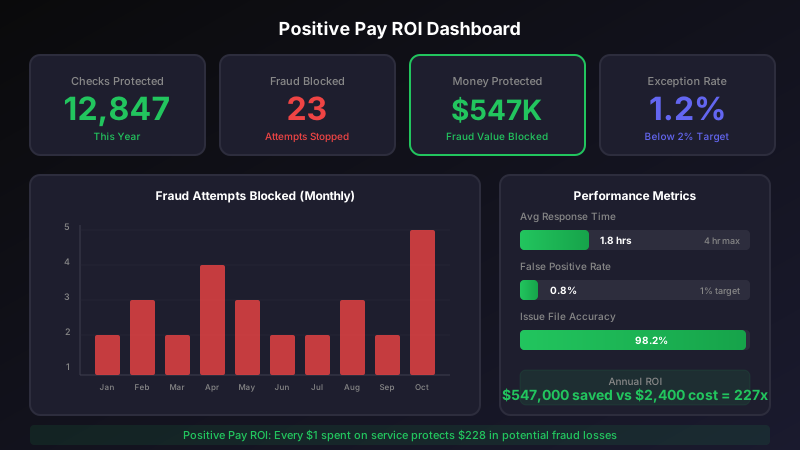
Track positive pay effectiveness through exception rates, fraud prevention, and ROI metrics
Measuring Positive Pay Effectiveness
Once implemented, monitor these metrics to ensure your positive pay program delivers expected value:
Key Positive Pay Metrics
Exception Rate
Percentage of checks generating exceptions
Fraud Attempts Blocked
Confirmed fraudulent checks rejected
Response Time
Average time to resolve exceptions
False Positive Rate
Legitimate checks flagged incorrectly
High exception rates indicate process issues—perhaps issue files aren't transmitting properly, or payee names have matching problems. Investigate patterns in exceptions to identify and address root causes.
Beyond Positive Pay: Comprehensive Check Security
While positive pay is essential, it works best as part of a layered security approach:
- Check stock security: Use security features like watermarks, microprinting, and chemical-reactive paper that make counterfeiting more difficult
- MICR verification: Ensure your printed MICR line meets bank specifications and reads consistently
- Signature controls: Implement dual signatures for high-value checks and secure signature plates or digital signatures
- Vendor verification: Validate vendor banking information before issuing initial payments to prevent misdirection fraud
- Account reconciliation: Perform timely bank reconciliations to detect any anomalies that slip through other controls
Each layer addresses different attack vectors. Positive pay catches fraudulent presentments, but won't help if a fraudster redirects a legitimate check through vendor master manipulation. Defense in depth protects against multiple fraud scenarios.
The Future of Check Security
As payment technology evolves, positive pay is integrating with broader fraud prevention capabilities. Modern platforms combine positive pay with AI-powered anomaly detection, real-time payment monitoring, and automated vendor verification to create comprehensive payment security.
These integrated approaches identify suspicious patterns across all payment types, correlating check activity with ACH, wire, and card payments to detect coordinated fraud attempts that single-channel monitoring might miss.
Getting Started
If you haven't implemented positive pay, start by contacting your primary banking partner. Most banks offer positive pay as a standard treasury management service, often at modest monthly fees that pale in comparison to a single fraud incident.
For organizations already using positive pay, evaluate your current implementation against these best practices. Are you using payee positive pay? Is issue file transmission automated? Do your exception workflows ensure timely response? Optimizing your existing program may provide significant additional protection.
Check fraud isn't going away—criminals continue targeting organizations with inadequate controls. Positive pay represents one of the most effective, straightforward protections available. Organizations that implement it properly sleep better knowing their check payments are protected by bank-level validation.
Ryan Shugars
Director of Product
Ryan has spent 15 years as a Systems Architect, building enterprise solutions that transform how organizations manage their financial operations.