Manufacturing AP: Integrating Invoice Processing with Inventory and Production
Manufacturing companies face unique AP challenges that generic automation cannot solve. When invoices must reconcile with goods receipts, production schedules, and complex cost accounting requirements, integration becomes everything. Here's how to build an AP process that keeps pace with your production floor.
Ryan Shugars
Director of Product
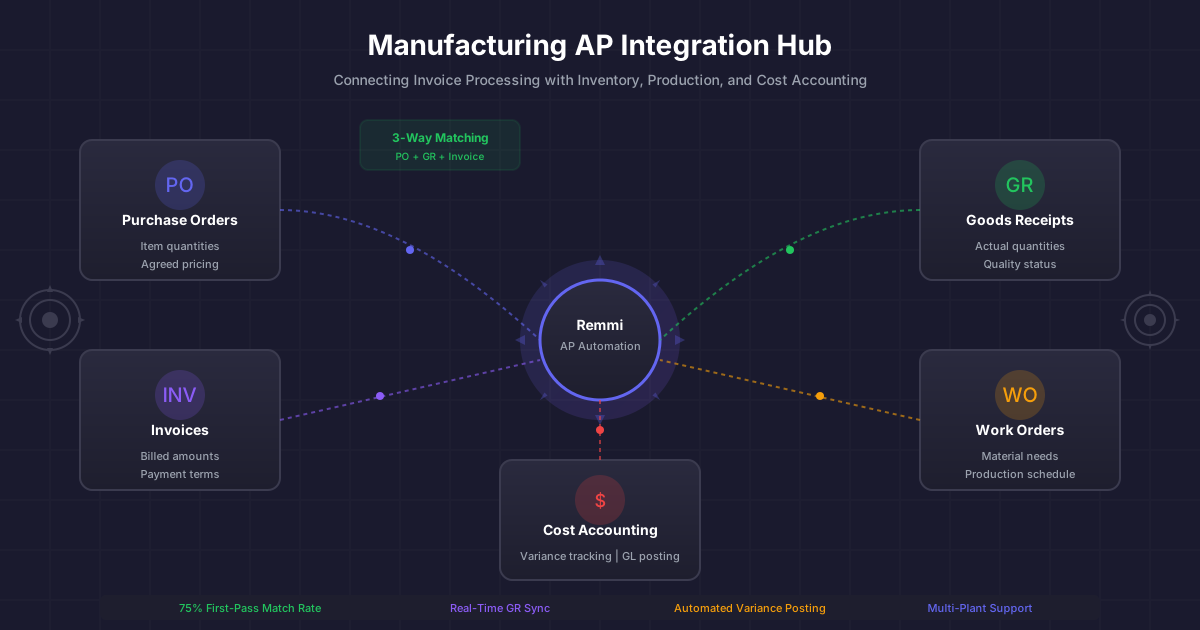
In manufacturing, accounts payable is not just about paying bills. It is the financial nervous system that connects procurement, receiving, production, and cost accounting into a coherent whole. When this system works well, materials flow smoothly, production costs are accurate, and vendor relationships thrive. When it breaks down, the consequences ripple through every aspect of operations.
According to the Institute of Finance and Management, manufacturing companies process an average of 35% more invoices per AP staff member than service industries, while dealing with significantly higher complexity. Raw material invoices require matching to goods receipts. Production services must align with work orders. Equipment purchases need asset tracking integration. The challenge is not volume alone but the intricate web of dependencies that each invoice represents.
The Manufacturing AP Challenge: Why Generic Automation Falls Short
Standard AP automation tools are built for straightforward purchase-to-pay workflows: a purchase order is issued, goods are received, an invoice arrives, and payment is made. This linear model breaks down in manufacturing environments where reality is far more complex.
Manufacturing AP Complexity Factors
Materials often arrive in multiple shipments against a single PO, requiring invoice matching across multiple goods receipts
Invoices may arrive before quality inspection is complete, creating timing mismatches
Commodity pricing fluctuations create legitimate differences between PO and invoice amounts
Decentralized receiving across plants and warehouses complicates goods receipt consolidation
These complexities mean that manufacturing AP teams spend disproportionate time on exception handling. Industry benchmarks show that 38% of manufacturing invoices require some form of manual intervention, compared to 23% for service industries. Each exception represents not just processing cost but potential production delays if materials cannot be released from receiving.
The Integration Imperative: Connecting AP to Operations
Effective manufacturing AP requires deep integration with three core operational systems: inventory management, production scheduling, and cost accounting. When these connections work seamlessly, invoices flow through processing with minimal friction. When they are broken or incomplete, AP becomes a bottleneck that affects the entire operation.
1. Inventory Management Integration
The foundation of manufacturing AP is the three-way match: purchase order, goods receipt, and invoice. In theory, this is straightforward. In practice, manufacturing creates endless variations that challenge simple matching logic.
Consider a typical scenario: a manufacturer orders 10,000 units of a component with delivery split across four weekly shipments. The first shipment arrives with 2,400 units instead of 2,500 due to supplier capacity constraints. The second shipment includes 2,600 units to make up the difference. Quality inspection rejects 50 units from the first shipment. The supplier issues a credit memo. Meanwhile, invoices arrive for each shipment based on quantities shipped, not quantities accepted.
- Real-time goods receipt visibility: AP must see receiving activity as it happens, not in nightly batch updates
- Quality status integration: Invoices should not process until materials pass inspection
- Quantity reconciliation: Automatic matching must handle partial receipts and returns
- Unit of measure conversion: POs may be in cases while receipts are in units
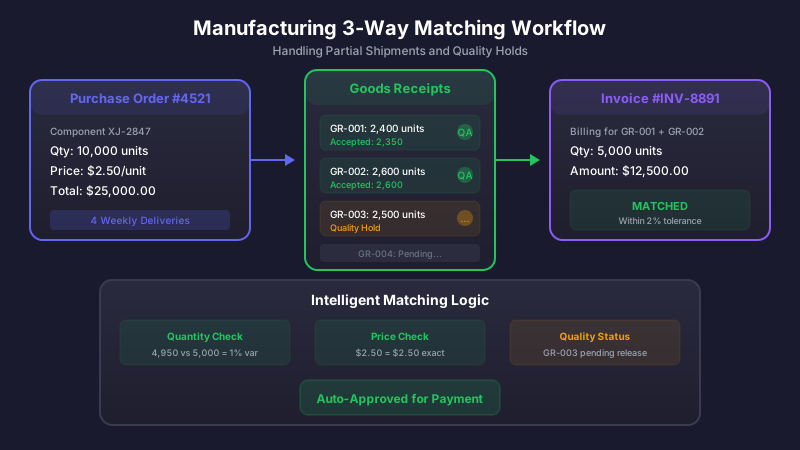
Manufacturing three-way matching requires handling partial shipments, quality holds, and quantity variances
2. Production Schedule Integration
In manufacturing, invoice timing matters. A delayed payment might not just damage a vendor relationship; it could stop a production line. When AP understands production schedules, it can prioritize processing for materials needed on the floor.
Production schedule integration enables:
- Priority-based processing: Invoices for critical materials move to the front of the queue
- Expedited approvals: Rush materials trigger accelerated approval workflows
- Receiving alerts: AP knows when expected materials have not arrived, enabling proactive supplier follow-up
- Payment timing optimization: Align payment runs with production cash flow requirements
Production-AP Synchronization
When AP systems integrate with production scheduling, invoice processing aligns with operational priorities. Materials needed for tomorrow's production run get approved before routine supplies, and payment timing supports vendor relationships without disrupting cash flow.
3. Cost Accounting Integration
Manufacturing cost accounting is notoriously complex. Raw materials must flow to work-in-process, then to finished goods, with proper allocation of direct and overhead costs. Every invoice touches this equation, and errors in AP translate directly to errors in product costing.
Critical cost accounting integrations include:
- Standard cost variance tracking: Capture purchase price variances at invoice entry
- Work order charging: Direct materials to specific jobs or production runs
- Overhead allocation: Apply indirect costs based on configured rates
- Period-end accruals: Automatically accrue for received-not-invoiced materials
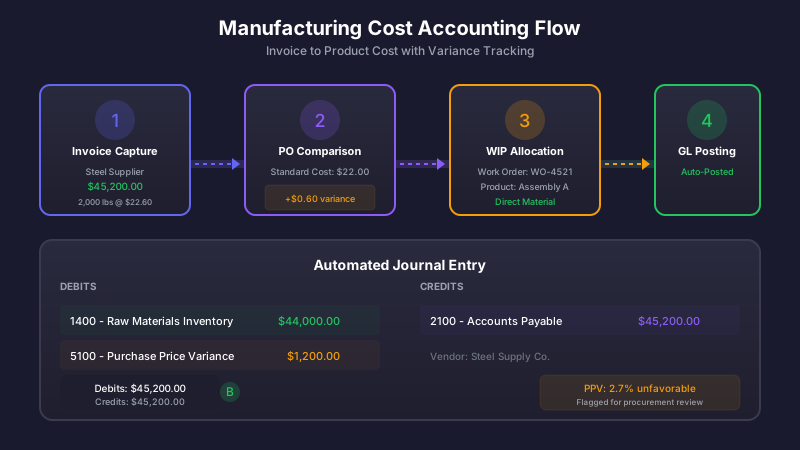
Manufacturing cost accounting requires precise invoice-to-production-order linking for accurate product costing
Building an Integrated Manufacturing AP Process
Transforming manufacturing AP from an isolated back-office function to an integrated operational capability requires rethinking process design from the ground up. The goal is not just faster invoice processing but seamless information flow across the organization.
Step 1: Map the Current State
Before implementing changes, document how invoices currently flow through your organization. For each invoice type, trace the path from receipt to payment, identifying:
- Which systems are touched and in what order
- Where data is re-entered or transformed
- What exceptions occur and how they are resolved
- Which approvals are required and by whom
- How long each step takes on average
This exercise typically reveals disconnects that have been papered over with manual processes. A common finding: goods receipt data exists in the ERP but is not visible to AP, forcing staff to email receiving for confirmation on every invoice.
Step 2: Define Integration Requirements
With the current state mapped, define what data must flow between systems and with what timing. Manufacturing AP typically requires integration with:
Core Integration Requirements
ERP System
Purchase orders, goods receipts, vendor master
Real-time sync
Inventory Management
Receipt status, quality holds, location data
Real-time sync
Production Planning
Work orders, material requirements, schedules
Near real-time
General Ledger
Account codes, cost centers, posting rules
Batch OK
Step 3: Implement Intelligent Matching
Manufacturing invoice matching cannot rely on simple exact-match logic. Intelligent matching must handle the realities of manufacturing operations:
- Tolerance-based matching: Accept quantity variances within configured thresholds by material type
- Price escalation handling: Automatically accept documented price increases for commodities
- Multi-receipt consolidation: Match single invoices to multiple goods receipts
- Partial invoice processing: Process matched lines while routing exceptions for review
- Retroactive matching: Re-evaluate invoices when delayed goods receipts arrive
Common Matching Pitfall
Many manufacturers set matching tolerances too tight, creating excessive exceptions, or too loose, allowing errors through. The solution is tolerance by material category: commodity materials may accept 3-5% variance while precision components require exact match.
Step 4: Automate Exception Resolution
Exceptions are inevitable in manufacturing AP. The goal is not to eliminate them but to resolve them efficiently. AI-powered systems can now handle many exceptions that previously required human judgment:
- Quantity discrepancy investigation: Check for pending goods receipts, returns in process, or short-ship documentation
- Price variance research: Verify against price agreements, commodity indices, or documented changes
- Missing PO resolution: Match to blanket orders, contracts, or suggest appropriate coding
- Duplicate detection: Identify potential duplicates across partial invoices and credit memos
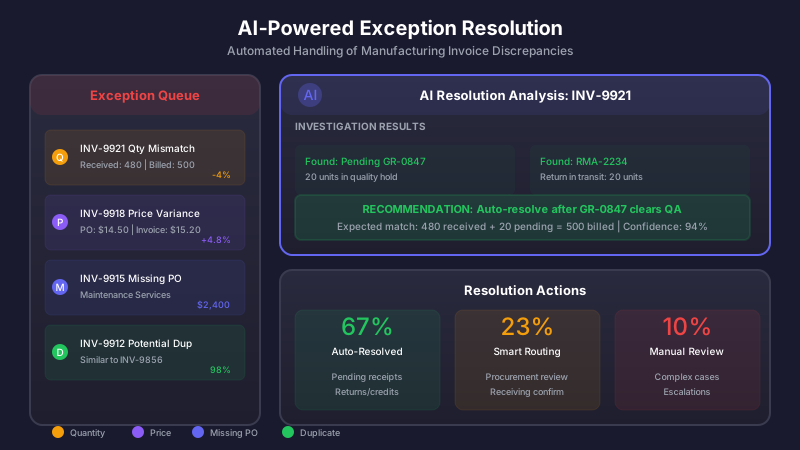
AI-powered exception handling resolves common manufacturing discrepancies automatically
Measuring Manufacturing AP Performance
Traditional AP metrics like cost per invoice and days payable outstanding remain important, but manufacturing environments require additional measures that reflect operational integration:
Manufacturing AP KPIs
First-Pass Match Rate
Invoices matched without exception
Target: > 75% for manufacturing
Receipt-to-Match Time
Hours from goods receipt to invoice match
Target: < 24 hours
Production Hold Rate
Invoices delaying material release
Target: < 1%
Variance Capture Accuracy
Price variances properly recorded
Target: 100%
Accrual Accuracy
Period-end GRNI accuracy
Target: > 98%
Exception Resolution Time
Average time to clear exceptions
Target: < 48 hours
Technology Considerations for Manufacturing AP
Selecting AP automation technology for manufacturing requires evaluating capabilities that may not matter in simpler environments:
- Multi-plant support: Can the system handle decentralized receiving with centralized AP?
- ERP integration depth: Does it read goods receipts in real-time or batch?
- Matching flexibility: Can tolerance rules be configured by vendor, material, or commodity class?
- Variance posting: Does it create proper accounting entries for price and quantity variances?
- Quality hold awareness: Can invoices hold pending quality release?
- Unit of measure handling: Does it convert between PO, receipt, and invoice units?
Integration Architecture Matters
The most sophisticated AP automation is useless if it cannot connect to your ERP. Prioritize solutions with pre-built connectors for your specific ERP platform and real-time API capabilities rather than file-based batch integration.
Implementation Roadmap
Transforming manufacturing AP is a journey, not a project. A phased approach reduces risk and builds organizational capability progressively:
Phase 1: Foundation (Months 1-3)
- - Implement invoice capture and data extraction
- - Establish ERP integration for PO and vendor data
- - Enable basic two-way matching for non-inventory invoices
- - Deploy approval workflows
Phase 2: Inventory Integration (Months 4-6)
- - Connect goods receipt data in real-time
- - Implement three-way matching with tolerances
- - Add quality hold awareness
- - Deploy multi-receipt matching logic
Phase 3: Cost Accounting (Months 7-9)
- - Implement variance capture and posting
- - Enable work order charging
- - Automate period-end accruals
- - Deploy cost analysis reporting
The Bottom Line
Manufacturing AP is fundamentally different from general-purpose invoice processing. The integration requirements are deeper, the matching logic more complex, and the stakes higher when invoice processing affects production flow.
Organizations that treat manufacturing AP as a specialized function, investing in proper system integration and manufacturing-aware automation, achieve dramatic improvements in efficiency and accuracy. Those that try to force-fit generic solutions spend more time on workarounds than on value-added activities.
The path forward requires understanding your specific manufacturing processes, mapping the integration requirements, and selecting technology that can handle manufacturing complexity without requiring excessive customization. The investment pays dividends in reduced processing costs, faster material availability, and more accurate product costing.
Modern AI-native AP automation, purpose-built for complex environments, makes manufacturing-grade invoice processing accessible to organizations of all sizes. The question is not whether to automate but how to automate in a way that serves your operational reality.
Ryan Shugars
Director of Product
Ryan has spent 15 years as a Systems Architect, building enterprise solutions that transform how organizations manage their financial operations.