Machine Learning for Invoice Coding: How AI Learns Your GL Structure
Invoice coding is one of the most time-consuming tasks in accounts payable. Machine learning models can now learn from your historical coding patterns to automate GL account assignment with accuracy rates exceeding 95%.
Ryan Shugars
Director of Product
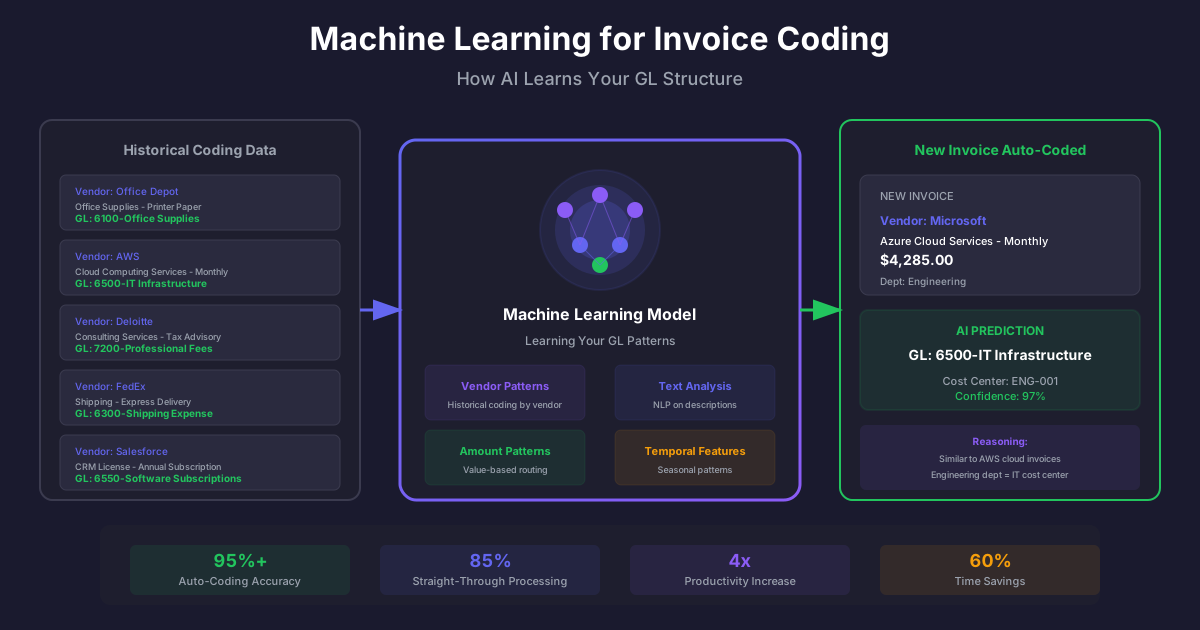
A mid-sized manufacturing company processes 15,000 invoices monthly. Each invoice requires coding to the correct GL accounts—a task that takes their AP team an average of 4 minutes per invoice. That's 1,000 hours of manual coding every month, with error rates hovering around 8% due to the complexity of their chart of accounts.
After implementing machine learning-based invoice coding, their accuracy improved to 97%, and the time spent on manual coding dropped by 85%. The AI learned their specific coding patterns—which vendors typically code to which accounts, how line item descriptions map to expense categories, and when to split invoices across multiple cost centers.
This transformation represents a fundamental shift in how organizations approach invoice processing. Rather than relying on rigid rules or time-consuming manual decisions, machine learning models adapt to your unique GL structure and coding conventions, becoming more accurate over time as they process more invoices.
The Invoice Coding Challenge
Invoice coding sounds simple: assign the right GL account to each line item. In practice, it's one of the most error-prone and time-intensive steps in the AP process. Here's why:
Why Invoice Coding Is So Complex
Enterprise organizations may have 500+ active GL accounts, making correct selection challenging
Modern ERP systems require account, cost center, department, project, and segment assignments
The same product may code differently based on department, project, or time of year
Month-end invoice surges leave little time for careful consideration of each coding decision
Traditional automation approaches rely on rule-based systems: if vendor X, then use account Y. These rules work for straightforward cases but fail when encountering new vendors, unusual line items, or context-dependent coding requirements. The result is high exception rates and continued manual intervention.
How Machine Learning Approaches Invoice Coding
Machine learning takes a fundamentally different approach. Instead of being programmed with explicit rules, ML models learn patterns from your historical coding decisions. They analyze thousands of previously coded invoices to understand how your organization makes coding choices.
Learning From Historical Data
The foundation of ML-based invoice coding is your existing data. Every invoice your team has ever coded contains valuable information about your coding conventions. The model examines:
- Vendor-to-account relationships—which accounts are typically used for specific vendors
- Line item text patterns—how descriptions like "consulting services" or "office supplies" map to accounts
- Amount-based routing—whether high-value items receive different treatment than routine purchases
- Temporal patterns—seasonal variations in coding, such as year-end adjustments or project-specific allocations
- User-specific tendencies—how different AP staff members approach similar coding decisions
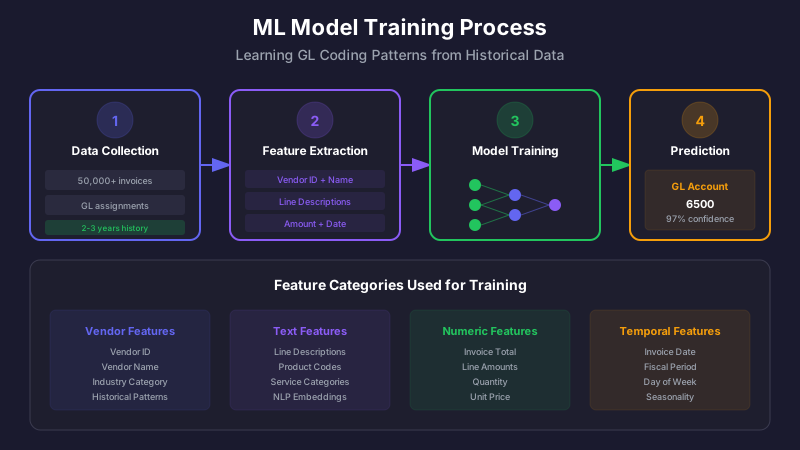
ML models learn from historical coding patterns to predict the correct GL accounts
Feature Engineering for Invoices
Machine learning models don't read invoices the way humans do. They analyze invoices through "features"—quantifiable attributes that capture relevant information. Effective invoice coding models use features like:
Key Features for Invoice Coding Models
Modern ML models extract and analyze multiple feature categories:
Natural language processing (NLP) techniques transform text descriptions into numerical representations the model can analyze. For example, "IT consulting services - monthly retainer" might be converted into vectors that capture both the service category (IT, consulting) and the billing type (retainer, monthly).
Model Architecture and Training
Invoice coding typically employs classification models—algorithms that predict which category (GL account) an invoice belongs to. Common approaches include:
- Gradient boosting models like XGBoost or LightGBM, which excel at handling structured data with mixed feature types
- Neural networks that can learn complex non-linear relationships between invoice features and account assignments
- Ensemble methods that combine multiple models to improve accuracy and reduce variance
Training involves feeding the model historical invoice-account pairs and optimizing its parameters to minimize prediction errors. The model learns which feature combinations predict each GL account, creating a sophisticated mapping that goes far beyond simple vendor-to-account rules.
The Continuous Learning Advantage
Unlike static rule-based systems, ML models improve over time. Every invoice your team codes provides new training data. This continuous learning creates a virtuous cycle:
The Continuous Improvement Cycle
Model Makes Prediction
AI suggests GL account with confidence score
Human Reviews and Corrects
AP staff confirms or adjusts the suggestion
Feedback Updates Model
Corrections become training data for model improvement
Accuracy Improves Over Time
Model learns from patterns, reducing future exceptions
This feedback loop means the system gets smarter the more you use it. New vendors, changed account structures, and evolving business needs are incorporated automatically as your team processes invoices. The model adapts without requiring IT involvement or rule maintenance.
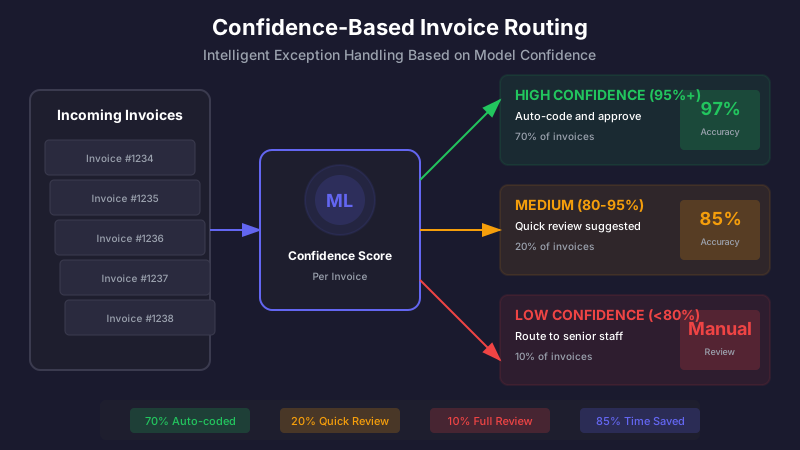
Confidence scores help route invoices for automatic processing or human review
Handling Multi-Dimensional Coding
Modern ERP systems often require coding beyond just the GL account. A single invoice might need assignment to:
- GL account (expense category)
- Cost center (organizational unit)
- Department (functional area)
- Project code (for project-based accounting)
- Product line or segment (for profitability analysis)
- Tax code (for compliance)
ML models can predict these dimensions simultaneously using multi-output classification or hierarchical models that understand the relationships between dimensions. For example, certain cost centers may only use specific accounts, and the model learns these constraints from historical data.
Confidence Scores and Exception Handling
One of the most valuable aspects of ML-based coding is confidence scoring. Rather than making binary right/wrong decisions, the model provides a probability for each prediction. This enables intelligent routing:
- High confidence (95%+): Auto-code and move to approval
- Medium confidence (80-95%): Suggest coding with quick-review option
- Low confidence (<80%): Route to experienced staff for manual coding
This tiered approach maximizes automation while ensuring human oversight for uncertain cases. Organizations typically see 70-85% of invoices auto-coded, with the remainder receiving efficient assisted coding.
Implementation Considerations
Deploying ML-based invoice coding requires thoughtful implementation to maximize accuracy and user adoption:
Data Quality Requirements
The model is only as good as its training data. Before implementation, assess your historical coding quality:
- Consistency: Do similar invoices receive consistent coding?
- Completeness: Are all required fields populated?
- Accuracy: What percentage of historical coding is correct?
- Volume: Do you have enough examples for each account?
Organizations with poor historical data quality may need a cleanup phase before ML implementation, or start with rule-based suggestions while building a quality training dataset.
Change Management
AP staff may initially distrust AI-generated coding suggestions. Successful implementation requires:
- Transparency about how the model makes decisions
- Easy override mechanisms that don't slow down workflows
- Visible accuracy metrics that build confidence over time
- Recognition that staff expertise improves the model
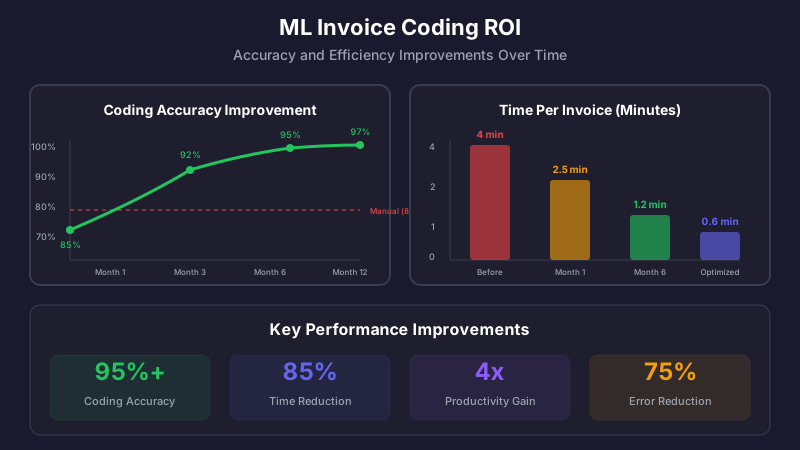
Organizations typically see significant accuracy and efficiency improvements within months
Measuring Success
Track these metrics to quantify the value of ML-based invoice coding:
Key Performance Indicators
95%+
Target Accuracy Rate
Percentage of correct auto-codes
70-85%
Straight-Through Rate
Invoices coded without manual intervention
4x
Productivity Improvement
Invoices processed per hour
60%
Time Reduction
In overall coding effort
Beyond Efficiency: Strategic Benefits
While time savings are the most visible benefit, ML-based coding provides strategic advantages:
- Improved data quality: Consistent coding enables better spend analytics and financial reporting
- Faster close: Reduced coding time accelerates month-end processing
- Reduced audit risk: Systematic, documented coding decisions support audit defense
- Scalability: Handle volume increases without proportional staff growth
- Knowledge preservation: Coding expertise is embedded in the model, not just in staff memory
The Knowledge Transfer Benefit
When experienced AP staff retire or leave, their coding knowledge typically walks out the door with them. ML models capture this institutional knowledge, learning the subtle patterns that veteran employees apply intuitively. This creates organizational resilience and easier onboarding for new staff.
The Future of Invoice Coding
Machine learning for invoice coding continues to evolve. Emerging capabilities include:
- Large language models: GPT-style models that understand invoice content with human-like comprehension
- Cross-organization learning: Models trained on anonymized data from multiple organizations, providing industry-specific coding intelligence
- Predictive coding: Suggesting account structure updates based on changing spend patterns
- Anomaly detection: Identifying unusual coding that may indicate errors or fraud
Getting Started
Implementing ML-based invoice coding doesn't require data science expertise. Modern AP automation platforms provide pre-built models that learn from your data without requiring custom development. The key steps are:
- Assess data quality: Review historical coding consistency and accuracy
- Define success metrics: Set baseline measurements for accuracy, processing time, and exception rates
- Start with high-volume vendors: Begin automation where you'll see the fastest impact
- Monitor and tune: Track performance and provide feedback to improve the model
- Expand gradually: Roll out to additional invoice types as confidence builds
The Bottom Line
Invoice coding has long been a necessary but tedious bottleneck in AP operations. Machine learning transforms this manual, error-prone task into an intelligent, self-improving process. By learning from your historical patterns and continuously adapting to changes, ML-based coding delivers higher accuracy with dramatically reduced effort.
For AP teams spending hours on coding decisions, the question isn't whether to adopt ML-based coding—it's how quickly they can implement it to reclaim that time for higher-value work.
Ryan Shugars
Director of Product
Ryan has spent 15 years as a Systems Architect, building enterprise solutions that transform how organizations manage their financial operations.