The Hidden Cost of Manual Invoice Processing: Why AP Automation Pays for Itself in 90 Days
When finance leaders calculate the cost of invoice processing, they typically count labor hours. But the real cost includes errors, late payment penalties, missed early payment discounts, and the opportunity cost of talented staff doing data entry. Here is the complete picture, and why automation ROI is faster than you think.
Ryan Shugars
Director of Product
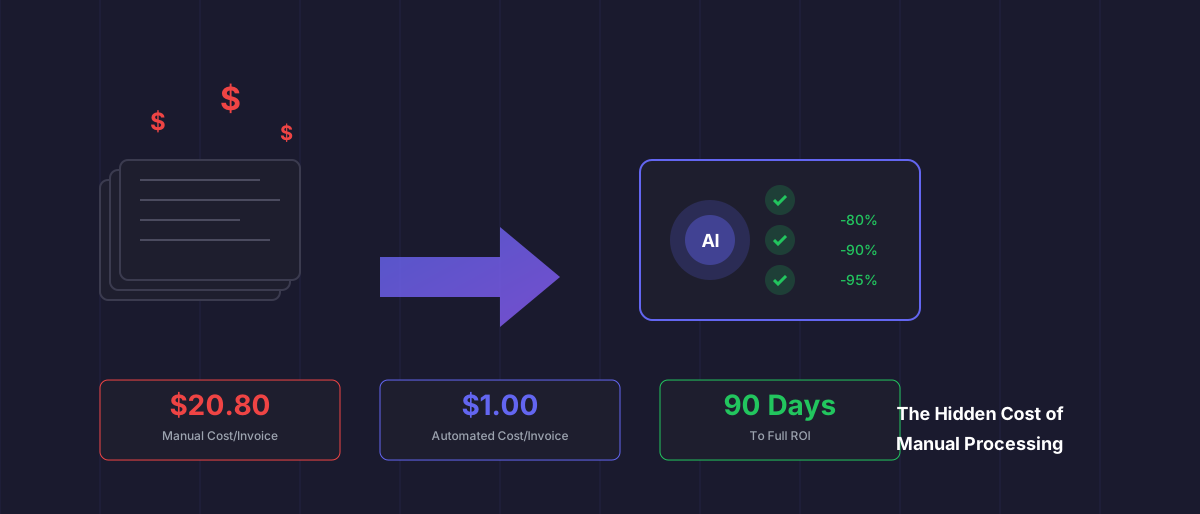
If you asked ten CFOs what it costs to process a single invoice, you would get ten different answers, most of them dramatically underestimated. The standard industry calculation focuses on labor: take the AP clerk's hourly rate, multiply by time spent, and divide by invoices processed. This gives you a number somewhere between $5-10 per invoice.
But this calculation is fundamentally flawed. It ignores the cascading costs that ripple through your organization every time an invoice touches a human hand. When you account for these hidden costs, the true figure ranges from $15-40 per invoice, depending on your industry and invoice complexity.
The True Cost Breakdown: What You Are Actually Paying
Let us dissect the real cost of processing an invoice manually. The numbers that follow are drawn from APQC benchmarking data, Ardent Partners research, and our analysis of over 500,000 invoices processed through Remmi.
Manual Invoice Processing: The Real Cost Per Invoice
These numbers represent median performance. Organizations with complex approval workflows, multi-entity structures, or high exception rates often see costs exceeding $35 per invoice. And we have not even discussed the most insidious cost of all: the opportunity cost of your finance team's potential.
The Five Hidden Cost Categories Most Companies Miss
1. The Exception Handling Tax
Industry data shows that 23% of invoices require some form of exception handling. These are not the invoices that flow smoothly through your system; they are the ones that get stuck in someone's inbox, waiting for clarification, approval, or correction.
Each exception takes an average of 15 additional minutes to resolve. When you factor in the back-and-forth emails, the time spent tracking down the right approver, and the cognitive cost of context-switching, exceptions become one of the most expensive aspects of invoice processing.

Exception handling workflow: each touchpoint adds time and cost
2. The Error Correction Cycle
Manual data entry has an inherent error rate of 1-3%, depending on invoice complexity. This might seem small until you calculate the downstream impact:
- Duplicate payments: Average recovery time is 45 days, and 10-15% are never recovered
- Wrong amounts: Each requires vendor communication and potential credit memo processing
- Incorrect GL coding: Creates month-end reconciliation nightmares and audit findings
- Tax calculation errors: Risk of compliance issues and penalties
The Association of Certified Fraud Examiners found that organizations lose an average of 5% of annual revenue to fraud and error combined. While not all of this is AP-related, invoice processing errors are a significant contributor.
3. The Late Payment Penalty Problem
When invoices pile up waiting for manual processing, payment deadlines slip. The average organization pays 12% of invoices late, incurring late fees that typically range from 1.5-3% of the invoice amount per month.
But the direct penalty is just the beginning. Late payments damage vendor relationships, eliminate early payment discount opportunities, and can impact your organization's credit terms over time.
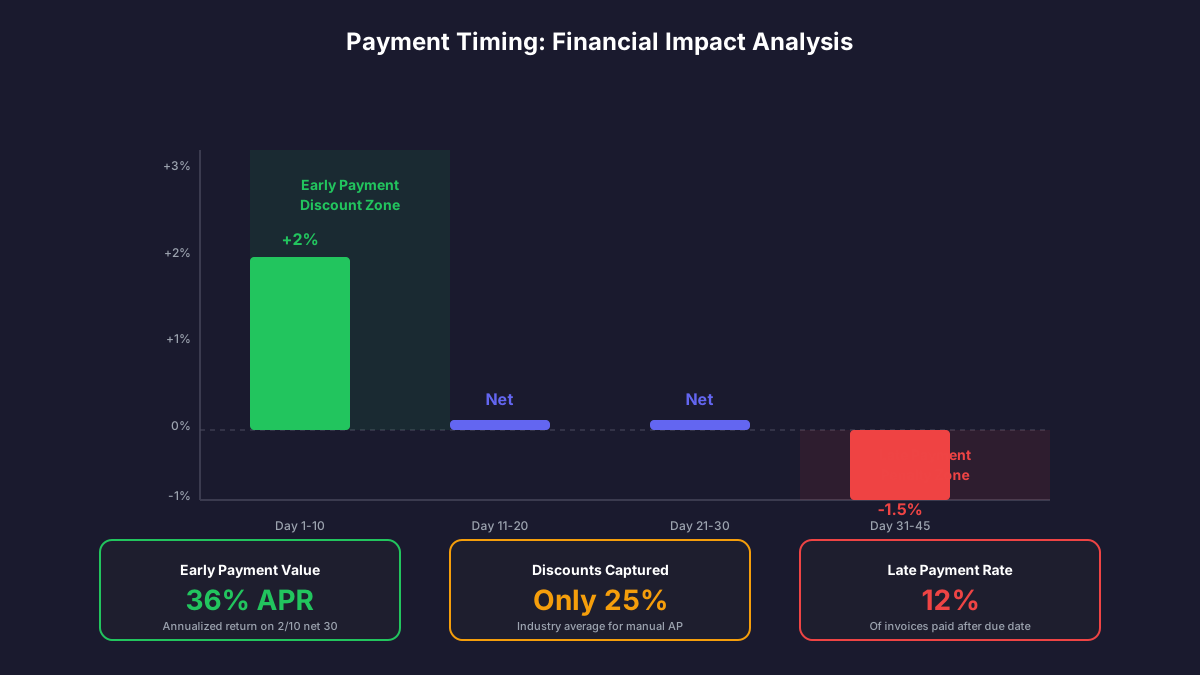
Payment timing directly impacts your bottom line: early discounts vs. late penalties
4. The Discount Opportunity You Are Leaving on the Table
Many vendors offer early payment discounts: 2/10 net 30 is common (2% discount for payment within 10 days). On a $10,000 invoice, that is $200 saved. Annualized, taking early payment discounts consistently can yield a 36% return on the money deployed.
Yet most organizations capture only 20-30% of available early payment discounts. Why? Because manual processing simply cannot move fast enough. By the time an invoice is received, entered, coded, matched, and approved, the discount window has closed.
5. The Opportunity Cost of Your Team
Your AP team did not join your organization to do data entry. They have skills in financial analysis, vendor management, and strategic thinking. Every hour spent keying invoice data is an hour not spent on:
- Analyzing spending patterns to negotiate better terms
- Building strategic vendor relationships
- Supporting business units with financial insights
- Identifying cost reduction opportunities
- Contributing to month-end close and audit preparation
The Real Question
What could your finance team accomplish if they spent 80% less time on invoice processing? The organizations we work with consistently report that freed-up capacity is the most valuable benefit of automation, even more than direct cost savings.
The 90-Day ROI Reality: How Automation Pays for Itself
Here is the calculation that changed how we think about AP automation ROI. For a mid-market organization processing 2,000 invoices per month:
90-Day ROI Calculation: 2,000 Invoices/Month
Before Automation (Monthly)
After Automation (Monthly)
Monthly Savings: $39,400
ROI achieved in less than 30 days with typical implementation
This calculation is conservative. It does not include the value of improved vendor relationships, better audit outcomes, or the strategic work your team can now accomplish. Most organizations report additional soft benefits worth 2-3x the direct cost savings.
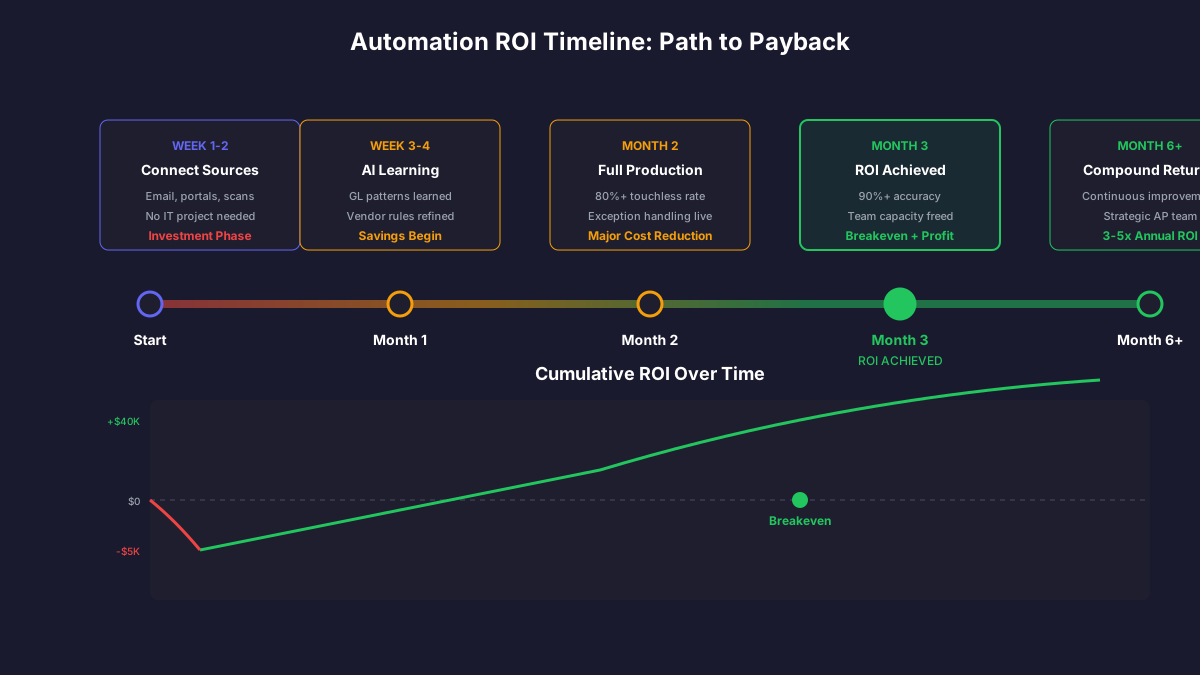
Typical ROI timeline: most organizations see positive returns within 90 days
Why Traditional AP Software Failed (And What Is Different Now)
If you have been in finance for more than a decade, you may be skeptical. Previous generations of AP automation promised similar results but delivered clunky interfaces, rigid workflows, and accuracy rates that still required extensive manual review.
The difference today is AI-native design. Modern systems like Remmi are built from the ground up with machine learning at the core, not bolted onto legacy architectures. This enables:
- 98%+ capture accuracy across any invoice format
- Intelligent GL coding that learns from your historical patterns
- Automatic 2-way and 3-way matching with line-level variance detection
- Real-time fraud detection using six complementary AI methods
- Transparent confidence scores so you know exactly what needs review
The Cost of Waiting
Every month you delay automation is another month of overpaying for invoice processing. For the example organization above, that is $39,400 in preventable costs, every single month. Over a year, that is $472,800 in potential savings left on the table.
Getting Started: The Path to 90-Day ROI
The fastest path to automation ROI follows a proven sequence:
- Week 1-2: Connect your invoice sources (email, portal, scan). No IT project required.
- Week 3-4: AI learns your GL coding patterns from historical data. You review and refine.
- Month 2: Full production processing. Handle exceptions as they arise.
- Month 3: Optimization. AI accuracy improves, exception rates drop, team capacity freed.
By the end of month three, most organizations are processing 80%+ of invoices with no human touch beyond approval, and the automation has paid for itself several times over.
The Bottom Line
Manual invoice processing is not just inefficient, it is actively costing your organization money every single day. The hidden costs of errors, exceptions, penalties, and missed discounts compound over time, while your talented finance team remains trapped in data entry work.
Modern AI-native automation eliminates these hidden costs while freeing your team to focus on strategic work. The ROI is not measured in years or even quarters. For most organizations, it is measured in weeks.
The question is not whether you can afford to automate. It is whether you can afford not to.
Ryan Shugars
Director of Product
Ryan has spent 15 years as a Systems Architect, building enterprise solutions that transform how organizations manage their financial operations.