Government Contractor AP: DCAA Compliance, Cost Accounting, and Audit Readiness
Government contractors operate under some of the most demanding financial oversight in any industry. From Defense Contract Audit Agency (DCAA) scrutiny to Federal Acquisition Regulation (FAR) requirements, every invoice, every cost allocation, and every payment must withstand rigorous audit examination. Here's your comprehensive guide to building AP processes that satisfy government contract requirements.
Ryan Shugars
Director of Product
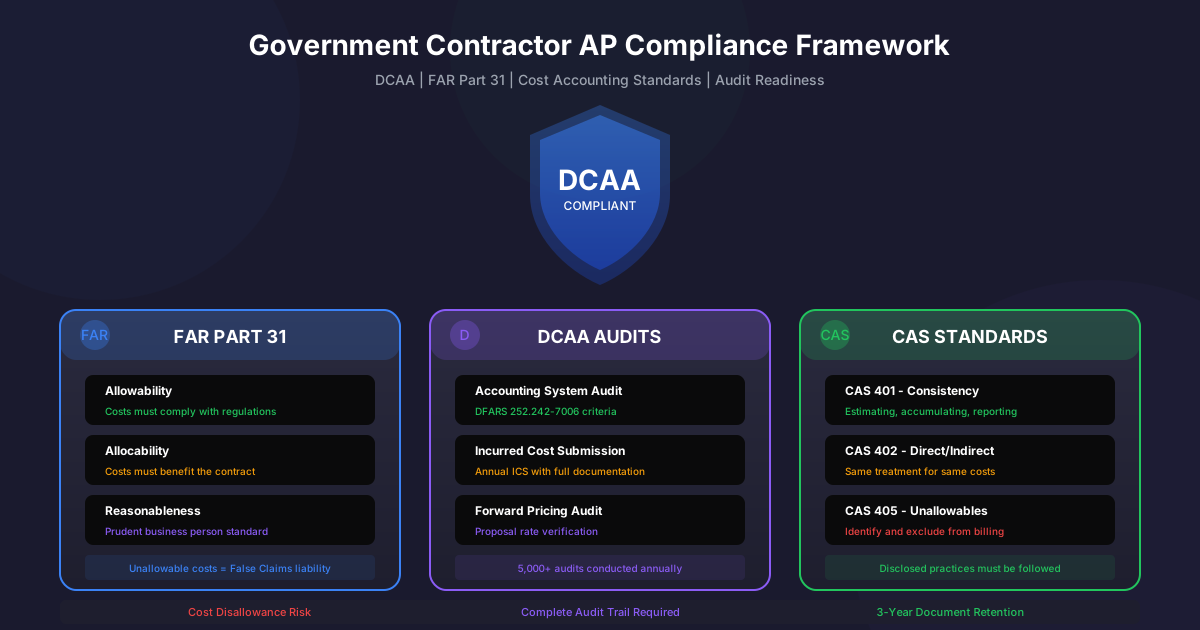
For government contractors, accounts payable is not just a financial function—it is a compliance function. The Defense Contract Audit Agency conducts over 5,000 audits annually, examining contractor accounting systems, cost claims, and supporting documentation. Contractors with inadequate AP processes face cost disallowances, contract terminations, and in severe cases, suspension or debarment from future government work.
The complexity begins with the requirement to maintain an accounting system that satisfies multiple regulatory frameworks simultaneously. The Federal Acquisition Regulation (FAR), Cost Accounting Standards (CAS), and DCAA-specific requirements create overlapping obligations that demand precision in how every dollar is tracked, allocated, and documented. Your AP processes must be built from the ground up to satisfy these requirements.
Understanding the Government Contractor Compliance Landscape
Government contract accounting differs fundamentally from commercial accounting. While commercial AP focuses on paying vendors accurately and on time, government contractor AP must also demonstrate that every cost is allowable, allocable, and reasonable—the three pillars of FAR cost principles that determine whether the government will reimburse your expenses.
Key Government Contractor Regulations
Contract Cost Principles
- Allowability determinations
- Allocability requirements
- Reasonableness standards
- Unallowable cost categories
Defense Contract Audit Agency
- Accounting system audits
- Incurred cost submissions
- Forward pricing audits
- Contractor purchasing reviews
Cost Accounting Standards
- Consistent cost allocation
- Disclosed practices
- Period cost matching
- Home office allocations
The Three Pillars of Cost Allowability
Every AP transaction in a government contracting environment must satisfy the FAR Part 31 requirements for cost allowability. Understanding these principles is essential for building compliant invoice processing workflows:
Allowability
FAR 31.201-2 establishes that a cost is allowable only if it complies with all applicable regulations, contract terms, and legal requirements. Certain cost categories are explicitly unallowable regardless of their reasonableness:
- Entertainment costs - Including amusement, social activities, and costs of alcohol
- Lobbying and political contributions - Activities to influence legislation or elections
- Bad debt expenses - Losses from uncollectible accounts
- Contingency provisions - Except as permitted under specific FAR provisions
- Fines and penalties - Resulting from violations of laws or regulations
- Executive compensation above benchmarks - Compensation exceeding established limits
Unallowable Cost Risk
Including unallowable costs in billing rates or cost claims can trigger False Claims Act liability with penalties up to $27,894 per false claimplus treble damages. Your AP system must automatically flag and segregate unallowable costs before they contaminate billing pools.
Allocability
A cost is allocable to a government contract if it is incurred specifically for that contract, benefits both the contract and other work but can be distributed in reasonable proportion, or is necessary to the overall operation of the business even if not directly connected to any particular cost objective.
Reasonableness
A cost is reasonable if it does not exceed what a prudent business person would incur in a competitive environment. DCAA auditors routinely challenge costs that appear excessive, comparing contractor purchases against market rates and industry standards.
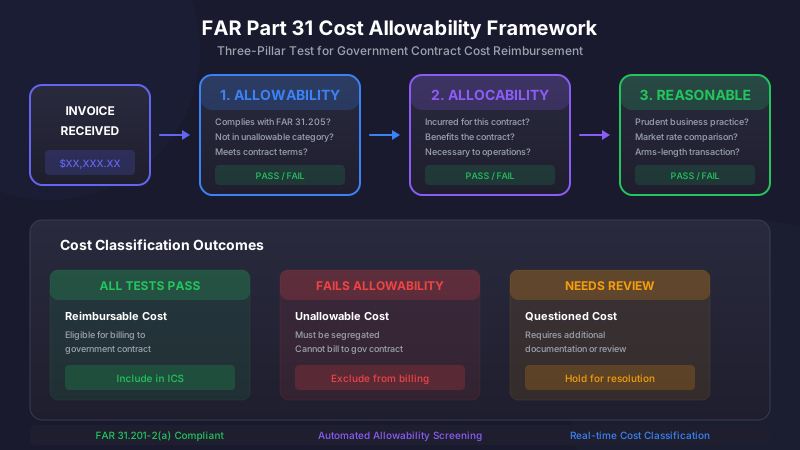
The three-pillar framework ensures every cost meets FAR Part 31 requirements before allocation to contracts
DCAA Accounting System Requirements
DCAA evaluates contractor accounting systems against specific criteria defined in DFARS 252.242-7006. An adequate accounting system must demonstrate capabilities that directly impact AP operations:
DCAA Accounting System Criteria for AP
Cost Segregation
Separate direct costs, indirect costs, and unallowable costs
Cost Accumulation
Accumulate costs by contract and cost element
Interim Billing
Generate accurate interim cost submissions
Audit Trail
Maintain records traceable from invoices to general ledger
The Incurred Cost Submission Challenge
Government contractors with cost-reimbursable, time-and-materials, or labor-hour contracts must submit an annual Incurred Cost Submission (ICS) to DCAA. This comprehensive report requires detailed documentation of all costs claimed, organized by contract, cost element, and indirect rate pool.
AP processes directly impact ICS accuracy. Every invoice must be:
- Properly coded - Assigned to the correct contract, task order, and cost element
- Period matched - Booked in the fiscal year the cost was incurred
- Fully documented - Supported by vendor invoices, receiving reports, and approval records
- Classified correctly - Identified as direct, indirect, or unallowable
Direct vs. Indirect Cost Classification
One of the most critical AP functions for government contractors is proper cost classification. Misclassifying costs between direct and indirect categories can result in audit findings, rate adjustments, and contract disputes.
- Direct costs - Costs identified specifically with a particular contract, such as materials purchased for that contract or labor charged directly to it
- Indirect costs - Costs incurred for common objectives that cannot be identified with a specific contract, allocated through approved indirect rate structures
Consistent Treatment Requirement
CAS 402 requires that costs be consistently classified as direct or indirect. If you charge travel costs directly to commercial projects, you cannot classify similar travel as indirect overhead on government contracts. Your AP coding practices must enforce this consistency across all work.
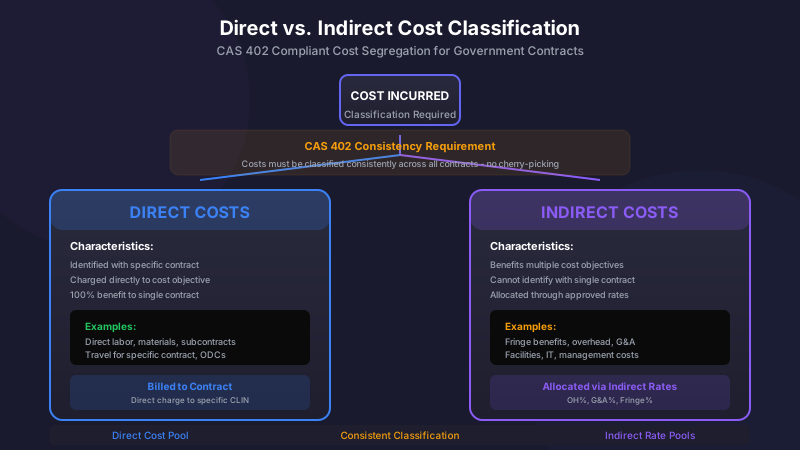
Proper cost classification ensures compliance with CAS requirements and accurate indirect rate calculations
Building DCAA-Compliant Invoice Processing
Your AP workflow for government contract invoices should incorporate specific controls and documentation requirements that satisfy audit expectations:
Invoice Receipt and Validation
- Capture complete invoice images with timestamps
- Extract and validate vendor information against approved vendor lists
- Verify invoice matches purchase order or subcontract terms
- Confirm receipt of goods or services through receiving documentation
Cost Classification and Coding
- Apply allowability screening against FAR Part 31 unallowable cost categories
- Assign costs to specific contracts, task orders, or indirect pools
- Code to appropriate cost elements (labor, materials, subcontracts, ODCs)
- Flag mixed-benefit costs requiring allocation
Government Contractor AP Documentation Checklist
- Original vendor invoice
- Purchase order or subcontract
- Receiving report or service acceptance
- Approval documentation
- Payment voucher
- Consent to subcontract (if required)
- Subcontractor cost or pricing data
- Certificate of current cost or pricing
- Small business subcontracting plan
- Subcontract terms verification
- Travel authorization
- Receipts for expenses over threshold
- GSA per diem compliance verification
- Business purpose documentation
- Contract/task order linkage
- Consulting agreement
- Rate justification
- Deliverable acceptance
- Time records (if applicable)
- Invoice detail breakdown
Approval Workflows for Government Contracts
Government contract invoices require approval authority tied to contract responsibility. Your workflow should enforce:
- Contract manager approval for direct charges to ensure proper contract benefit
- Purchasing authority verification to confirm the purchase was authorized
- Technical acceptance for deliverables and services
- Finance review for allowability and coding accuracy
Cost Accounting Standards (CAS) Compliance
Contractors meeting CAS thresholds must comply with specific standards that affect AP processes. Key standards impacting invoice processing include:
- CAS 401 - Consistency in estimating, accumulating, and reporting costs
- CAS 402 - Consistency in allocating costs for the same purpose
- CAS 405 - Accounting for unallowable costs
- CAS 418 - Allocation of direct and indirect costs
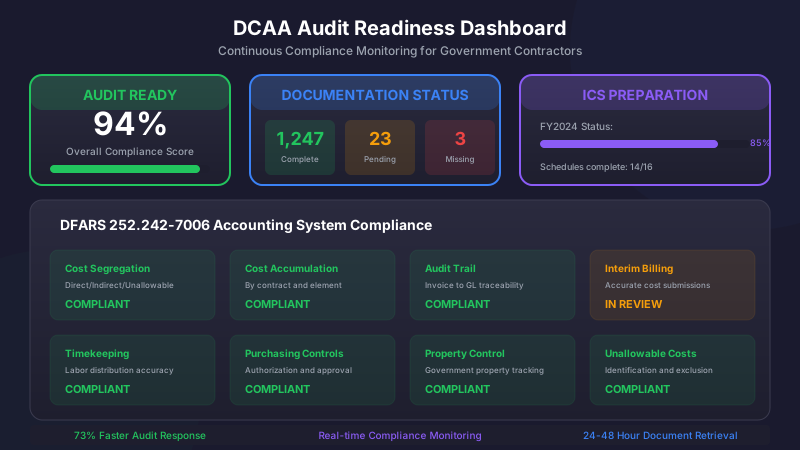
Continuous audit readiness monitoring ensures your AP system maintains DCAA compliance standards
Preparing for DCAA Audits
DCAA auditors can request access to your accounting records at any time. Maintaining continuous audit readiness, rather than scrambling when an audit is announced, significantly reduces both audit findings and the operational burden of audit support.
Documentation Retention
FAR 4.703 requires retention of records for three years after final payment under the contract, or longer if specified in the contract. Your AP system must maintain:
- Complete invoice images and supporting documentation
- Approval trails with timestamps and approver identification
- Cost coding and classification decisions
- Changes or corrections with audit trails
- Payment records tied to specific invoices
Audit Response Capability
When DCAA requests supporting documentation for specific costs, you should be able to produce the complete invoice package within 24-48 hours. Contractors with automated AP systems report 73% faster audit response times and significantly fewer findings related to documentation gaps.
Automating Government Contractor AP Compliance
Manual AP processes cannot reliably maintain the documentation standards and compliance controls required for government contracting. Modern AP automation platforms address these requirements through:
- Automated allowability screening - Flag potential unallowable costs before coding
- Contract-aware coding - Enforce proper cost classification based on contract type
- Complete audit trails - Maintain immutable records of all transactions and changes
- Document retention - Automatically maintain records for required retention periods
- ICS preparation support - Organize costs for annual incurred cost submissions
- Real-time compliance monitoring - Track compliance status across all contracts
Your Government Contractor AP Compliance Action Plan
Building and maintaining DCAA-compliant AP processes requires systematic attention to regulatory requirements. Start with these priorities:
- Assess your current state: Evaluate your AP processes against DCAA accounting system criteria
- Implement cost segregation: Ensure your system properly separates direct, indirect, and unallowable costs
- Build documentation standards: Define required documentation for each cost type
- Establish coding controls: Create validation rules that enforce proper cost classification
- Automate compliance checks: Implement automated screening for unallowable costs
- Train your team: Ensure AP staff understand government contractor requirements
- Test audit readiness: Conduct mock audits to identify documentation gaps
Government contract AP compliance is demanding, but organizations that invest in proper processes and systems protect themselves from audit findings, cost disallowances, and the reputational damage that accompanies compliance failures. The return on investment in compliant AP processes is measured not just in efficiency gains, but in contracts won and maintained through demonstrated financial management capability.
Ryan Shugars
Director of Product
Ryan has spent 15 years as a Systems Architect, building enterprise solutions that transform how organizations manage their financial operations.