Capturing Early Payment Discounts: Strategies to Boost AP's Bottom Line Impact
The math is simple: a 2% discount for paying 20 days early translates to a 36% annualized return. Yet most organizations capture fewer than 25% of available early payment discounts. The culprit? Manual AP processes that cannot move fast enough to meet discount deadlines. Here is how to change that.
Ryan Shugars
Director of Product
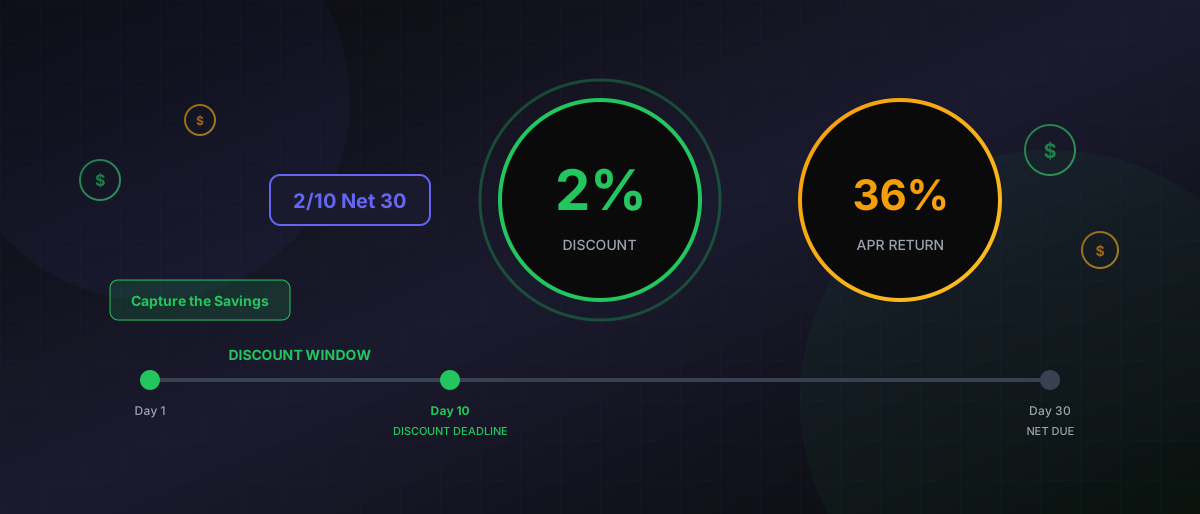
Every CFO knows the value of early payment discounts in theory. The standard 2/10 net 30 terms offer a 2% discount for payment within 10 days instead of the full 30. On a $50,000 invoice, that is $1,000 saved for paying 20 days early. Multiply that across thousands of invoices per year, and you are looking at hundreds of thousands, potentially millions, in captured savings.
Yet according to Ardent Partners research, only 24% of organizations consistently capture available early payment discounts. The remaining 76% are leaving substantial money on the table, not because they do not want the savings, but because their AP processes simply cannot move fast enough.
The gap between knowing about early payment discounts and actually capturing them is a process gap. And closing that gap requires understanding exactly where time is lost in the invoice-to-payment cycle.
The Mathematics of Early Payment Discounts
Before diving into strategies, let us establish why early payment discounts deserve significant attention from finance leadership. The annualized return on early payment discounts is remarkably high:
Annualized Returns on Common Discount Terms
2% for paying 20 days early
1% for paying 20 days early
2% for paying 30 days early
3% for paying 50 days early
The Formula: (Discount % / (100 - Discount %)) x (365 / Days Saved) = Annualized Return
Compare these returns to typical corporate investment options. Money market accounts yield 4-5%. High-grade corporate bonds offer 5-7%. Even equity investments historically return 8-10% annually. A 36% return on 2/10 net 30 discounts makes early payment one of the highest-return uses of corporate cash available.
The question is not whether to capture early payment discounts. The question is what prevents organizations from capturing them systematically.
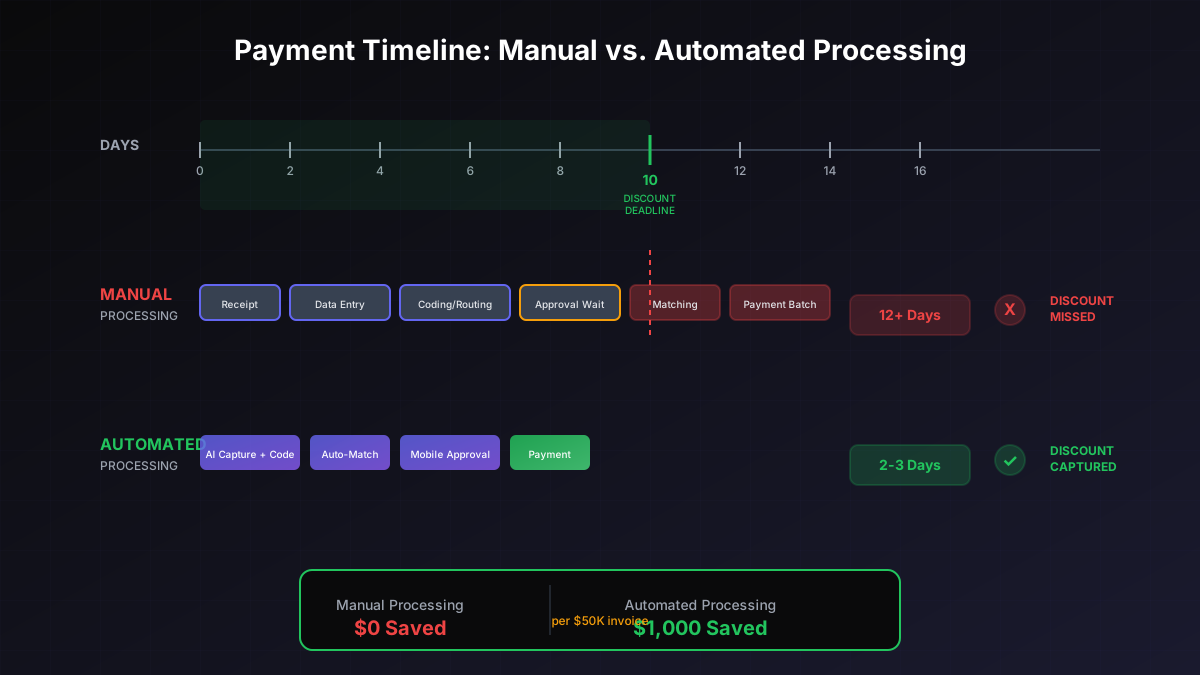
The race against time: manual invoice processing often exceeds the discount window
Where the Discount Window Closes: A Timeline Analysis
To understand why discounts are missed, we need to trace the typical invoice journey through a manual AP process. Consider a 2/10 net 30 invoice received on Day 1:
- Day 1-2: Invoice arrives via email or mail. Sits in general inbox until routed to AP.
- Day 2-4: AP team manually enters invoice data into the system.
- Day 4-6: Invoice routed for coding approval. Waits in approver's queue.
- Day 6-8: Approver reviews, requests clarification, or approves.
- Day 8-10: Three-way matching performed. Exceptions flagged for review.
- Day 10-12: Payment batch prepared and scheduled.
By the time this invoice reaches payment approval, the 10-day discount window has already closed. This is not an unusually slow process. It is the typical timeline for manual AP operations.
APQC benchmarking data shows that top-performing organizations process invoices in 3.1 days on average, while median performers take 10.1 days. Bottom performers can take 25 days or more. Only top performers consistently fall within discount windows.
The Five Barriers to Discount Capture
1. Invoice Receipt and Routing Delays
Invoices arriving via email often sit in shared inboxes for hours or days before someone routes them to AP. Paper invoices have even longer delays as they move through internal mail systems. Every day an invoice spends in transit is a day subtracted from your discount window.
Solution: Centralized invoice intake with automated routing. AI-powered systems can identify invoices in email streams, extract key data, and route them to the appropriate workflow immediately upon receipt, reducing this delay to minutes instead of days.
2. Manual Data Entry Bottlenecks
A skilled AP clerk can manually enter 20-30 invoices per hour, depending on complexity. For organizations processing thousands of invoices monthly, this creates an inherent backlog. Invoices queue up waiting for human processing capacity.
Speed Matters
AI-powered invoice capture processes documents in seconds, not hours. Remmi customers report average processing times of under 30 seconds per invoice, with 98%+ accuracy, eliminating the data entry bottleneck entirely.
3. Approval Workflow Friction
Even after data entry, invoices must navigate approval workflows. When approvers are traveling, in meetings, or simply busy with higher-priority tasks, invoices stall. A single three-day delay in the approval queue can eliminate any chance of capturing a 2/10 discount.
Solution: Mobile-enabled approvals with intelligent escalation. When approvers can review and approve invoices from their phones, approvals happen faster. Automated escalation ensures that approaching discount deadlines trigger priority notifications.
4. Exception Handling Delays
Industry data shows that 20-25% of invoices require some form of exception handling: price variances, quantity mismatches, missing purchase orders, or coding questions. Each exception adds days to processing time as the invoice bounces between AP, purchasing, and vendors.
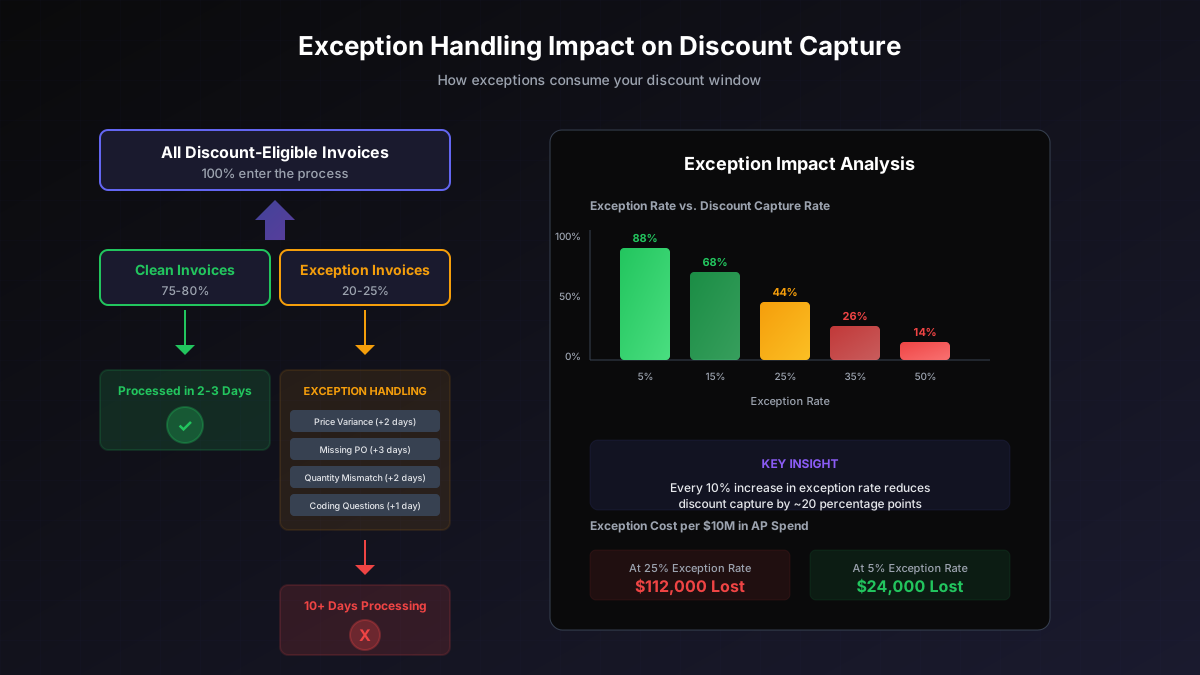
Every exception adds processing time, pushing invoices past discount windows
5. Payment Batch Scheduling
Many organizations run payment batches on fixed schedules: weekly or bi-weekly. An invoice approved on Wednesday might not be paid until the following Monday's payment run. This scheduling gap alone can consume 3-7 days of the discount window.
Solution: Dynamic payment scheduling that prioritizes discount-eligible invoices. Intelligent systems can identify invoices with approaching discount deadlines and include them in expedited payment runs, balancing cash flow management with discount capture.
Building a Discount-Capture Machine: The Strategic Framework
Systematically capturing early payment discounts requires more than faster processing. It requires a strategic framework that identifies, prioritizes, and executes on discount opportunities. Here is what that framework looks like:
Step 1: Visibility into Discount Opportunities
You cannot capture discounts you do not see. The first step is ensuring that discount terms are automatically extracted from every invoice and tracked throughout the payment lifecycle. This requires:
- Automated extraction of payment terms from invoice documents
- Centralized tracking of discount deadlines across all invoices
- Real-time dashboards showing pending discounts at risk
- Proactive alerts when discount deadlines approach
Step 2: Process Acceleration
Once you have visibility, you need the processing speed to act on it. The goal is reducing your average invoice processing time to under three days, well within most discount windows. Key acceleration points include:
- Same-day intake: Invoices captured and routed within hours of receipt
- Automated coding: AI applies GL codes based on historical patterns
- Parallel matching: Three-way match performed simultaneously with routing
- Mobile approvals: Approvers can act from any device, anywhere
The Discount Capture Opportunity: Real Numbers
Typical Mid-Market Organization
Discount Capture Comparison
Step 3: Cash Flow Integration
Capturing discounts requires having cash available when discount windows are open. This means integrating discount capture strategy with broader cash management:
- Cash forecasting: Model discount capture impact on daily cash positions
- Threshold management: Set minimum cash levels before pursuing discounts
- Opportunity ranking: Prioritize highest-APR discounts when cash is limited
- Dynamic payment terms: Negotiate extended terms for non-discount invoices
Step 4: Vendor Term Optimization
Once you have the capability to capture discounts consistently, you can negotiate more aggressively for discount terms. Vendors are often willing to offer early payment discounts when they see them being consistently captured, as it improves their own cash flow.

The virtuous cycle: consistent discount capture enables better term negotiations
Measuring Success: Discount Capture KPIs
To drive improvement, you need to measure performance. Key metrics for discount capture programs include:
- Discount Capture Rate: Percentage of available discounts captured (target: 75%+)
- Discount Dollars Captured: Total value of discounts taken per period
- Invoice Processing Time: Average days from receipt to payment-ready
- Discount-Eligible Aging: Days discount-eligible invoices spend in each stage
- Missed Discount Value: Dollar value of discounts that expired uncaptured
Best-in-Class Benchmarks
Top-performing organizations capture 85%+ of available early payment discounts, process invoices in under 3 days on average, and have less than 5% of invoices in exception status at any time. These benchmarks are achievable with modern automation.
The Technology Foundation: What to Look For
Not all AP automation solutions are created equal when it comes to discount capture. Key capabilities to evaluate include:
- Intelligent OCR/ICR: Accurate extraction of payment terms from any invoice format
- Discount Tracking: Automated monitoring of discount deadlines and aging
- Priority Routing: Ability to fast-track discount-eligible invoices
- Mobile Approval: Full approval capability from any device
- Dynamic Scheduling: Flexible payment batch timing based on discount opportunities
- Analytics and Reporting: Clear visibility into capture rates and missed opportunities
Getting Started: Quick Wins for Discount Capture
While comprehensive automation delivers the largest gains, organizations can begin improving discount capture immediately:
- Audit your current capture rate: Pull data on available discounts versus captured discounts over the past year. The gap quantifies your opportunity.
- Identify the bottleneck: Map your current process and measure time spent at each stage. Where are discount-eligible invoices getting stuck?
- Prioritize discount invoices: Create a priority queue for invoices with approaching discount deadlines. Even manual prioritization improves capture rates.
- Enable mobile approvals: Give approvers the ability to act on invoices from anywhere. This alone can save 1-2 days per invoice.
- Negotiate new terms: Armed with faster processing capability, approach key vendors about early payment discount programs.
The Bottom Line: Discounts as a Profit Center
Early payment discounts represent one of the most overlooked profit opportunities in corporate finance. The math is compelling: 36% annualized returns available on routine vendor payments. The barrier is not financial, it is operational.
Organizations that invest in process speed, typically through intelligent automation, transform their AP function from a cost center into a profit center. Every invoice processed within the discount window contributes directly to the bottom line.
The question is not whether early payment discounts are worth capturing. It is how quickly you can build the operational capability to capture them consistently. For most organizations, the answer is faster than you might think.
The Compound Effect
Organizations that consistently capture early payment discounts often find vendors more willing to offer favorable terms. Your reputation as a fast-paying customer becomes a negotiating advantage, creating a virtuous cycle of improved terms and increased savings.
Ryan Shugars
Director of Product
Ryan has spent 15 years as a Systems Architect, building enterprise solutions that transform how organizations manage their financial operations.