Duplicate Payment Prevention: How AI Catches What Manual Review Misses
Duplicate payments cost organizations between 0.5% and 2% of total AP spend annually. Traditional detection methods catch the obvious cases, but sophisticated duplicates slip through unnoticed. AI-powered detection changes the equation entirely.
Ryan Shugars
Director of Product
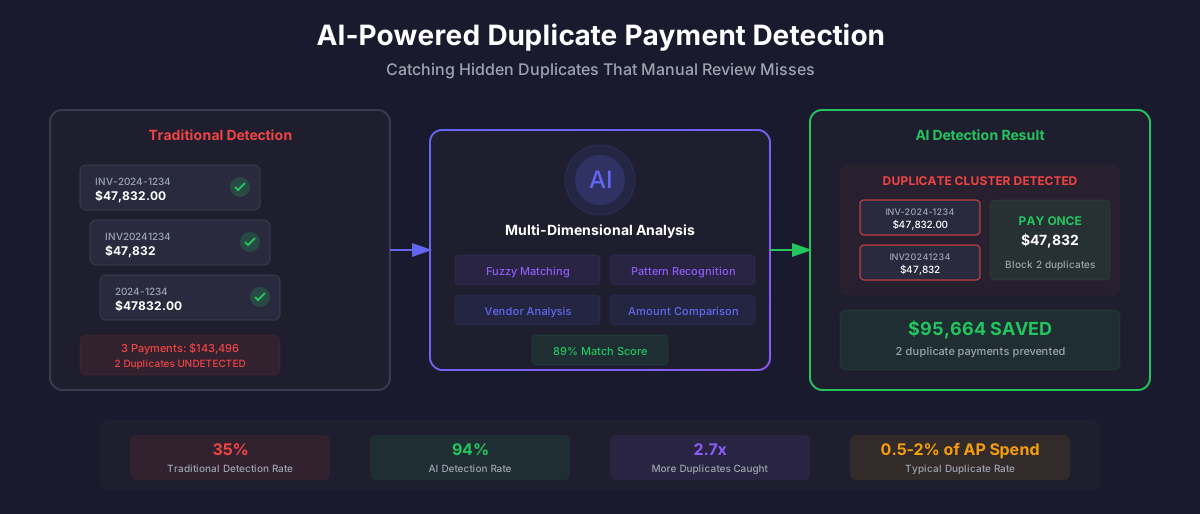
A Fortune 500 company recently discovered they had paid the same vendor invoice three times over 18 months. The amounts were $47,832, $47,832.00, and $47,832. Same vendor, same amount, slightly different invoice formats. Their ERP flagged nothing. Their AP team noticed nothing. An external audit found it.
This story repeats across organizations of every size. According to the Institute of Finance and Management, duplicate payments represent between 0.5% and 2% of total accounts payable disbursements. For an organization processing $100 million in annual payments, that's $500,000 to $2 million walking out the door unnecessarily.
The challenge isn't that organizations don't try to prevent duplicates. They do. But traditional methods rely on exact matches—same invoice number, same amount, same vendor. Fraudsters and simple human errors easily circumvent these basic controls.
Why Manual Review Fails
Manual duplicate detection relies on AP clerks recognizing patterns across thousands of invoices processed monthly. Even experienced professionals miss duplicates for several reasons:
Common Duplicate Disguises That Escape Detection
INV-2024-1234 vs INV20241234 vs 2024-1234—same invoice, different formats
$15,847.00 vs $15,847 vs $15847.00—decimal and formatting differences
Acme Corp vs ACME Corporation vs Acme Co.—same vendor, multiple master records
Same services billed with different invoice dates to appear as separate transactions
The human brain isn't wired to spot these patterns across large data sets. An AP clerk processing 200 invoices daily cannot remember if "Invoice 87432" from three weeks ago matches "Inv-87432" arriving today. They rely on systems that often use primitive matching rules.
The True Cost of Duplicate Payments
Beyond the direct financial loss, duplicate payments create cascading problems:
- Recovery costs exceed the duplicate itself—staff time, vendor negotiations, and legal fees can cost more than the original overpayment
- Vendor relationship strain—requesting refunds creates awkward conversations and may damage important partnerships
- Audit and compliance risks—duplicates may indicate weak internal controls, triggering deeper regulatory scrutiny
- Cash flow impact—money tied up in duplicate payments isn't available for operations or investment
- Staff morale—discovering repeated errors erodes confidence and creates a blame-seeking culture
Duplicate Payment Impact by Organization Size
$50K - $200K
Annual Loss
$10-20M AP Spend
$500K - $2M
Annual Loss
$100M AP Spend
$5M - $20M
Annual Loss
$1B AP Spend
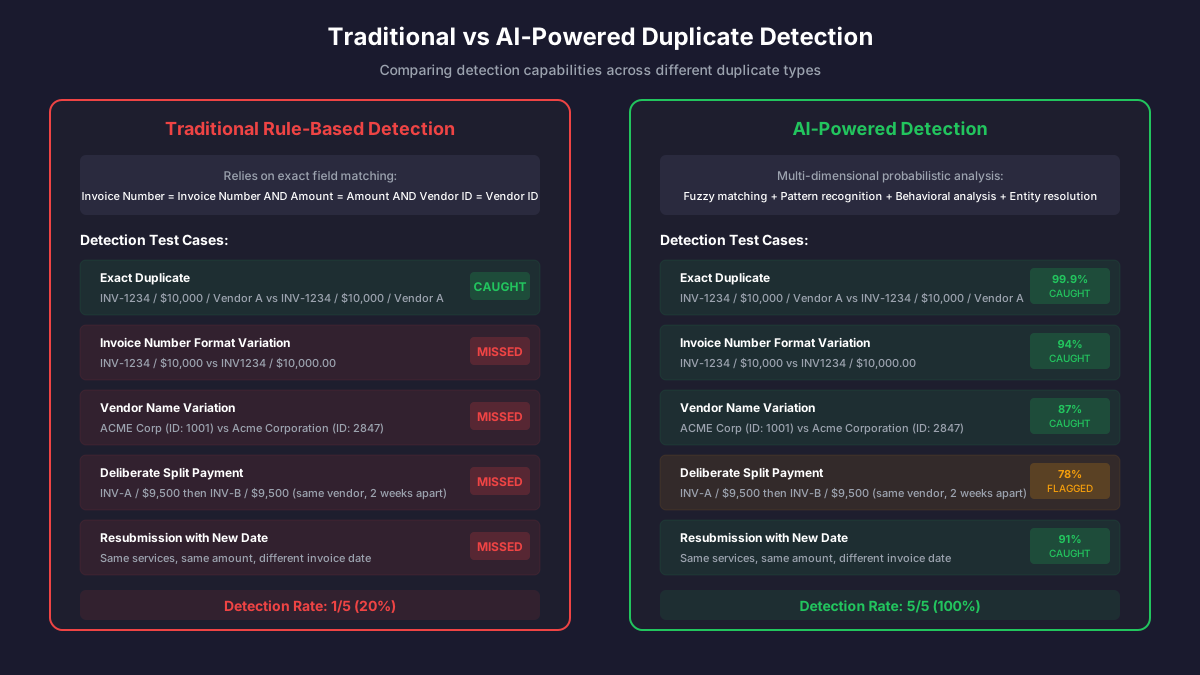
AI detection analyzes multiple data dimensions to identify duplicates that simple matching misses
How AI-Powered Detection Works Differently
Modern AI duplicate detection doesn't just compare fields—it understands context, learns patterns, and identifies anomalies across multiple dimensions simultaneously. Here's what makes it fundamentally different:
Fuzzy Matching at Scale
Instead of requiring exact matches, AI systems use probabilistic matching algorithms that calculate similarity scores across all invoice attributes. An invoice number of "INV-2024-1234" scores 95% similarity to "INV20241234"—close enough to flag for review but different enough to pass basic validation.
Machine Learning in Action
AI models trained on millions of invoice pairs learn to recognize duplicate patterns that humans never codified. They identify that "ACME CORP" and "Acme Corporation" are the same vendor, that $10,000.00 and $10000 represent identical amounts, and that invoices 30 days apart with identical line items warrant scrutiny.
Multi-Dimensional Analysis
AI doesn't just look at invoice number and amount. It analyzes:
- Vendor behavioral patterns—does this vendor typically send invoices weekly or monthly?
- Line item content—are the services or products described similarly even if formatted differently?
- Payment timing—are we paying the same vendor for overlapping service periods?
- Document metadata—was this PDF created from the same template as a previous invoice?
- Historical relationships—has this vendor ever submitted duplicates before?
Continuous Learning
Every confirmed duplicate teaches the system. Every false positive refined by AP staff improves accuracy. Over time, the AI adapts to your specific vendor ecosystem and invoice patterns, becoming more precise with each transaction.
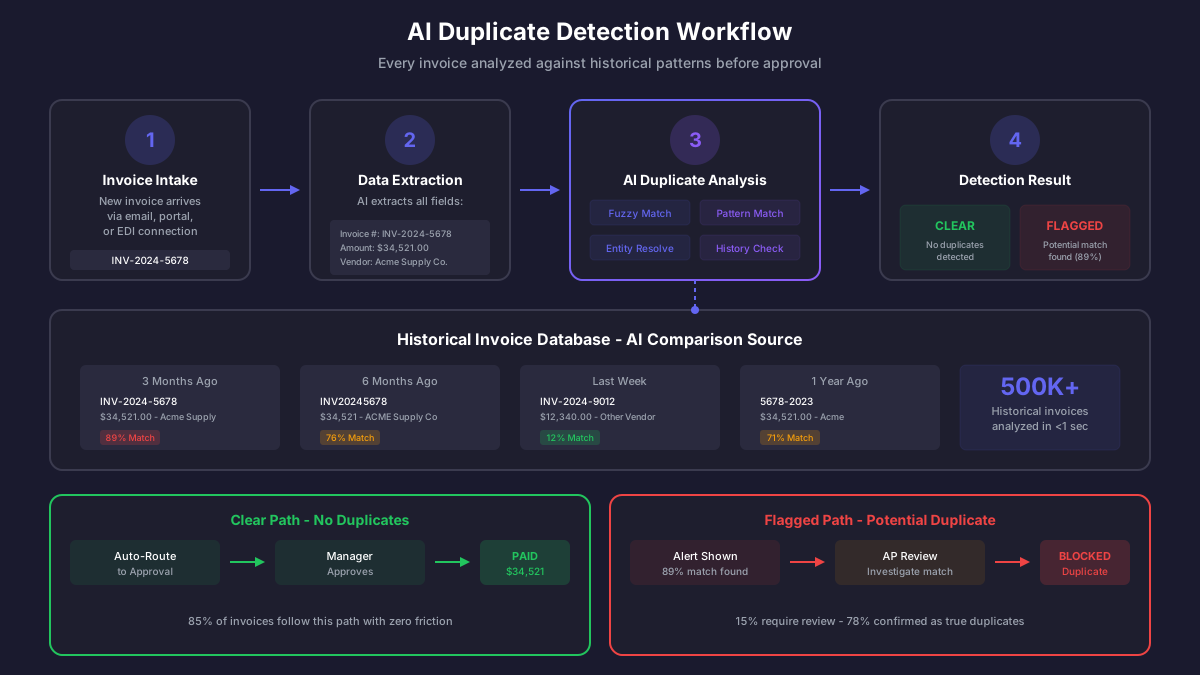
The AI detection workflow analyzes every invoice against historical patterns before approval
Real-World Detection Scenarios
Let's examine specific scenarios where AI detection outperforms traditional methods:
Scenario 1: The Reformatted Invoice
A vendor submits invoice #12847 for $34,521.00 on March 15. Six weeks later, their new billing system generates a "resubmission" as INV-0012847 for $34,521. Traditional systems see two different invoices. AI recognizes the numerical pattern, matches the vendor and amount, and flags the relationship.
Scenario 2: The Split Payment Scheme
A fraudster submits an invoice for $9,500—just under the $10,000 threshold requiring additional approval. Two weeks later, they submit a "supplemental" invoice for $9,500 with a different service description. AI detects the unusual pattern: same vendor, same amount, and timing suggests intentional splitting.
Scenario 3: The Vendor Master Duplicate
Over years of acquisitions, your vendor master accumulated three records for the same supplier: "Johnson Supply Co.", "Johnson Supply Company", and "JSC Industries" (their parent company). Invoices paid under different vendor IDs appear unrelated. AI's entity resolution identifies them as the same economic entity and cross-references all invoices.
AI Detection vs Traditional Detection: Success Rates
Exact Duplicates
Same invoice #, vendor, amount
Traditional
AI
Format Variations
Invoice # or amount formatting differs
Traditional
AI
Vendor Master Splits
Same vendor, multiple records
Traditional
AI
Intentional Fraud
Deliberate duplicate submission
Traditional
AI
Implementation Best Practices
Deploying AI duplicate detection requires thoughtful implementation to maximize value while minimizing false positives that frustrate AP staff:
1. Start with Historical Analysis
Before going live, run AI detection against 2-3 years of historical payments. This accomplishes two goals: it identifies recoverable duplicates already paid, and it trains the model on your specific patterns. Many organizations recover enough from historical duplicates to fund the entire implementation.
2. Tune Confidence Thresholds Carefully
AI systems report confidence scores for potential duplicates. Setting thresholds too low creates alert fatigue; too high misses real duplicates. Start conservative (catching obvious issues) and gradually lower thresholds as staff develops confidence in the system.
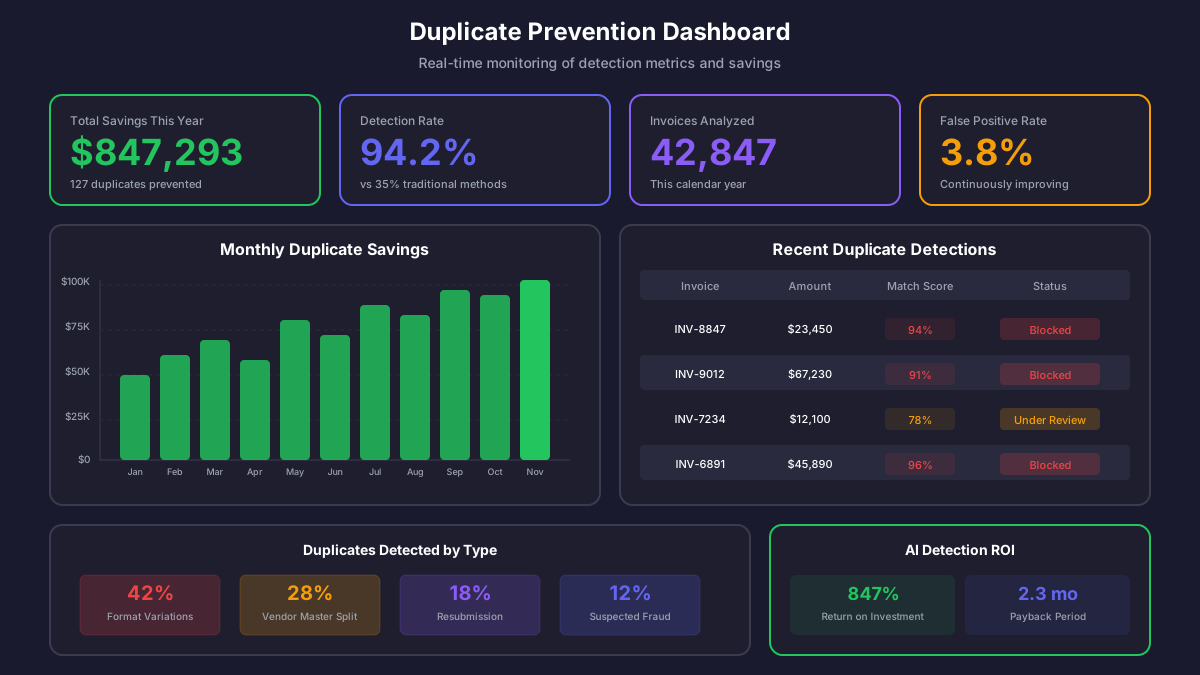
Real-time dashboards track detection rates, confirmed duplicates, and savings achieved
3. Integrate with Approval Workflows
Duplicate flags should appear during invoice approval, not after payment. When an approver sees "Potential duplicate: 89% match to Invoice #12847 paid March 15", they can investigate immediately rather than attempting recovery later.
4. Address Root Causes
Detection catches duplicates, but prevention requires fixing underlying issues. Use duplicate reports to identify:
- Vendors needing invoice format standardization
- Vendor master records requiring consolidation
- Process gaps allowing resubmission
- Training needs for AP staff or requisitioners
Measuring Success
Track these metrics to quantify your duplicate prevention ROI: Duplicates prevented (count and dollar value), False positive rate (flags that weren't duplicates), Detection-to-resolution time (how quickly flagged items are resolved), and Historical recoveries (duplicates found in prior payments).
The Fraud Prevention Connection
While most duplicates result from honest mistakes, a significant percentage represent intentional fraud. Duplicate payment schemes are among the most common AP fraud tactics because they're difficult to detect and easy to rationalize as errors if caught.
AI detection serves as a fraud deterrent beyond its direct prevention value. When employees and vendors know that sophisticated detection is in place, they're less likely to attempt schemes that would have succeeded against basic controls. The perception of omniscient detection creates powerful behavioral change.
Building a Defense-in-Depth Strategy
AI duplicate detection works best as part of a layered control framework:
- Prevention: Vendor onboarding controls, invoice submission portals, and PO matching requirements stop duplicates before they enter the system
- Detection: AI-powered analysis identifies potential duplicates during processing, before payment
- Recovery: Regular audits and vendor statement reconciliation catch any that slip through
- Continuous improvement: Root cause analysis prevents recurring patterns
Each layer reinforces the others. Prevention reduces the volume requiring detection. Detection provides data for prevention improvements. Recovery identifies gaps in both prevention and detection.
The Bottom Line
Duplicate payments represent one of the most preventable sources of financial leakage in accounts payable. Traditional detection methods, while necessary, miss sophisticated duplicates that cost organizations millions annually.
AI-powered detection transforms duplicate prevention from a game of chance to a systematic control. By analyzing multiple dimensions, learning from patterns, and improving continuously, these systems catch what human review cannot.
For most organizations, the question isn't whether to implement AI duplicate detection—it's how quickly they can deploy it to stop the ongoing losses they may not even know they're experiencing.
Ryan Shugars
Director of Product
Ryan has spent 15 years as a Systems Architect, building enterprise solutions that transform how organizations manage their financial operations.