Contract Compliance Validation: Ensuring Invoices Match Negotiated Terms
Your procurement team spent months negotiating favorable pricing, volume discounts, and payment terms with vendors. But without systematic contract validation, those hard-won savings can leak away through pricing errors and unauthorized charges.
Ryan Shugars
Director of Product
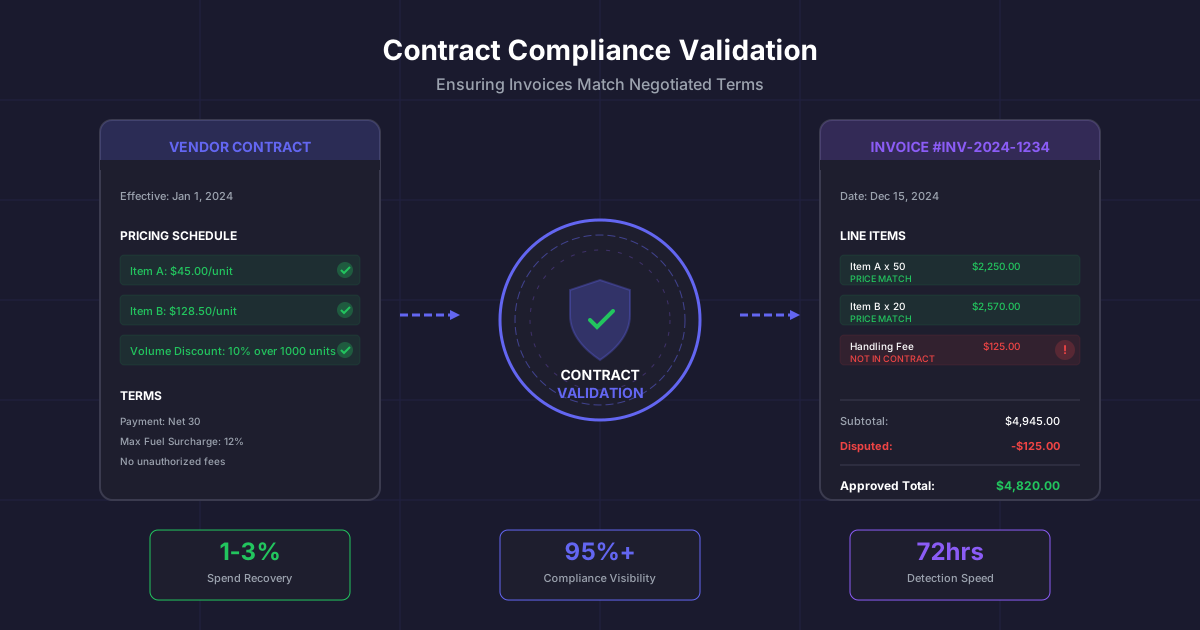
A Fortune 500 retailer discovered they had been overpaying a major logistics vendor by 8% for nearly two years. The negotiated fuel surcharge cap of 12% had been routinely exceeded on invoices, but with thousands of invoices monthly, no one caught the discrepancy. The total overpayment exceeded $3.2 million—money that walked out the door despite having a clear contractual right to lower rates.
This story is far more common than most finance leaders realize. According to research by KPMG, organizations lose an average of 1-3% of contract value to billing errors and non-compliance. For companies with $100 million in annual vendor spend, that translates to $1-3 million in preventable losses every year.
The challenge isn't that AP teams don't want to validate contracts. It's that manual validation is nearly impossible at scale. When you're processing hundreds or thousands of invoices daily, checking each line item against contracted rates, approved quantities, and term conditions simply isn't practical. This is where automated contract compliance validation transforms from a nice-to-have into a critical financial control.
The Hidden Cost of Contract Non-Compliance
Contract compliance failures manifest in multiple ways, each eating into your bottom line:
Common Contract Compliance Failures
Vendors charging list prices instead of contracted rates, or failing to apply negotiated discounts
Fees, surcharges, or services not covered under the contract terms being added to invoices
Failing to apply tier-based discounts when purchase volumes hit contractual thresholds
Billing for quantities exceeding contract limits, or charging after contract expiration
These issues aren't always the result of vendor misconduct. Often, they stem from legitimate administrative errors—outdated price files, misconfigured billing systems, or sales reps not communicating new contract terms to their billing departments. Regardless of intent, the financial impact is the same: your organization pays more than it should.
Why Manual Contract Validation Fails
Traditional AP processes rely on human review to catch contract discrepancies. In theory, AP clerks check invoices against purchase orders and contracts. In practice, several factors make comprehensive manual validation impossible:
- Volume overwhelms capacity: A single AP clerk processing 100+ invoices daily cannot thoroughly validate each line item against contract terms
- Contract complexity: Modern vendor agreements often run 50+ pages with complex pricing tiers, conditional discounts, and multiple schedules
- Document fragmentation: Contracts may be stored across multiple systems—legal repositories, procurement platforms, and email archives
- Dynamic pricing: Contracts with cost-plus terms, index-linked pricing, or currency adjustments require real-time calculations
- Institutional knowledge gaps: When key staff leave, contract knowledge often leaves with them
The result is that most organizations validate contracts reactively rather than proactively. They catch discrepancies months later during spend analysis or not at all. By then, the money is already gone, and recovery is difficult.
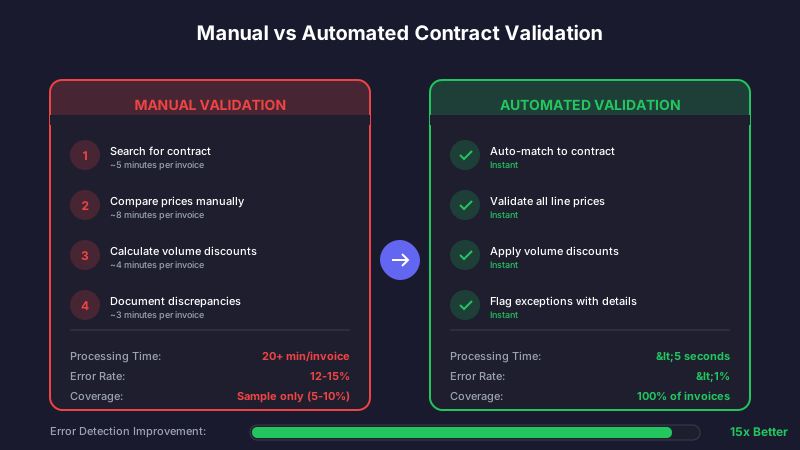
Automated validation catches discrepancies that manual review consistently misses
How Automated Contract Compliance Validation Works
Modern AP automation platforms can validate every invoice against contract terms in real-time, before payment. This transforms contract compliance from a sample-based audit function to a comprehensive control embedded in your payment workflow.
Building the Contract Knowledge Base
The foundation of automated validation is a structured repository of contract terms that the system can query. This typically involves:
- Contract digitization: Extracting key terms from PDF contracts using AI-powered document processing
- Pricing schedule capture: Loading rate cards, discount matrices, and pricing formulas into queryable formats
- Term structuring: Converting contractual language into validation rules the system can apply
- Version management: Tracking contract amendments and effective dates to apply correct terms over time
AI-Powered Contract Extraction
Advanced natural language processing can now extract pricing terms, discount structures, and compliance requirements directly from contract documents. Rather than manual data entry, AI models identify and structure the key terms that matter for invoice validation, reducing setup time from weeks to hours.
Real-Time Invoice Validation
Once contracts are digitized, every incoming invoice is automatically validated against the relevant contract terms. The system checks:
Contract Validation Checkpoints
Unit Price Validation
Verify each line item price matches the contracted rate for that SKU or service
Discount Application
Confirm volume discounts, promotional rates, and rebates are correctly applied
Fee Authorization
Check that all fees and surcharges are authorized under contract terms
Term Compliance
Validate quantities, dates, and conditions fall within contract parameters
Exception Management and Resolution
When the system identifies a discrepancy, it doesn't just flag the invoice— it provides actionable intelligence for resolution:
- Discrepancy quantification: Calculate the exact dollar impact of the pricing error or unauthorized charge
- Contract reference: Link directly to the contract clause being violated, making vendor communication straightforward
- Historical pattern analysis: Identify if this is a one-time error or a recurring issue with the vendor
- Resolution workflow: Route exceptions to the appropriate stakeholder for vendor negotiation or approval
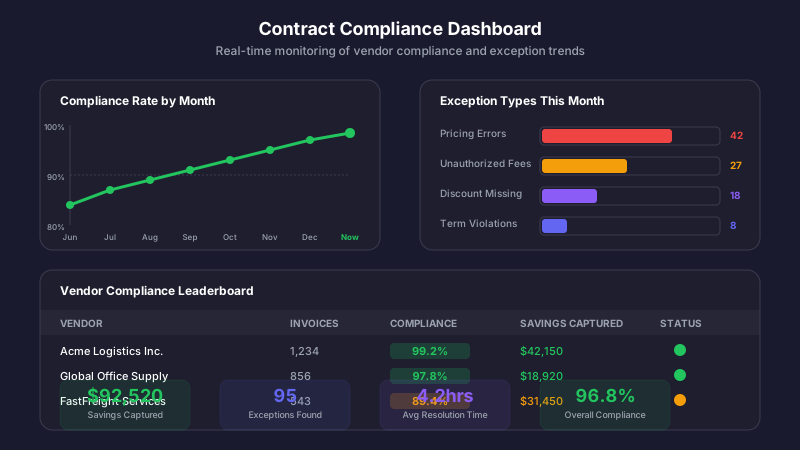
Real-time dashboards track compliance rates and identify problematic vendors
Key Validation Scenarios
Automated contract validation is especially valuable in complex pricing scenarios where manual validation would be impractical:
Tiered Volume Discounts
Many contracts include discount tiers based on cumulative purchase volume. For example, a supplier might offer:
- 0-1,000 units: List price
- 1,001-5,000 units: 5% discount
- 5,001-10,000 units: 10% discount
- 10,001+ units: 15% discount
Tracking cumulative volume across invoices and ensuring the correct tier is applied requires ongoing calculation. Automated systems maintain running totals and validate that each invoice reflects the appropriate discount level.
Cost-Plus Contracts
Service providers often bill on a cost-plus basis, where the invoice should reflect actual costs plus an agreed markup percentage. Validation requires:
- Verifying the base costs are documented and reasonable
- Confirming the markup percentage matches the contract
- Checking that passthrough costs don't include additional markups
Index-Linked Pricing
Contracts tied to commodity indices, inflation rates, or currency exchange rates require dynamic validation. The system must:
- Retrieve current index values from authoritative sources
- Calculate the adjusted contract price
- Validate that invoiced amounts match the correctly calculated rate
Protecting Against Rate Creep
One of the most insidious compliance issues is gradual rate creep—small increases applied over time that individually seem insignificant but compound to substantial overcharges. Automated validation catches these incremental changes immediately, preventing the slow erosion of negotiated savings.
Implementation Best Practices
Successfully implementing contract compliance validation requires thoughtful planning. Here are the critical success factors:
Prioritize High-Value Contracts
Start with contracts that represent the highest spend or greatest risk. Validate the Pareto principle applies: typically 20% of vendors represent 80% of spend. Focus initial implementation on:
- Top 20 vendors by annual spend
- Contracts with complex pricing structures
- Vendors with historical compliance issues
- Categories with frequent pricing errors (logistics, raw materials)
Establish Tolerance Thresholds
Not every minor discrepancy warrants investigation. Define tolerance levels that balance control with efficiency:
- Unit price variance: Flag deviations greater than 2%
- Invoice total variance: Investigate differences exceeding $100
- Unauthorized charges: Zero tolerance for fees not in contract
Integrate with Procurement Workflows
Contract validation shouldn't exist in isolation. Connect with procurement to ensure:
- Contract terms flow automatically from CLM systems to AP validation
- Price changes and amendments update validation rules in real-time
- Compliance exceptions inform contract renewal negotiations
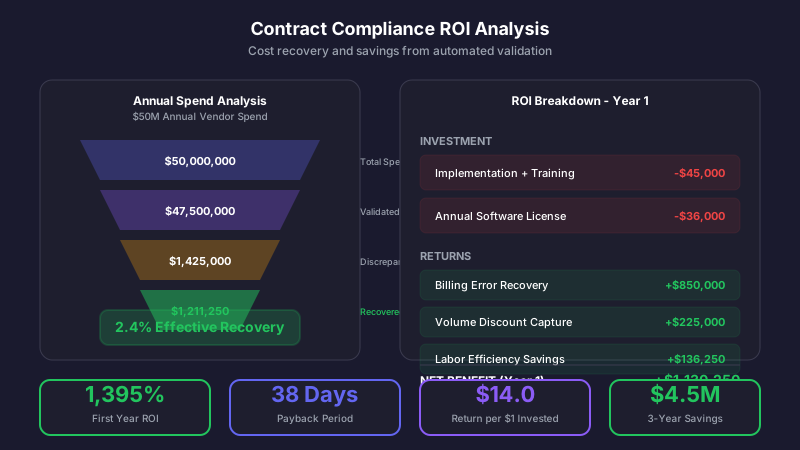
Organizations typically recover 1-3% of vendor spend through improved contract compliance
Measuring the Impact
Contract compliance validation delivers measurable returns. Track these metrics to quantify value:
Key Performance Metrics
1-3%
Spend Recovery
Typical savings from catching billing errors
95%+
Compliance Visibility
Percentage of spend validated against contracts
72hrs
Detection Speed
From invoice receipt to discrepancy identification
85%
Recovery Rate
Percentage of identified overcharges successfully recovered
Beyond Direct Savings
The financial impact extends beyond recovered overcharges:
- Vendor relationship improvement: Clean, documented compliance issues lead to constructive vendor conversations rather than disputes
- Negotiation leverage: Compliance data provides concrete evidence for contract renewal discussions
- Audit readiness: Systematic validation creates defensible records for internal and external auditors
- Process efficiency: Reduced time investigating billing issues and chasing credits after payment
Common Challenges and Solutions
Organizations implementing contract compliance validation often encounter these challenges:
Contract Data Quality
Challenge: Many contracts exist only as PDFs with inconsistent formatting, making automated extraction difficult.
Solution: Start with structured data entry for high-value contracts while deploying AI extraction for the long tail. Most ROI comes from top vendors, so manual structuring of priority contracts is worthwhile.
Contract Access
Challenge: Contracts may be scattered across legal, procurement, and departmental file shares with no central repository.
Solution: Use contract compliance implementation as a catalyst for contract consolidation. The visibility provided by centralized contract data justifies the effort of collection.
Vendor Pushback
Challenge: Some vendors resist detailed compliance validation, viewing it as adversarial.
Solution: Position validation as beneficial to both parties. Systematic validation catches errors faster, reduces dispute aging, and creates cleaner payment relationships.
The Strategic Value of Contract Compliance
Contract compliance validation isn't just about catching billing errors— it's about ensuring your organization realizes the full value of its procurement efforts. Every dollar of negotiated savings that leaks through compliance gaps undermines the work of your sourcing team.
As organizations face pressure to control costs, the ability to systematically validate contract compliance becomes a competitive advantage. Those who implement robust validation capture savings that competitors allow to slip away.
Turning Contracts into Enforceable Controls
A contract only protects you if it's enforced. Automated contract compliance validation transforms paper agreements into active financial controls, ensuring that every negotiated term translates into actual savings. In an environment where every dollar matters, this systematic enforcement separates organizations that realize their negotiated value from those that merely document it.
Getting Started
Implementing contract compliance validation doesn't require a massive initiative. Start with these practical steps:
- Inventory high-value contracts: Identify your top 20 vendors by spend and locate their current contracts
- Document key terms: Extract pricing schedules, discount structures, and fee authorization from priority contracts
- Establish baseline metrics: Measure current compliance rates through spot audits to quantify improvement potential
- Select enabling technology: Evaluate AP automation platforms with native contract validation capabilities
- Pilot and expand: Start with one vendor category, prove value, then systematically expand coverage
The Bottom Line
Every organization negotiates contracts with the expectation of receiving agreed-upon terms. Yet without systematic validation, a significant portion of those negotiated savings never materializes. Automated contract compliance validation closes this gap, ensuring that your invoices accurately reflect the deals your procurement team worked hard to secure.
For AP teams looking to demonstrate strategic value beyond transaction processing, contract compliance validation offers a compelling opportunity. It transforms AP from a cost center into a profit protector—actively safeguarding your organization's financial interests with every invoice processed.
Ryan Shugars
Director of Product
Ryan has spent 15 years as a Systems Architect, building enterprise solutions that transform how organizations manage their financial operations.