AP Automation for Construction: Managing Complex Multi-Project Invoice Processing
Construction companies face AP challenges unlike any other industry. Progress billing, retainage tracking, certified payroll compliance, and job cost allocation across dozens of active projects create a perfect storm of complexity. Here is how modern AP automation addresses these unique requirements.
Ryan Shugars
Director of Product
The construction industry operates on razor-thin margins, typically between 2-5% net profit. In this environment, every dollar lost to invoice processing inefficiencies, payment errors, or compliance failures directly impacts project profitability. Yet construction companies continue to struggle with AP processes designed for simpler business models.
Unlike typical B2B transactions where one invoice equals one straightforward payment, construction invoicing involves layered complexity: progress billing against estimated budgets, retainage holdbacks that span months or years, certified payroll requirements for government projects, and the need to allocate every expense to specific job codes for accurate project costing.
This article explores the unique AP challenges construction companies face and how purpose-built automation solutions are transforming invoice processing from a project risk into a competitive advantage.
The Unique Complexity of Construction Invoice Processing
General contractors and specialty trade contractors alike deal with invoice scenarios that would overwhelm traditional AP systems. Understanding these challenges is the first step toward solving them.
Progress Billing and Schedule of Values
Most construction projects operate on progress billing, where subcontractors submit monthly applications for payment based on work completed. These are not simple invoices. They reference a Schedule of Values (SOV) that breaks the contract into line items, each with an original value, previous billings, current billing amount, and calculated percentage complete.
The AIA G702/G703 forms are industry standard, but many subcontractors use variations or custom formats. Each application must be validated against the original contract, previous payments, and the project manager's assessment of actual work completed. This creates multiple touchpoints for error and delay.
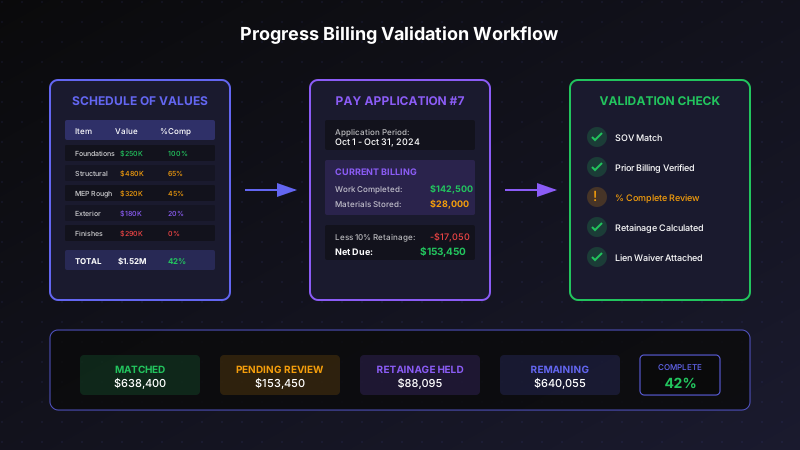
Progress billing requires validation against Schedule of Values, previous payments, and work completion
Construction AP Complexity: By the Numbers
Retainage: The Long-Tail Liability
Retainage is the practice of withholding a percentage (typically 5-10%) of each progress payment until project completion. This protects the owner and general contractor against incomplete work or defects, but it creates significant accounting complexity.
For a general contractor managing 30 active projects with 15 subcontractors each, that is 450 individual retainage balances to track. Each must be:
- Calculated correctly on each pay application
- Tracked against the original contract retainage terms
- Monitored for release eligibility based on project milestones
- Processed accurately when substantial completion is achieved
- Reported correctly for cash flow forecasting and financial statements
Errors in retainage management are common and costly. Overpaying retainage means losing leverage before work is truly complete. Underpaying damages subcontractor relationships and can trigger lien filings. Failing to release retainage promptly violates many state prompt-pay laws, exposing the company to penalties and interest.
Certified Payroll and Davis-Bacon Compliance
Government and federally funded projects require certified payroll documentation. Under the Davis-Bacon Act and related state prevailing wage laws, contractors must ensure that workers on covered projects receive specified wage rates and that all payroll is properly documented.
This creates additional verification requirements for every subcontractor invoice on qualifying projects:
- Weekly certified payroll reports (WH-347 or equivalent)
- Verification of prevailing wage compliance by trade classification
- Fringe benefit calculations and documentation
- Apprenticeship ratio compliance verification
- Statement of Compliance with proper officer signatures
Missing or incorrect certified payroll documentation can delay payments, trigger audits, and result in significant penalties. The administrative burden falls heavily on AP teams who must collect, verify, and archive these documents alongside payment processing.
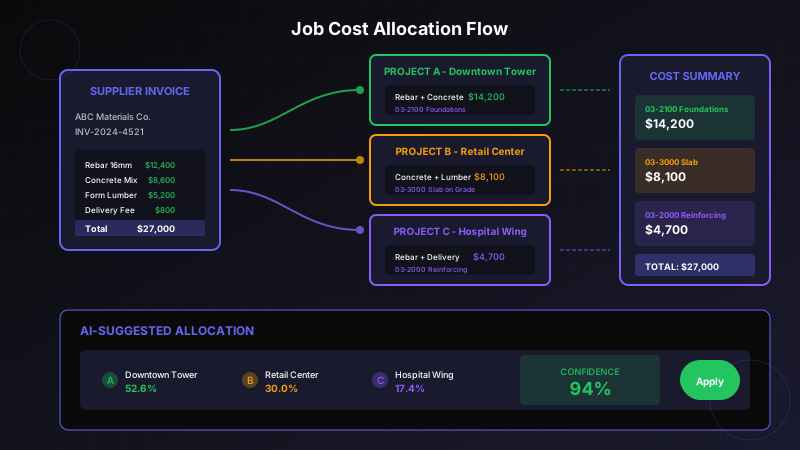
Job cost allocation ensures every expense flows to the correct project and cost code
Job Cost Allocation: The Foundation of Project Profitability
In construction, accurate job costing is not optional. It is the foundation of project management, profitability analysis, and future estimating. Every invoice, no matter how small, must be coded to the correct job and cost code.
A single invoice from a material supplier might need to be split across:
- Three different job sites that received deliveries
- Multiple cost codes (structural steel, reinforcing steel, metal decking)
- Different phases within each job (Foundation, Superstructure, Exterior)
- Budget categories that may not align perfectly with invoice line items
Manual job coding is time-consuming and error-prone. When invoices are coded incorrectly, the cascade of problems includes inaccurate work-in-progress reports, misleading project profitability metrics, flawed estimates for future bids, and potential disputes with owners over cost-plus billing.
The Job Costing Imperative
Research shows that construction companies with accurate, real-time job costing outperform competitors by 15-20% on average project margins. When costs are allocated correctly and visible immediately, project managers can make informed decisions before small overruns become major losses.
The Hidden Costs of Manual Construction AP
Beyond the direct labor costs of processing invoices, construction companies face hidden costs that compound over time:
Delayed Project Reporting
When invoices sit in processing queues, job cost reports become stale. Project managers make decisions based on last month's numbers rather than current reality. By the time cost overruns become visible, it may be too late to course-correct.
Subcontractor Relationship Strain
Construction runs on relationships. Subcontractors who experience payment delays or disputes will prioritize other general contractors when scheduling their best crews. In a labor-constrained market, being known as a slow payer directly impacts your ability to execute projects successfully.
Lien Risk and Legal Exposure
Mechanic's liens are a constant concern in construction. Improper payment documentation, missed lien waivers, or retainage disputes can result in liens filed against your projects. The cost of resolving lien claims far exceeds the cost of preventing them through proper AP processes.
Hidden Costs of Manual Construction AP
How Modern AP Automation Addresses Construction Complexity
Purpose-built AP automation for construction goes far beyond basic invoice capture and workflow routing. Here is how modern systems address each of the challenges outlined above:
Intelligent Progress Billing Processing
AI-powered systems can parse AIA G702/G703 forms and similar progress billing formats, extracting Schedule of Values data automatically. The system cross-references against the original contract SOV, calculates expected values based on previous billings, and flags discrepancies for review.
When a subcontractor bills for 45% completion but the project manager's field report shows only 38%, the system surfaces this variance immediately. What once required manual calculation and multiple phone calls now happens automatically.
Automated Retainage Tracking
Modern systems maintain retainage balances automatically, calculating holdbacks on each payment, tracking accumulated balances by subcontract, and monitoring release eligibility based on configurable rules (substantial completion, punch list closure, warranty period).
Integration with project management systems can trigger automatic retainage release workflows when milestones are achieved, ensuring timely payment while maintaining appropriate controls.
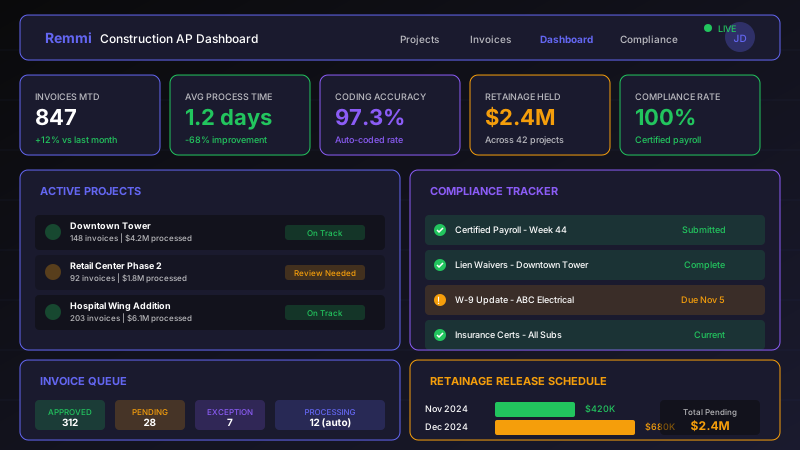
Modern dashboards provide real-time visibility across all projects and compliance requirements
Certified Payroll Document Management
For projects requiring certified payroll, automation platforms can require document submission before payment processing proceeds. The system can verify that required forms are attached, check for completeness (all weeks covered, proper signatures), and archive documentation in compliance-ready format.
Some advanced systems even parse certified payroll data to verify prevailing wage rates against published requirements, flagging potential compliance issues before payment.
Intelligent Job Cost Coding
Machine learning models trained on historical invoice coding can suggest job and cost code allocations with high accuracy. For vendors who consistently supply specific job sites or project types, the system learns these patterns and applies them automatically.
When invoices require split coding, the system can suggest allocations based on delivery addresses, PO references, or historical patterns. What once took 10-15 minutes of manual coding can be reviewed and approved in seconds.
Construction AP Automation ROI: Sample Calculation
Before Automation (Monthly)
After Automation (Monthly)
Monthly Savings: $9,583 | Annual Savings: $115,000+
Plus improved project visibility and reduced compliance risk
Implementation Considerations for Construction Companies
Successfully implementing AP automation in construction requires attention to industry-specific factors:
Integration with Construction-Specific Systems
Your AP automation platform must integrate with your existing construction management ecosystem. This typically includes:
- ERP/Accounting: Sage 300 CRE, Viewpoint Vista, Foundation Software, or similar construction accounting platforms
- Project Management: Procore, PlanGrid, Buildertrend, or custom project management tools
- Document Management: Contract files, change orders, and compliance documentation repositories
- Estimating Systems: For linking actual costs to estimated budgets
Handling Construction Document Formats
Construction invoices come in many formats: AIA forms, custom spreadsheets, supplier invoices, equipment rental agreements, and more. Your automation platform needs proven capability with construction-specific document types, not just generic invoice processing.
Mobile and Field Access
Project managers need to approve invoices and verify work completion from job sites, not just the office. Mobile-friendly approval workflows with the ability to attach field photos or notes streamline the verification process.
Compliance Cannot Wait
Construction AP compliance requirements continue to evolve. New reporting requirements, expanded prevailing wage coverage, and stricter prompt-pay enforcement mean that manual processes become riskier every year. The cost of non-compliance far exceeds the investment in proper automation.
The Competitive Advantage of Construction AP Excellence
Beyond cost savings and risk reduction, AP automation creates strategic advantages for construction companies:
- Faster project closeout: Clean AP records accelerate final billing and retainage collection
- Better subcontractor relationships: Reliable, transparent payment processes attract top-tier subs
- Accurate bidding: Historical cost data from properly coded invoices improves future estimates
- Audit readiness: Complete, organized documentation reduces audit costs and findings
- Real-time visibility: Project stakeholders access current cost data, not last month's reports
Measuring Success
Construction companies implementing modern AP automation typically report: 60-75% reduction in invoice processing time, 90%+ reduction in coding errors, 40% faster payment cycle times, and near-elimination of prompt-pay penalties. The impact on project manager productivity alone often justifies the investment.
Getting Started: A Phased Approach
Construction companies often find success with a phased implementation:
- Phase 1 (Weeks 1-4): Deploy core invoice capture and routing. Focus on reducing paper handling and establishing digital workflows without disrupting existing coding processes.
- Phase 2 (Weeks 5-8): Enable intelligent job cost coding. Train the system on historical data and begin shifting from manual coding to AI-assisted coding with human review.
- Phase 3 (Weeks 9-12): Implement progress billing automation and retainage tracking. This requires deeper integration with project data but delivers significant time savings.
- Phase 4 (Ongoing): Add compliance automation (certified payroll verification, lien waiver management) and optimize based on lessons learned.
The Bottom Line
Construction AP is fundamentally different from general business AP. The complexity of progress billing, retainage management, certified payroll compliance, and multi-project job costing requires purpose-built solutions that understand these unique requirements.
Manual processes that might work for simpler industries become bottlenecks and risk factors in construction. Every delayed invoice update means stale project reports. Every coding error compounds through project profitability calculations. Every compliance gap exposes the company to penalties and disputes.
Modern AP automation addresses these challenges while delivering the cost savings and efficiency gains that construction companies need to protect their margins. In an industry where 2-3% can mean the difference between a successful project and a losing one, AP excellence is not a luxury. It is a competitive necessity.
The construction companies that invest in modernizing their AP operations today will be better positioned to compete for projects, attract quality subcontractors, and maintain the financial visibility needed to thrive in an increasingly competitive market.
Ryan Shugars
Director of Product
Ryan has spent 15 years as a Systems Architect, building enterprise solutions that transform how organizations manage their financial operations.