Approval Delegation Management: Maintaining Control When Approvers Are Unavailable
When key approvers are on vacation, traveling, or simply unavailable, invoice processing grinds to a halt without proper delegation frameworks. Learn how to design delegation policies that maintain workflow velocity while preserving audit trails and financial controls.
Ryan Shugars
Director of Product
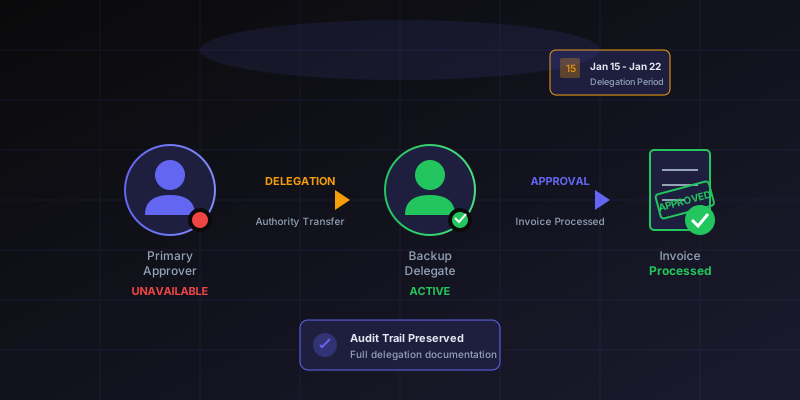
Every organization faces the same challenge: approvers take vacations, attend conferences, fall ill, or simply become unreachable at critical moments. Without a well-designed delegation framework, invoices stack up, payment deadlines pass, early payment discounts evaporate, and vendor relationships suffer. Effective delegation management keeps invoices flowing while maintaining the control and accountability that finance teams require.
The cost of approval bottlenecks extends far beyond late payment fees. When invoices wait in queue for an unavailable approver, your organization loses early payment discounts, damages vendor relationships, and creates month-end close complications. Research from the Institute of Finance and Management indicates that 23% of all invoice processing delays stem directly from approver unavailability.
Yet many organizations address delegation inconsistently or not at all. Some rely on informal arrangements where approvers forward emails to colleagues. Others simply wait for approvers to return. Neither approach provides the control, visibility, or audit trail that modern AP operations require.
Understanding Delegation Requirements
Effective delegation frameworks balance competing priorities. Invoices must continue flowing during absences, but financial controls cannot be compromised. Audit trails must clearly document who approved what and under what authority. The solution lies in structured delegation policies that address these requirements systematically.
Core Delegation Framework Components
Who can serve as backup approvers
- - Authority level requirements
- - Department/cost center alignment
- - Segregation of duties compliance
When delegations activate and expire
- - Start and end date controls
- - Automatic expiration enforcement
- - Extension procedures
What the delegate can approve
- - Dollar amount thresholds
- - Vendor or category restrictions
- - Exception handling rules
Documentation and reporting
- - Delegation authorization records
- - Approval action logging
- - Notification and confirmation
Delegation vs. Escalation
Many organizations confuse delegation with escalation, but these serve different purposes. Delegation transfers approval authority proactively during planned absences. Escalation routes invoices to alternative approvers when the primary approver fails to act within defined timeframes. Both mechanisms address approver unavailability, but they operate differently.
- Delegation: Proactive authority transfer for known absences like vacations
- Escalation: Reactive routing when approvers don't respond within SLAs
- Combined approach: Use delegation for planned absences, escalation for unexpected delays
Maintaining Segregation of Duties
Delegation frameworks must respect segregation of duties requirements. An approver cannot delegate to someone who requested the purchase or will receive the goods. Automated systems should validate delegate eligibility against these constraints before accepting delegation assignments, preventing compliance violations that manual processes might miss.
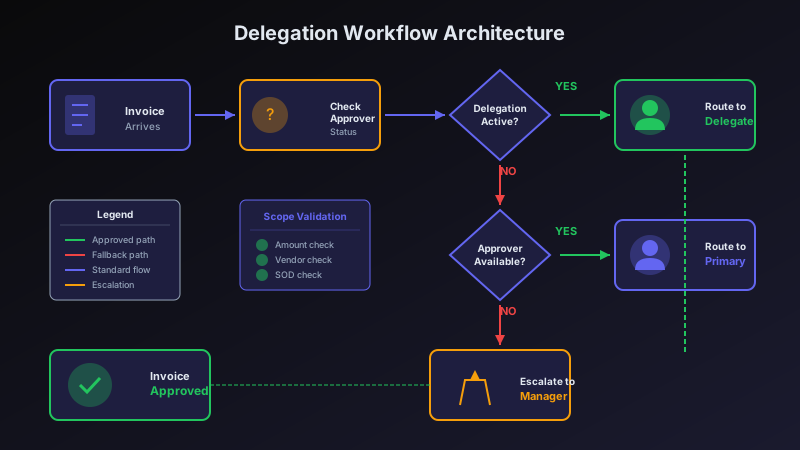
A well-designed delegation workflow maintains approval velocity while preserving control
Designing Effective Delegation Policies
Policy design determines whether delegation serves its purpose or creates new problems. Too restrictive, and invoices still pile up. Too permissive, and financial controls erode. The right balance depends on your organization's risk tolerance, approval structure, and operational requirements.
Authority Level Matching
The fundamental question in delegation is whether delegates must match the primary approver's authority level exactly, or whether flexibility exists. Different approaches suit different situations:
- Equal authority required: Delegates must have the same or higher approval limits
- Limited authority acceptable: Delegates can approve up to their own limits, with excess escalating
- Hybrid approach: Equal authority for high-value items, limited authority for routine approvals
Most organizations find the hybrid approach most practical. Routine invoices flow through delegates regardless of authority level differences, while high-value or unusual items require either an equal-authority delegate or escalation to a higher authority during the primary approver's absence.
Delegation Scope Controls
Smart delegation policies limit scope to reduce risk. Rather than granting blanket delegation authority, consider restricting delegations based on invoice characteristics:
Delegation Scope Restrictions
Dollar Amount Caps
Limit delegate approvals to specific thresholds
Most Common
Vendor Restrictions
Exclude specific vendors or vendor categories
High Security
GL Account Limits
Restrict delegation by expense category
Budget Control
PO vs. Non-PO Split
Different rules for matched vs. unmatched invoices
Risk-Based
Time-Bound Delegations
Open-ended delegations create risk. When an approver sets up delegation for a vacation and forgets to remove it upon return, the delegate continues approving indefinitely. All delegations should include explicit end dates with automatic expiration to prevent authority drift.
Best practice calls for delegation periods to match the planned absence closely, with perhaps one day of buffer on either end. If an absence extends beyond the original delegation period, the approver should explicitly extend the delegation rather than having it remain open indefinitely.
The Forgotten Delegation Problem
Organizations frequently discover active delegations from employees who left months ago, or delegations established for vacations years in the past that were never removed. Regular delegation audits should identify and clean up stale delegations, and automatic expiration provides a safety net when approvers forget to deactivate delegation upon return.
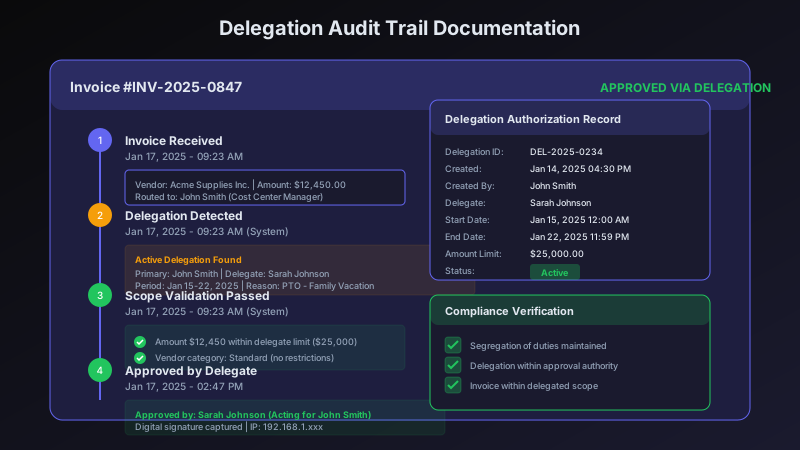
Comprehensive audit trails document delegation authority and all approvals made under delegation
Implementing Automated Delegation
Manual delegation processes create friction that discourages proper use. When setting up delegation requires emailing IT or submitting a help desk ticket, approvers often skip the formal process in favor of informal workarounds. Modern AP systems should make delegation self-service while maintaining appropriate controls and documentation.
Self-Service Delegation Setup
Empowering approvers to manage their own delegations improves compliance and reduces administrative burden. The ideal delegation interface allows approvers to:
- Select delegates: Choose from pre-approved delegate options based on role and authority
- Set date ranges: Define clear start and end dates for the delegation period
- Configure scope: Apply any relevant restrictions to the delegation
- Notify stakeholders: Automatically inform delegates and relevant parties
Automatic Routing During Delegation
Once delegation is active, the system should automatically route invoices to delegates without requiring requestor intervention. The approval request should clearly indicate that delegation is in effect, showing both the original approver (who is unavailable) and the delegate (who is acting on their behalf).
Automated Delegation Workflow
Delegation Activated
Approver configures delegation with delegate, dates, and scope
Invoice Arrives for Approval
System checks if primary approver has active delegation
Eligibility Validation
Invoice characteristics checked against delegation scope limits
Routing Decision
Eligible invoices route to delegate; others escalate or wait
Delegate Action
Delegate reviews and approves with full audit trail documentation
Notification Management
Proper notification ensures all stakeholders understand when delegation is active and who is acting in the approver's absence. Notification should occur at multiple points in the delegation lifecycle:
- Delegation setup: Notify the delegate that they've been assigned
- Delegation start: Confirm activation to both approver and delegate
- Approval actions: Include delegation context in approval notifications
- Delegation end: Notify when delegation expires or is manually ended
Delegate Awareness
Delegates must understand when they're acting under delegation and what limits apply. Approval screens should clearly display delegation status, including the primary approver's name and any scope restrictions. This transparency helps delegates make appropriate decisions and ensures they're aware of their delegated authority and its boundaries.
Audit Trail Requirements
Delegation adds complexity to audit trails. When someone other than the designated approver signs off on an invoice, auditors need to understand why this was acceptable and verify proper authorization existed. Complete delegation audit trails capture the full picture.
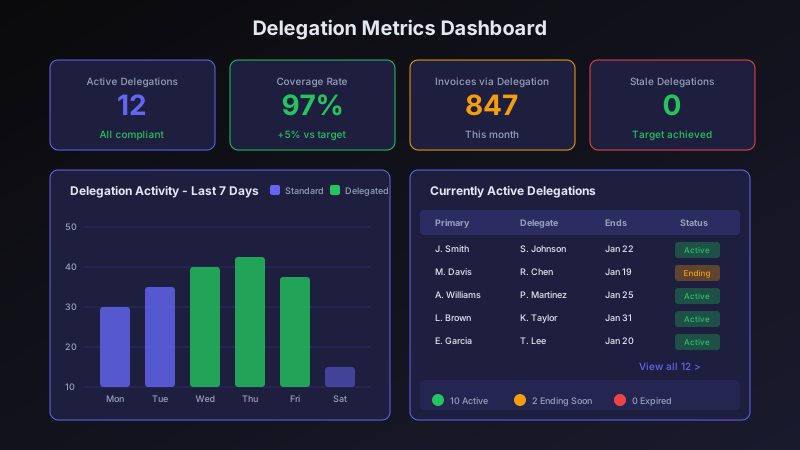
Monitor delegation usage to ensure policies work as intended and identify optimization opportunities
Essential Audit Documentation
Every delegated approval should be traceable back to explicit authorization. Audit trails must capture:
- Delegation authorization: Who created the delegation, when, and with what parameters
- Delegate identity: Clear identification of the person acting under delegation
- Primary approver: The approver whose authority was delegated
- Delegation validity: Evidence the delegation was active when approval occurred
- Scope compliance: Confirmation the invoice fell within delegation limits
Delegation Monitoring Metrics
Delegation Coverage Rate
Percentage of planned absences with active delegation
Target: 95%+
Delegation Utilization
Invoices processed under delegation vs. awaiting return
Track ratio
Scope Exception Rate
Invoices outside delegation scope requiring escalation
Under 10%
Stale Delegation Count
Active delegations past their intended end date
Target: 0
Common Delegation Challenges
Even well-designed delegation frameworks encounter practical challenges. Understanding common issues helps organizations anticipate and address them proactively.
Chain Delegation
What happens when the delegate is also unavailable? Some organizations allow chain delegation where delegates can further delegate their authority. Others prohibit this to maintain clear accountability. If chain delegation is permitted, ensure the audit trail captures the complete delegation chain.
Overlapping Delegations
Multiple active delegations from the same approver create confusion. Which delegate receives the invoice? Most organizations implement either a primary/secondary delegate hierarchy or distribute work based on workload balancing when multiple delegates exist.
Last-Minute Absences
Unexpected absences don't allow time for proper delegation setup. Escalation mechanisms handle these situations, but organizations should also consider standing delegation arrangements that activate automatically when the primary approver becomes unresponsive.
Standing Delegation Arrangements
Consider establishing standing delegation pairs where each approver has a pre-designated backup who can act on their behalf. These arrangements activate either through explicit delegation or automatic escalation, ensuring coverage regardless of whether the absence was planned. Standing arrangements reduce setup friction while maintaining formal authorization.
The Bottom Line
Approval delegation management transforms an operational challenge into a structured process that maintains workflow velocity without sacrificing control. Organizations that implement proper delegation frameworks experience fewer approval bottlenecks, capture more early payment discounts, and maintain better vendor relationships.
The key principles are straightforward: make delegation easy to set up, enforce appropriate controls automatically, maintain comprehensive audit trails, and monitor for policy compliance. When delegation works well, it's invisible, invoices flow smoothly whether the primary approver is at their desk or on a beach halfway around the world.
Start by documenting your current delegation practices, or lack thereof. Identify where informal workarounds exist and what risks they create. Then design a formal framework that addresses those risks while preserving the workflow benefits that drove the informal practices in the first place. The goal isn't to add bureaucracy but to formalize what's already happening in a controlled, auditable way.
Implementation Checklist
- Document delegation policies including authority matching and scope limits
- Implement self-service delegation with automatic expiration
- Configure notifications for delegates and stakeholders
- Establish audit trail requirements and reporting
- Create escalation procedures for unplanned absences
- Schedule regular delegation audits to identify stale entries
Ryan Shugars
Director of Product
Ryan has spent 15 years as a Systems Architect, building enterprise solutions that transform how organizations manage their financial operations.