Maximizing AP Staff Productivity: From Transaction Processing to Strategic Analysis
Your AP team possesses skills far beyond data entry. Yet industry research shows the average AP professional spends 60-70% of their time on repetitive, manual tasks. Here is how modern automation transforms AP departments from cost centers into strategic value drivers.
Ryan Shugars
Director of Product
The accounts payable function has long been viewed as a necessary back-office operation, a team whose primary job is to process invoices and cut checks. But this perception dramatically undervalues the potential of AP professionals and the strategic insights buried within payables data. The organizations that recognize this, and act on it, gain a significant competitive advantage.
Consider the daily reality for most AP teams: they arrive at work, open their email to find dozens of invoice attachments, and begin the tedious process of opening each one, manually keying data into their ERP, chasing down approvals, and reconciling discrepancies. By day's end, they have processed invoices, but they have contributed little to the strategic direction of the finance function. This is not a failure of the people; it is a failure of the process.
The Hidden Potential Within Your AP Department
Your AP team members likely have skills and knowledge that remain largely untapped. Many have deep expertise in vendor relationships, payment optimization, and spend analysis. They understand the nuances of your supplier base better than anyone else in the organization. They can spot pricing anomalies, identify consolidation opportunities, and flag potential compliance issues.
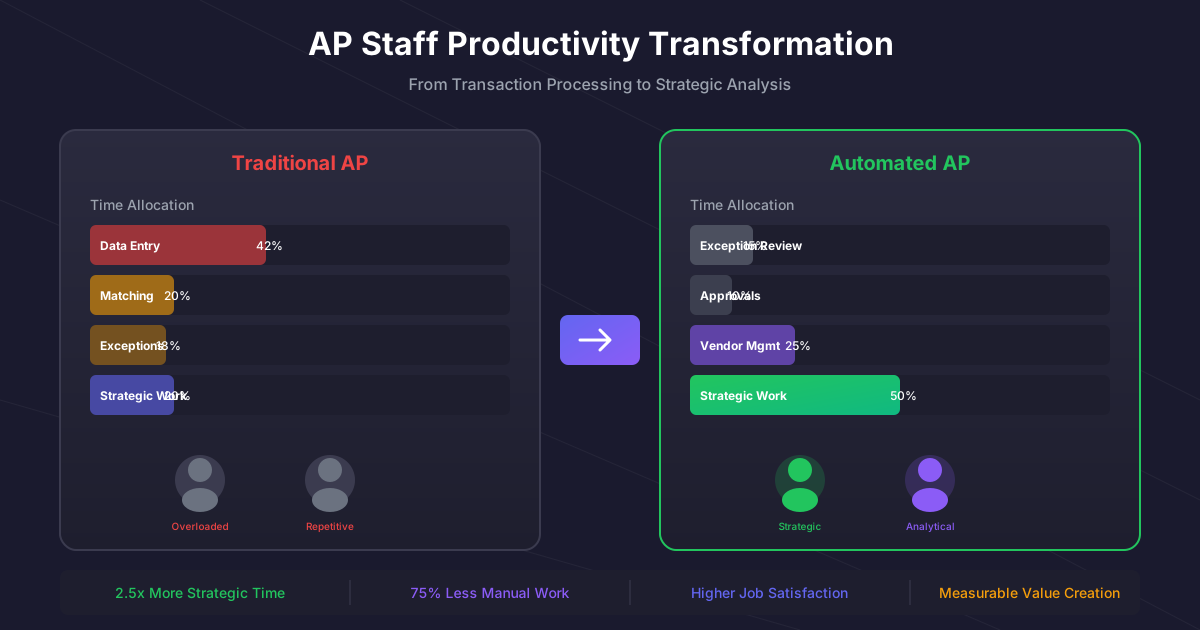
Yet according to the Institute of Finance and Management, the average AP clerk spends 62% of their time on data entry and transaction processing. Another 18% goes to exception handling and error correction. That leaves just 20% for anything resembling value-added work.
How AP Staff Actually Spend Their Time (Before Automation)
Source: Institute of Finance and Management AP Benchmark Study
This imbalance represents an enormous opportunity cost. Every hour your AP professionals spend on manual data entry is an hour not spent on activities that drive real business value: analyzing spending trends, negotiating better terms, strengthening vendor relationships, or supporting strategic sourcing decisions.
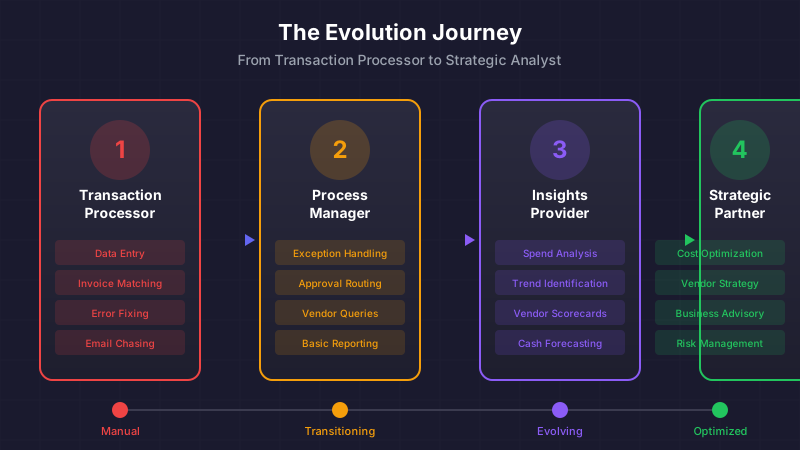
The evolution from transaction processor to strategic analyst unlocks hidden value
The Strategic Activities Your AP Team Should Be Doing
When freed from repetitive tasks, AP professionals can contribute to organizational success in ways that far exceed their traditional role. Here are the high-value activities that become possible with automation:
1. Spend Analysis and Cost Optimization
With visibility into all payables data, AP teams can identify spending patterns, consolidation opportunities, and cost reduction strategies. They can spot maverick spending outside preferred vendor contracts, identify duplicate vendors offering similar services, and flag unusual pricing trends before they become embedded costs.
One mid-market manufacturing company discovered that automating invoice processing freed their AP manager to conduct the first comprehensive spend analysis in the company's history. The result? They identified $340,000 in annual savings through vendor consolidation and renegotiated contracts, a return that dwarfed the cost of their automation investment.
2. Vendor Relationship Management
Strong vendor relationships are built on consistent, predictable interactions. When AP staff are not drowning in transaction processing, they can proactively communicate with vendors, resolve issues before they escalate, and build partnerships that benefit both parties.
This includes strategic activities like conducting quarterly business reviews, negotiating early payment discounts, identifying vendors at risk of financial difficulty, and ensuring compliance with contract terms. These activities require human judgment and relationship skills that cannot be automated, but they are often sacrificed when teams are overwhelmed with basic processing tasks.
3. Cash Flow Optimization
AP has a direct line of sight into future cash requirements. With time freed from manual processing, AP teams can work with Treasury to optimize payment timing, maximize early payment discount capture, and provide accurate cash forecasting data.
Organizations that capture just 80% of available early payment discounts (compared to the typical 20-30%) can generate returns equivalent to 36% APR on the cash deployed. This strategic treasury function requires AP insight and analysis, work that is impossible when staff are buried in data entry.
The Productivity Multiplier Effect
When AP teams shift from transaction processing to strategic analysis, the value creation multiplies. Each hour spent on data entry produces only one hour of processing output. But each hour spent on vendor negotiation or spend analysis can generate returns that compound over months and years.
4. Compliance and Risk Management
Regulatory requirements continue to expand, from 1099 reporting to international tax compliance to ESG supplier verification. AP teams with time to focus on compliance can ensure documentation is complete, reporting is accurate, and audit trails are maintained.
More importantly, they can proactively identify risks before they become problems. This includes monitoring vendor financial health, ensuring insurance certificates remain current, verifying tax status, and maintaining accurate supplier master data. Reactive compliance is expensive; proactive risk management is valuable.
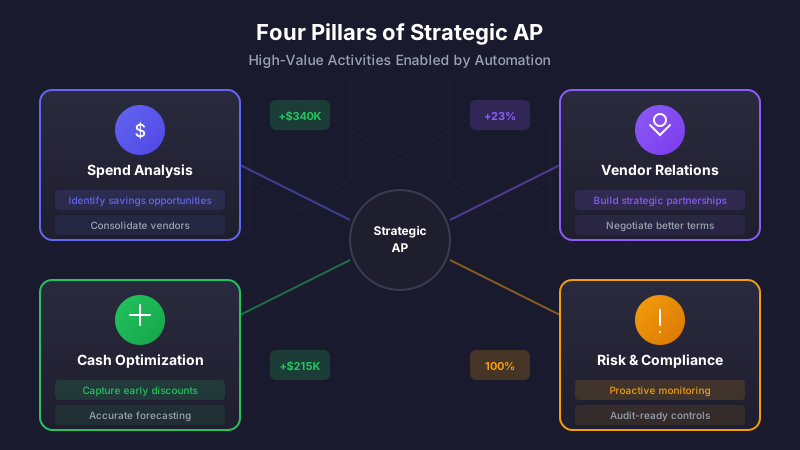
Four pillars of strategic AP: the activities that drive real business value
Measuring the Productivity Transformation
The shift from transaction processing to strategic analysis is measurable. Organizations that successfully implement AP automation typically see dramatic improvements in how staff time is allocated:
Staff Time Allocation: Before and After Automation
Before Automation
After Automation
2.5x Increase in Strategic Work Time
From 20% to 50% of staff capacity focused on value-adding activities
This reallocation of time does not just improve efficiency; it fundamentally changes the role of AP within the organization. AP teams become partners to procurement, treasury, and business operations rather than isolated back-office functions.
Building the Business Case: ROI Beyond Cost Savings
When building a business case for AP automation, most organizations focus exclusively on cost savings: reduced headcount, lower processing costs, fewer late payment penalties. These are legitimate benefits, but they tell only part of the story.
The more compelling ROI comes from the value created by newly productive staff. Consider these examples from Remmi customers:
Spend Consolidation Opportunity
A regional healthcare provider freed their AP team to analyze spending patterns. They discovered 12 different vendors providing similar medical supplies at varying prices.
Result: $480,000 annual savings through vendor consolidation
Early Payment Discount Capture
A manufacturing company used freed AP capacity to implement a systematic early payment discount program with key suppliers.
Result: $215,000 annual discount capture (from 18% to 76% capture rate)
Vendor Relationship Enhancement
A professional services firm redirected AP staff time toward proactive vendor communication and quarterly business reviews.
Result: 23% improvement in vendor satisfaction scores, leading to priority service and better pricing
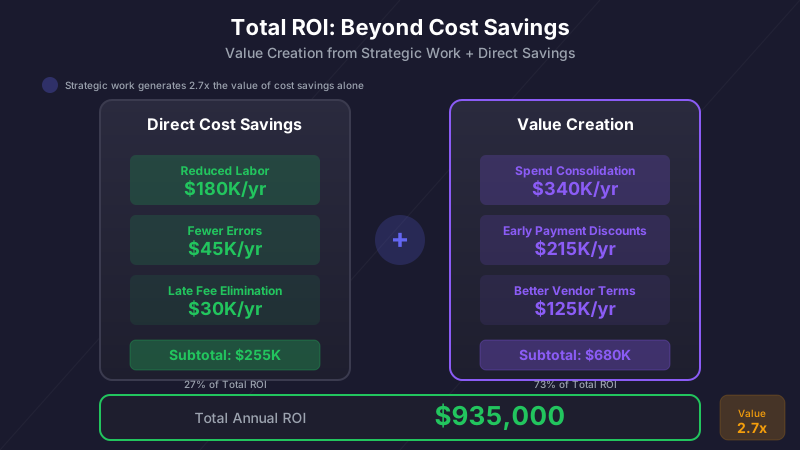
The total ROI includes both cost savings and value creation from strategic work
The Implementation Path: Transforming Your AP Function
Moving from transaction processing to strategic analysis requires more than just implementing software. It requires a deliberate effort to redefine roles, build new skills, and establish new metrics for success.
Phase 1: Automate the Routine (Weeks 1-4)
Start by eliminating the most time-consuming manual tasks: invoice capture, data entry, and basic matching. Modern AI-native solutions like Remmi can achieve 98%+ accuracy on these tasks, immediately freeing significant staff time. During this phase, focus on building trust in the automation and refining rules for your specific invoice patterns.
Phase 2: Reallocate Capacity (Weeks 5-8)
As automation takes over routine work, actively reassign staff to higher-value activities. This is not a passive process. Create new responsibilities, define deliverables, and establish clear expectations. Common initial assignments include cleaning up the vendor master file, analyzing spending by category, and building vendor scorecards.
Phase 3: Develop Strategic Capabilities (Months 3-6)
Invest in training and tools that enable strategic analysis. Provide access to spend analytics dashboards, train staff on data analysis techniques, and integrate AP insights into broader financial planning processes. The goal is to establish AP as a source of actionable intelligence, not just transaction data.
Phase 4: Measure and Optimize (Ongoing)
Track metrics that reflect the new strategic focus: discount capture rates, cost savings identified, vendor satisfaction scores, and time spent on value-added activities. These metrics reinforce the transformation and identify areas for continued improvement.
The 90-Day Transformation
Most organizations see measurable improvements within 90 days of implementing automation. By month three, the average AP team has reduced manual processing time by 75% and increased strategic work capacity by 150%. The key is to actively redirect freed capacity rather than allowing it to be absorbed by expanded processing volumes.
Common Obstacles and How to Overcome Them
The transition from transaction processing to strategic analysis is not without challenges. Here are the most common obstacles and strategies for addressing them:
Resistance to change: Some team members may feel threatened by automation or uncertain about new responsibilities. Address this directly by positioning automation as an opportunity for professional growth, not a replacement. Involve staff in defining their new roles and celebrate early wins.
Lack of analytical skills: Not every AP clerk is immediately prepared for strategic analysis. Invest in training, pair experienced analysts with developing team members, and start with straightforward analysis projects that build confidence.
Volume absorption: Without intentional reallocation, freed capacity often gets absorbed by increased invoice volumes or expanded scope without corresponding value creation. Set explicit targets for strategic work time and monitor actual allocation.
Organizational skepticism: Other departments may not initially view AP as a strategic partner. Demonstrate value through early wins: a spend analysis that reveals savings opportunities, a vendor issue caught before it became a problem, or accurate cash forecasting that improves treasury operations.
The Future of AP: Strategic Finance Partners
The evolution of accounts payable from transaction processing to strategic analysis is not just possible; it is inevitable. As automation technology continues to improve, the routine aspects of invoice processing will become fully autonomous. Organizations that proactively develop their AP teams' strategic capabilities will gain lasting advantages over those that cling to traditional operating models.
The question is not whether to make this transition, but how quickly you can execute it. Every month of delay is a month where your AP team's strategic potential remains untapped, where spending insights go undiscovered, and where vendor relationships remain transactional rather than strategic.
The Bottom Line
Your AP staff are capable of far more than data entry. They possess knowledge about vendors, spending patterns, and payment optimization that can drive significant business value. But unlocking this potential requires freeing them from the repetitive tasks that consume their days.
Modern AP automation, particularly AI-native solutions that can handle the full spectrum of invoice processing, provides the key to this transformation. By automating routine work, you do not just reduce costs; you redefine what your AP function can contribute to organizational success.
The most successful finance organizations of the next decade will be those that recognize AP not as a cost center to minimize, but as a strategic function to optimize. The technology to enable this transformation exists today. The only remaining question is when you will begin.
Quick Assessment: Is Your AP Team Ready to Transform?
Does your team spend more than 50% of time on manual data entry and matching?
Are spending analysis and vendor reviews conducted reactively rather than proactively?
Is your early payment discount capture rate below 50%?
Do AP team members express frustration with repetitive tasks?
Is AP viewed as a cost center rather than a strategic function?
If you answered yes to three or more questions, your organization is a strong candidate for AP transformation through automation.
Ryan Shugars
Director of Product
Ryan has spent 15 years as a Systems Architect, building enterprise solutions that transform how organizations manage their financial operations.