Process Mining for AP: Discovering Hidden Inefficiencies in Invoice Workflows
Most AP teams believe they understand their invoice workflows. Process mining reveals what's actually happening—and the hidden bottlenecks that cost organizations thousands of hours and millions of dollars annually.
Ryan Shugars
Director of Product
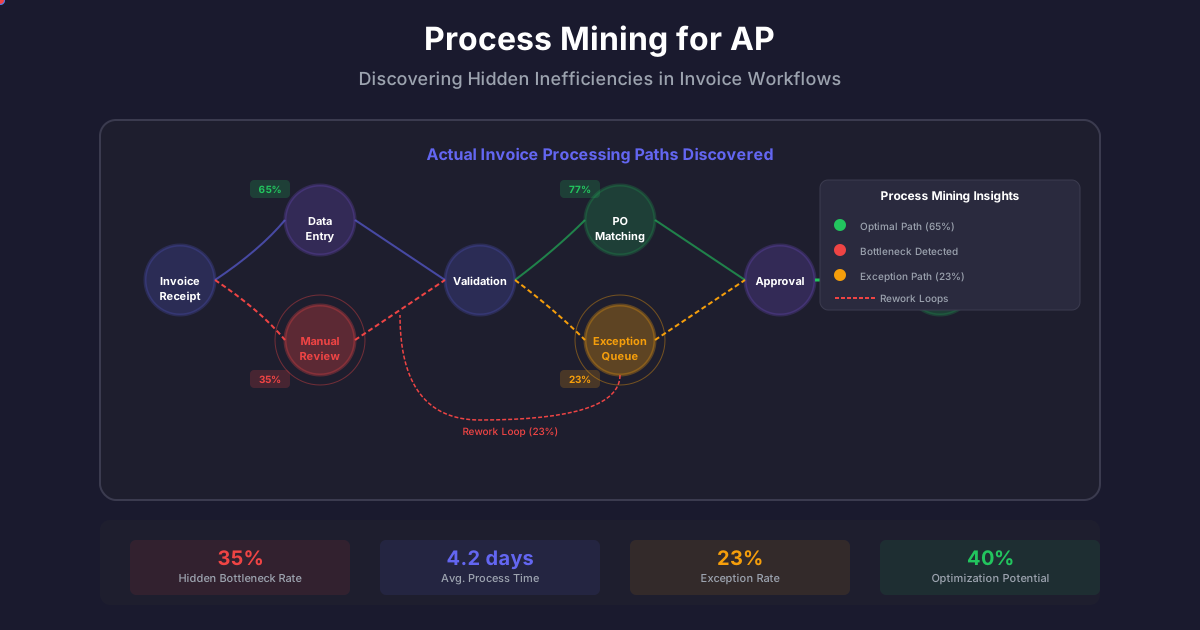
A Fortune 500 manufacturing company was confident their invoice processing was efficient. Their documented procedures were clear, their team was experienced, and their metrics looked reasonable. Then they applied process mining to their AP operations—and discovered that 35% of invoices were taking a completely different path than anyone expected, with hidden rework loops adding an average of 3.2 days to processing time.
Process mining is a data-driven technique that uses event logs from your systems to reconstruct and visualize how work actually flows through your organization. Unlike traditional process mapping—which documents how work should happen—process mining reveals how work really happens, including the deviations, bottlenecks, and inefficiencies that remain invisible in day-to-day operations.
For accounts payable operations, where invoices touch multiple systems and people, process mining provides unprecedented visibility into the true cost of inefficiency. Organizations that apply these techniques typically discover 40-60% more optimization opportunities than traditional process improvement methods identify.
What Is Process Mining?
Process mining sits at the intersection of data science and business process management. It extracts knowledge from event logs recorded by information systems—every timestamp, every status change, every user action—and uses algorithms to construct a complete picture of how processes actually execute.
Three Types of Process Mining
Automatically constructs process models from event logs without any prior knowledge
Compares actual process execution against intended designs to identify deviations
Extends existing models with performance data like timing, costs, and resources
In accounts payable, process mining analyzes event data from your ERP system, document management platform, email servers, and workflow tools to create a complete picture of invoice lifecycles. Every invoice becomes a "case" with a series of timestamped events that trace its journey from receipt to payment.
Why AP Is Perfect for Process Mining
Accounts payable workflows are ideal candidates for process mining because they generate rich, structured event data. Every invoice creates a digital trail:
- Arrival events—when and how invoices enter the system (email, portal, mail, EDI)
- Processing events—data extraction, validation, coding, and matching activities
- Routing events—assignments to reviewers, approvers, and exception handlers
- Decision events—approvals, rejections, and hold actions
- Payment events—scheduling, execution, and confirmation
This event data reveals patterns that are impossible to see through traditional observation or sampling. When you analyze thousands of invoices, you can identify statistical patterns that single-case reviews would miss entirely.

Process mining algorithms transform raw event logs into visual workflow models
Common AP Bottlenecks Revealed by Process Mining
When organizations apply process mining to their AP operations, they consistently uncover the same categories of hidden inefficiencies. These bottlenecks often account for 50-70% of total processing delays:
1. Manual Validation Queues
Process mining frequently reveals that invoices spend disproportionate time waiting for manual validation—even when automated validation exists. In one analysis, 35% of invoices were routed to manual review despite matching criteria for straight-through processing. The cause? Overly conservative confidence thresholds set during initial automation deployment that were never revisited.
The Validation Paradox
Many organizations discover that their manual validation step catches errors at a rate of only 2-3%—meaning 97% of manually reviewed invoices could have processed automatically. Process mining quantifies this hidden cost: if manual validation adds 45 minutes per invoice and handles 35% of volume, you can calculate the exact hours wasted.
2. Approval Routing Inefficiencies
Process mining exposes approval workflows that have grown organically over years, accumulating unnecessary steps and redundant reviews. Common findings include:
- Sequential approvals that could run in parallel
- Multiple approvers reviewing the same invoice for different reasons
- Delegation chains that add days without adding value
- Threshold-based routing that hasn't been updated as roles evolved
3. Exception Handling Loops
Perhaps the most valuable insight process mining provides is visibility into rework loops—invoices that cycle back through earlier process stages. These loops are often invisible in aggregate metrics because each individual step looks normal. Only by tracing complete invoice journeys can you see that 12% of invoices go through the same steps multiple times.
4. Waiting Time vs. Processing Time
Process mining distinguishes between active processing time (when work is actually being done) and waiting time (when invoices sit in queues). Most organizations are shocked to discover that waiting time accounts for 85-90% of total cycle time. An invoice that takes 4 days to process might have only 25 minutes of actual work spread across those four days.
Where Invoice Time Really Goes
Typical distribution of invoice processing time revealed by process mining
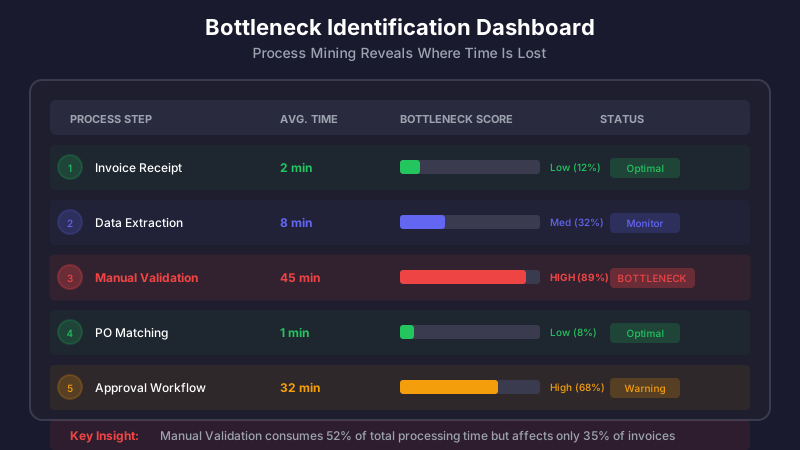
Process mining dashboards identify bottlenecks and prioritize optimization efforts
Implementing Process Mining for AP
Successful process mining implementation requires careful attention to data quality, tool selection, and organizational readiness. Here's a practical roadmap:
Step 1: Assess Data Availability
Process mining requires event logs with three essential elements:
- Case ID—a unique identifier linking all events to a specific invoice
- Activity—what happened (e.g., "Invoice Received," "Approval Requested")
- Timestamp—when it happened, with sufficient precision (ideally seconds, not just dates)
Most modern ERP and workflow systems maintain this data, but it may be spread across multiple tables or systems. An initial data assessment identifies what's available and what gaps need to be addressed.
Step 2: Extract and Transform Data
Raw system data rarely maps directly to meaningful process events. Transformation involves:
- Consolidating events from multiple source systems
- Standardizing activity names (e.g., "Approved" vs "APPR" vs "Manager Approval")
- Handling missing timestamps or out-of-sequence events
- Enriching events with relevant attributes (vendor, amount, department)
Step 3: Discover and Analyze
Process mining tools apply algorithms like the Alpha Miner, Heuristic Miner, or Inductive Miner to construct process models from event data. These models visualize:
- The actual paths invoices take through your system
- Frequency of each path (how many invoices follow each route)
- Duration statistics for each step and transition
- Variants—the different ways the same process executes
Process Variants: The Hidden Complexity
Most organizations expect to find 5-10 process variants when they document their AP workflows. Process mining typically reveals 50-200 distinct variants—each representing a unique path an invoice can take through the system. Understanding this hidden complexity is the first step toward simplification.
Step 4: Identify Optimization Opportunities
With process models in hand, analysis focuses on identifying the highest-impact optimization opportunities:
- Bottleneck elimination—removing or automating the steps that cause the longest delays
- Variant reduction—standardizing processes to reduce unnecessary complexity
- Rework prevention—addressing root causes of exception loops
- Automation targeting—identifying manual steps ripe for automation based on volume and consistency
Measuring Process Mining ROI
The value of process mining comes from the improvements it enables. Organizations typically measure ROI across several dimensions:
Typical Process Mining Impact
40-60%
Cycle Time Reduction
Through bottleneck elimination
25-35%
Cost Per Invoice Reduction
Via automation targeting
50-70%
Exception Rate Reduction
Through root cause analysis
3-6 months
Typical Payback Period
For process mining initiatives
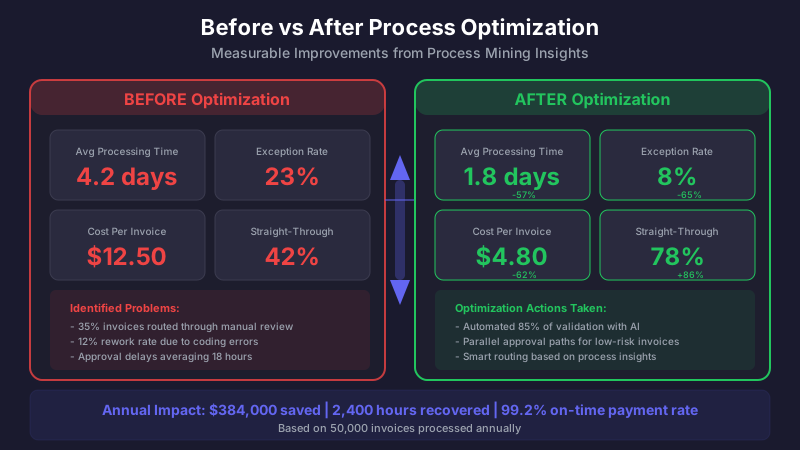
Process mining enables measurable improvements across key AP performance metrics
Continuous Process Intelligence
The most sophisticated organizations treat process mining not as a one-time project but as an ongoing capability. Continuous process intelligence involves:
- Real-time monitoring—detecting process deviations and bottlenecks as they emerge, not months later
- Predictive analytics—forecasting which invoices are likely to encounter problems based on early indicators
- Automated alerts—triggering notifications when process performance degrades beyond acceptable thresholds
- Impact measurement—quantifying the effect of process changes to validate improvements and catch regressions
This shift from periodic analysis to continuous intelligence transforms process mining from a consulting exercise into an operational capability that drives ongoing improvement.
Common Pitfalls to Avoid
Organizations new to process mining often encounter these challenges:
Analysis Paralysis
Process mining reveals so many insights that teams can become overwhelmed. Focus on the highest-impact opportunities first—typically the bottlenecks affecting the largest volume of invoices or causing the longest delays.
Data Quality Issues
Incomplete or inconsistent event logs produce unreliable process models. Invest time upfront in data validation and cleansing. If timestamps are missing or inaccurate, the resulting analysis will be misleading.
Ignoring Human Factors
Process mining reveals what happens, not why. Before optimizing, investigate the reasons behind unexpected patterns. That "inefficient" manual step might exist because of a legitimate business requirement that wasn't documented.
Success Factor: Stakeholder Engagement
The most successful process mining initiatives involve AP staff throughout the project. They can explain why certain patterns exist, identify which improvements are practically implementable, and champion changes during rollout. Process mining is a tool for collaboration, not criticism.
Getting Started with Process Mining
Organizations ready to explore process mining for their AP operations should consider these initial steps:
- Audit your event data—understand what process data your systems capture and where gaps exist
- Define success metrics—establish baseline measurements for cycle time, cost per invoice, exception rates, and other KPIs
- Start with a pilot—analyze a subset of invoices (e.g., one vendor category or department) before expanding
- Build internal capability—invest in training so your team can interpret results and drive improvements
- Plan for action—insights without implementation deliver no value; ensure you have capacity to act on findings
The Bottom Line
Process mining transforms AP optimization from guesswork into science. By revealing how invoices actually flow through your organization—not how they're supposed to flow—process mining identifies the hidden inefficiencies that traditional improvement methods miss.
For AP teams struggling with high processing costs, slow cycle times, or persistent exceptions, process mining provides the visibility needed to prioritize improvements and measure their impact. The question isn't whether your AP process has hidden inefficiencies—it's how quickly you can find and fix them.
Organizations that embrace process mining as a core capability gain a sustainable advantage: the ability to continuously optimize their AP operations based on data rather than assumptions. In a function where efficiency directly impacts cash flow and vendor relationships, that capability can be transformative.
Ryan Shugars
Director of Product
Ryan has spent 15 years as a Systems Architect, building enterprise solutions that transform how organizations manage their financial operations.