AP Outsourcing vs. Automation: Making the Right Choice for Your Organization
When organizations seek to improve accounts payable operations, two primary paths emerge: outsourcing to a business process outsourcing (BPO) provider or implementing in-house automation technology. Each approach offers distinct advantages and tradeoffs that must align with your organization's specific needs, resources, and strategic objectives.
Ryan Shugars
Director of Product
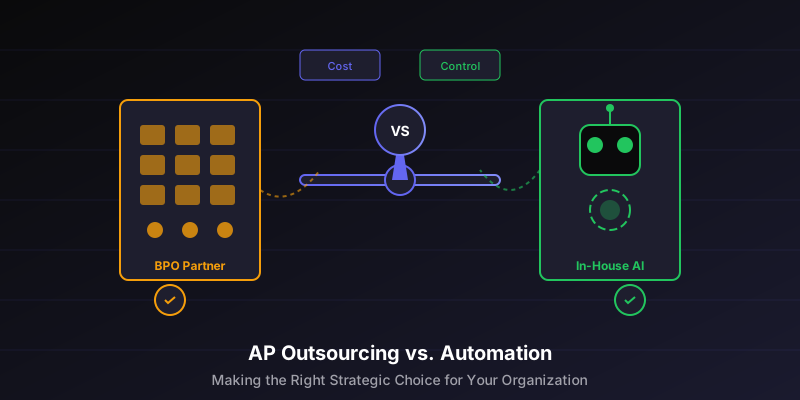
The decision between AP outsourcing and automation represents one of the most significant strategic choices for finance leaders. This isn't simply a cost comparison exercise. It's a fundamental decision about how your organization will manage vendor relationships, maintain financial controls, and position itself for future growth. Making the wrong choice can lock your organization into costly contracts, create data security vulnerabilities, or leave efficiency gains on the table.
Organizations processing thousands of invoices monthly face mounting pressure to reduce costs while maintaining accuracy and compliance. Both outsourcing and automation promise these outcomes, but through fundamentally different mechanisms. Understanding these differences requires examining not just the direct costs, but the hidden implications for control, flexibility, security, and long-term strategic positioning.
Understanding the Two Approaches
Before diving into evaluation criteria, let's establish clear definitions of what each approach actually entails and how they differ in execution.
Defining the Options
AP Outsourcing (BPO)
Transferring invoice processing operations to a third-party provider who handles data entry, validation, coding, and often payment execution on your behalf.
- Provider manages day-to-day operations
- Offshore or nearshore labor arbitrage
- Service level agreements govern performance
In-House Automation
Implementing AI-powered technology that automates invoice capture, coding, matching, and routing while your team retains operational oversight.
- Technology handles repetitive tasks
- Your team maintains control and oversight
- Data stays within your systems
The Evolution of AP Outsourcing
AP outsourcing emerged in the 1990s as organizations sought labor cost reductions through offshore processing centers. The value proposition was straightforward: why pay domestic wages for data entry when the same work could be performed in lower-cost regions? This model delivered meaningful savings when invoice processing was predominantly manual.
However, the outsourcing model has struggled to evolve alongside technological advances. Many BPO providers still rely heavily on human processors, with automation serving as a supplement rather than the primary processing engine. This creates a structural cost floor that limits how much efficiency can be gained over time.
The Rise of AI-Native Automation
Modern AP automation has fundamentally changed the equation. AI-powered systems can now perform tasks that previously required human judgment: extracting data from unstructured documents, learning your GL coding patterns, matching invoices to complex purchase orders, and detecting anomalies that suggest fraud or errors. The technology has reached a point where automation rates of 80-95% are achievable for organizations with reasonably clean data and consistent processes.
The Automation Advantage
Unlike outsourcing, where costs scale linearly with volume, automation costs are largely fixed after implementation. Processing 10,000 invoices costs roughly the same as processing 5,000 with modern automation platforms. This creates compounding returns as invoice volume grows, while outsourcing costs continue to scale with each additional invoice processed.
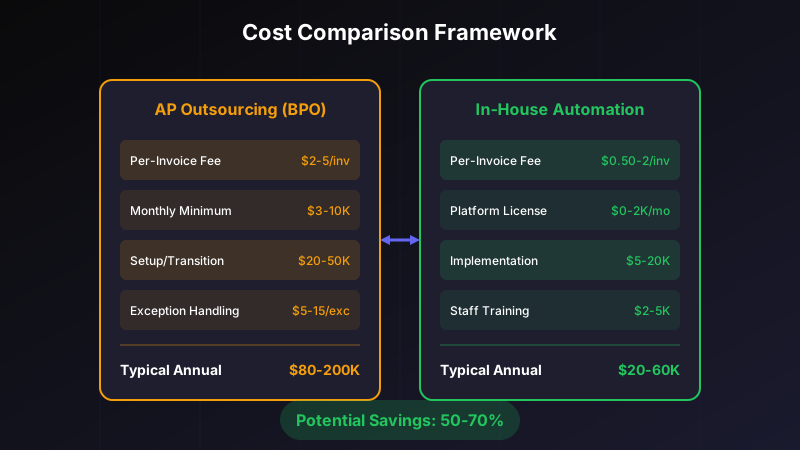
Comparing typical cost structures between outsourcing and in-house automation approaches
Key Evaluation Criteria
Making an informed decision requires evaluating multiple dimensions beyond simple cost comparison. Organizations that focus solely on per-invoice processing costs often overlook factors that become significant over time.
Control and Visibility
Perhaps the most significant difference between outsourcing and automation lies in operational control. When you outsource, you're trusting a third party to represent your organization in vendor interactions, make judgment calls on exceptions, and maintain the accuracy of your financial data.
Control Comparison
Process Changes
How quickly can you modify workflows?
Outsourcing: Weeks to months
Automation: Hours to days
Exception Handling
Who decides how to resolve issues?
Outsourcing: Provider follows SLA
Automation: Your team decides
Vendor Communication
Who interacts with your suppliers?
Outsourcing: Third party
Automation: Your team
Real-time Visibility
Access to processing status?
Outsourcing: Portal/reports
Automation: Direct access
Data Security and Compliance
Outsourcing inherently requires sharing sensitive financial data with a third party. Your vendor payment details, banking information, pricing arrangements, and spending patterns all flow through external systems and personnel. While reputable BPO providers maintain security certifications, you are expanding your attack surface and adding data handling risks that don't exist with in-house processing.
- Data residency: Where is your data stored and processed? Offshore centers may create compliance issues for certain industries.
- Access controls: How many people at the BPO provider can access your financial data?
- Audit rights: Can you audit the provider's security controls and data handling practices?
- Breach liability: Who bears responsibility if a data breach occurs at the provider?
- Exit provisions: How do you ensure complete data destruction when the relationship ends?
Hidden Risk: Vendor Lock-in
Many outsourcing contracts include multi-year terms with significant termination penalties. Once you've transitioned operations and institutional knowledge to a BPO provider, switching costs become substantial. This creates leverage imbalances during contract renewals and limits your ability to respond to changing business needs.
Cost Structure Analysis
While outsourcing often appears cheaper on a per-invoice basis initially, the true cost comparison requires examining the complete cost structure over time.
Outsourcing costs typically include:
- Per-invoice processing fees (typically $2-5 per invoice)
- Monthly minimum charges regardless of volume
- Setup and transition costs (often $20,000-50,000+)
- Exception handling fees for complex invoices
- Change request fees for process modifications
- Annual escalation clauses (typically 3-5%)
Automation costs include:
- Per-invoice processing fees (typically $0.50-2 per invoice)
- Platform licensing (often included in per-invoice pricing)
- Implementation and configuration ($5,000-20,000 typical)
- Staff training (minimal with modern platforms)
- Internal labor for exception handling (typically reduced 60-80%)
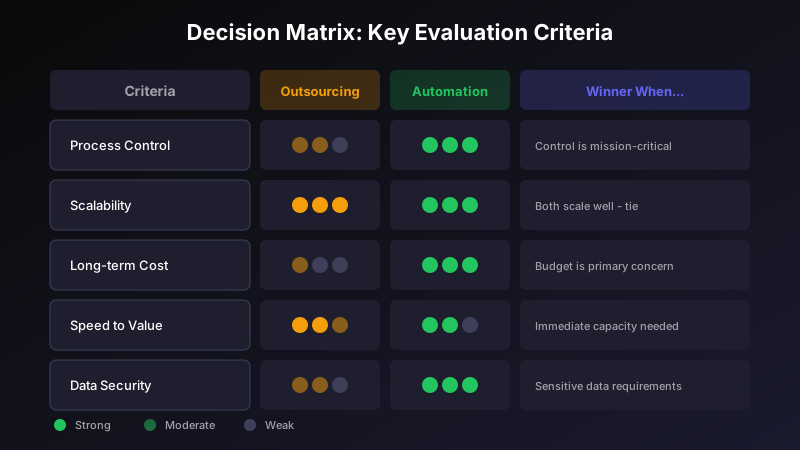
Key evaluation criteria and how each approach performs across different dimensions
When Outsourcing Makes Sense
Despite automation's advantages, outsourcing remains the right choice for certain organizational situations. Understanding when outsourcing fits helps ensure you make the decision for the right reasons.
Outsourcing Is Often Best When...
Immediate Capacity Needed
You need to quickly scale processing capacity due to acquisition, growth, or staff departure without time for technology implementation.
No Internal Resources
Your organization lacks the IT and finance staff to manage an automation platform, even a low-maintenance one.
Complex Legacy Environment
Your ERP and systems landscape is so complex that automation integration would require extensive custom development.
Temporary Solution
You need a bridge solution while planning a major systems transformation that will change your AP infrastructure entirely.
When Automation Is the Clear Winner
For most organizations with stable operations and reasonable technology infrastructure, automation delivers superior outcomes across nearly every dimension. The case for automation strengthens when specific conditions exist.
Automation Excels When...
Control Is Critical
Your organization values maintaining direct oversight of vendor relationships and financial processes.
Data Sensitivity
Industry regulations, security requirements, or competitive concerns limit sharing financial data with third parties.
Long-term Cost Focus
You're optimizing for total cost of ownership over 3-5 years rather than minimizing immediate cash outlay.
Volume Growth Expected
Anticipated business growth will increase invoice volume, magnifying automation's per-invoice cost advantage.
The Hybrid Approach
Increasingly, organizations are discovering that the outsourcing vs. automation choice isn't binary. A hybrid model can combine the strengths of both approaches while mitigating their respective weaknesses.
In a hybrid model, AI-powered automation handles the majority of invoice processing: data capture, coding, matching, and routing for approval. A BPO partner or shared services center handles only the true exceptions that require human judgment or research that would be inefficient for your internal team to perform.
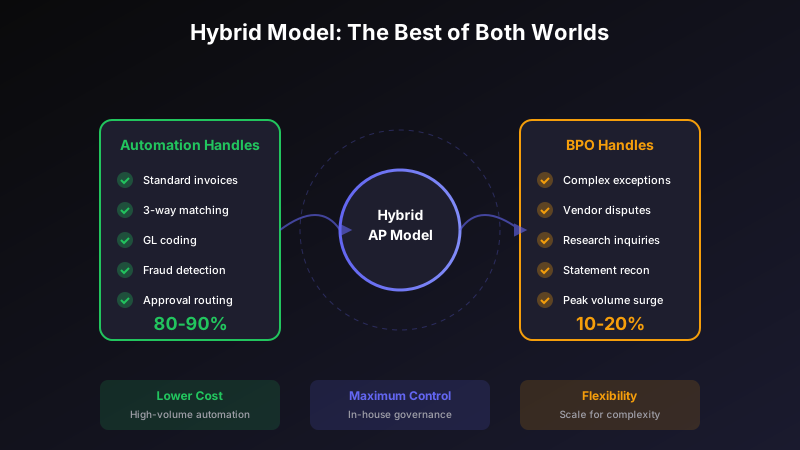
Hybrid models leverage automation for volume while using outsourcing for complex exceptions
Hybrid Model Benefits
Organizations using a hybrid approach typically achieve 80-90% automation rates for standard invoice processing while maintaining access to human support for complex exceptions. This delivers the cost benefits of automation with the flexibility of outsourcing, without the control compromises of full outsourcing.
Making Your Decision
The right choice depends on your organization's specific circumstances, priorities, and constraints. Use this framework to guide your evaluation:
Decision Framework
1. Assess Your Current State
Document current invoice volumes, processing costs, error rates, and pain points. Understand what you're optimizing for and what success looks like.
2. Define Your Requirements
Prioritize control, cost, speed, and security. Identify non-negotiable requirements like data residency or audit capabilities.
3. Evaluate Total Cost of Ownership
Build 3-5 year cost models for each option, including hidden costs like management overhead, contract escalations, and exit costs.
4. Consider Hybrid Options
Evaluate whether a combined approach delivers the benefits you need without the compromises of full outsourcing.
5. Plan for the Long Term
Consider how your needs will evolve and ensure your chosen approach can adapt without requiring a complete reset.
The Bottom Line
The outsourcing vs. automation decision is ultimately about alignment between your organization's priorities and the inherent characteristics of each approach. Outsourcing trades control for convenience and shifts operational responsibility to a third party. Automation preserves control while using technology to eliminate manual effort.
For organizations that value control, data security, long-term cost optimization, and flexibility, in-house automation increasingly represents the superior choice. Modern AI-powered platforms have eliminated the complexity barriers that once made automation challenging to implement, while delivering automation rates that match or exceed what human processors can achieve.
That said, outsourcing remains viable for organizations needing immediate capacity, lacking internal resources, or operating in uniquely complex environments. The key is making the choice deliberately, with full understanding of what each approach delivers and what it requires.
Whatever path you choose, avoid the trap of viewing this as a permanent, irreversible decision. The best approaches build in flexibility to evolve as your needs change and as technology continues to advance. Start where you are, optimize for your current priorities, and maintain the ability to adapt as circumstances evolve.
Ryan Shugars
Director of Product
Ryan has spent 15 years as a Systems Architect, building enterprise solutions that transform how organizations manage their financial operations.