What is Days Payable Outstanding?
The essential AP metric that reveals how efficiently you manage supplier payments and optimize working capital.
Quick Definition
Days Payable Outstanding (DPO) is a financial metric that measures the average number of days a company takes to pay its suppliers and vendors after receiving an invoice. It indicates how well a company manages its accounts payable and cash flow.
- Key indicator of AP efficiency and cash management
- Critical component of the Cash Conversion Cycle
- Directly impacts working capital and liquidity
Understanding Days Payable Outstanding
Days Payable Outstanding (DPO) is one of the most important metrics for accounts payable teams and CFOs alike. It tells you, on average, how many days your company takes to pay its bills after receiving an invoice from a supplier.
A higher DPO means you're holding onto cash longer before paying suppliers, which can improve your liquidity and working capital position. However, extending payment times too far can damage supplier relationships, miss early payment discounts, and even impact your credit rating.
DPO is part of the working capital triad, alongside Days Sales Outstanding (DSO) and Days Inventory Outstanding (DIO). Together, these three metrics form the Cash Conversion Cycle (CCC), which measures how efficiently your business converts investments into cash.
The DPO Formula
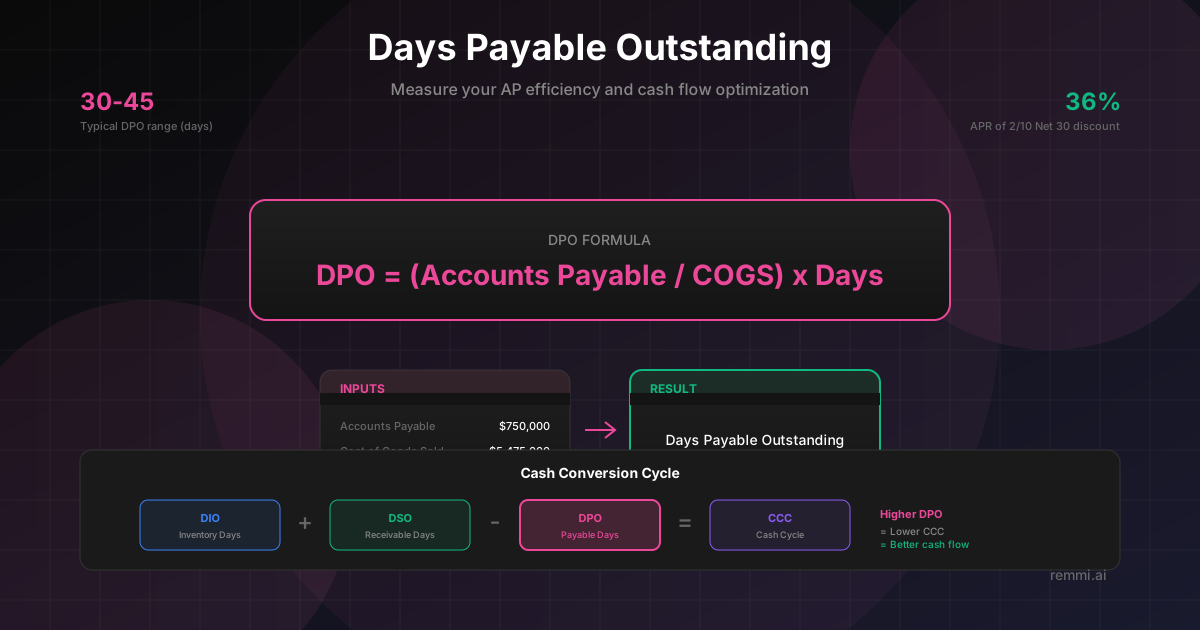
DPO = (Accounts Payable / COGS) x Number of Days
Accounts Payable
Average accounts payable balance during the period (ending AP or average of beginning and ending)
Cost of Goods Sold
Total COGS for the period (some use total purchases for more accuracy)
Number of Days
Days in the period: 365 for annual, 90 for quarterly, 30 for monthly
Example DPO Calculation
Input Values
- •Accounts Payable: $750,000
- •Cost of Goods Sold: $5,475,000
- •Period: Annual (365 days)
Calculation
DPO = ($750,000 / $5,475,000) x 365
DPO = 0.137 x 365
DPO = 50 days
This company takes an average of 50 days to pay its suppliers.
What DPO Tells You About AP Efficiency
Higher DPO (50+ days)
Indicates:
- • Better cash flow management
- • Stronger negotiating power with suppliers
- • More capital for operations/investments
- • Potential strain on vendor relationships
Lower DPO (under 30 days)
Indicates:
- • Potentially capturing early payment discounts
- • Strong supplier relationships
- • Possible cash flow optimization opportunity
- • May be paying before terms require
Industry DPO Benchmarks
| Industry | Typical DPO Range | Notes |
|---|---|---|
| Retail | 45-60 days | Strong retailer leverage over suppliers |
| Manufacturing | 40-55 days | Varies by supply chain complexity |
| Technology | 35-50 days | Mix of hardware and service purchases |
| Healthcare | 30-45 days | Regulatory and supply chain factors |
| Professional Services | 20-35 days | Fewer large purchases, more recurring |
DPO vs DSO vs DIO: The Cash Conversion Cycle
These three metrics together determine how efficiently your business converts investments into cash flows.
Days Inventory Outstanding
How long inventory sits before being sold
Days Sales Outstanding
How long to collect payment from customers
Days Payable Outstanding
How long to pay your suppliers
Cash Conversion Cycle Formula
CCC = DIO + DSO - DPO
A lower CCC means faster cash conversion. Increase DPO to reduce CCC.
Best Practices for Optimizing DPO
Negotiate Better Payment Terms
Work with suppliers to extend standard payment terms from Net 30 to Net 45 or Net 60 where appropriate.
Pay on Time, Not Early
Unless capturing early payment discounts, schedule payments to arrive on the due date, not before.
Automate AP Processes
Use AP automation to ensure invoices are processed efficiently without paying late or unnecessarily early.
Evaluate Early Payment Discounts
Calculate if 2/10 Net 30 discounts are worth taking. The effective annual rate of 2/10 is about 36%.
Monitor DPO Trends
Track DPO monthly to identify changes and ensure you're staying within target ranges.
Common DPO Mistakes to Avoid
- ×DPO too high (90+ days) — Strains supplier relationships, may result in supply disruptions or losing preferred vendor status
- ×DPO too low (under 20 days) — Leaving cash on the table; paying faster than terms require without getting discounts
- ×Ignoring early payment discounts — A 2% discount for paying 20 days early equals 36% annualized return
- ×Not benchmarking against industry — Your DPO should be compared to industry peers, not arbitrary targets
Why DPO Matters
Annual cash flow improvement from 10-day DPO increase (for $36M COGS)
Annualized return of 2/10 Net 30 early payment discount
Typical target DPO for balanced cash and vendor relations
Related Terms
Accounts Payable
Department managing vendor invoices and payments
Cash Flow
Movement of money in and out of a business
Payment Terms
Agreed conditions for when payment is due
Working Capital
Capital available for day-to-day operations
Days Sales Outstanding
Average days to collect payment from customers
Cash Conversion Cycle
Time to convert investments into cash flows